Search Results for: a hanging

Promised You a Miracle

A vivid, seminal portrait of early 1980s Britain: a period that changed Britain forever The early 1980s in Britain were a time of hope, and of dread: of Cold War tension and imminent conflict, when crowds in the street could mean an ecstatic national celebration or an inner-city riot. Here, Andy Beckett recreates an often misunderstood moment of transition, with all its potential and uncertainty: the first precarious years of Margaret Thatcher’s government. By the end of 1982, the country was changing, leaving the kinder, more sluggish postwar Britain decisively behind, and becoming the country we have lived in ever since: assertive, commercially driven, outward-looking, often harsher than its neighbours. Taken from www.penguin.co.uk

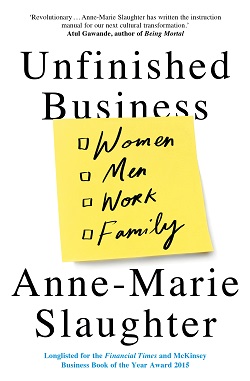
Unfinished Business

When Anne-Marie Slaughter’s Atlantic article,”Why Women Still Can’t Have it All”first appeared, it immediately went viral, sparking a firestorm of debate across countries and continents. Within four days, it had become the most-read article in the history of the magazine. In the following months, Slaughter became a leading voice in the discussion on work-life balance and on women’s changing role in the workplace. Now, Slaughter is here with her eagerly anticipated take on the problems we still face, and how we can finally get past them. In her pragmatic, down-to-earth style, Slaughter bursts the bubble on all the”half-truths”we tell young women about”having it all”, and explains what is really necessary to get true gender equality, both in the workplace and at home. Deeply researched, and filled with all the warm, wise and funny anecdotes that first made her the most trusted and admired voice on the issue, Anne-Marie Slaughter’s book is sure to change minds, ignite debate and be the topic of conversation.   Taken from and read more at https://www.oneworld-publications.com/books/anne-marie-slaughter/unfinished-business#.Vt18_vmLRD8

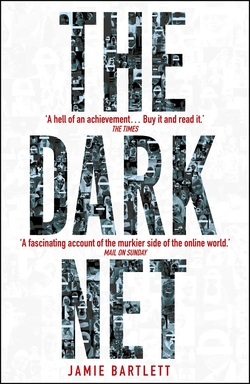
The Dark Net

Dark Net cover

Beyond the familiar online world that most of us inhabit – a world of Google, Hotmail, Facebook and Amazon – lies a vast and often hidden network of sites, communities and cultures where freedom is pushed to its limits, and where people can be anyone, or do anything, they want. A world that is as creative and complex as it is dangerous and disturbing. A world that is much closer than you think. The dark net is an underworld that stretches from popular social media sites to the most secretive corners of the encrypted web. It is a world that frequently appears in newspaper headlines, but one that is little understood, and rarely explored. The Dark Net is a revelatory examination of the internet today, and of its most innovative and dangerous subcultures: trolls and pornographers, drug dealers and hackers, political extremists and computer scientists, Bitcoin programmers and self-harmers, libertarians and vigilantes. Based on extensive first-hand experience, exclusive interviews and shocking documentary evidence, The Dark Net offers a startling glimpse of human nature under the conditions of freedom and anonymity, and shines a light on an enigmatic and ever-changing world. Taken from Random House

Capital

When Rana Dasgupta arrived in Delhi at the turn of the twenty-first century, he had no intention of staying for long, but the city beguiled him – he ‘fell in love and in hate with it’ – and fifteen years later, Delhi is still his home. Over these fifteen years, he has watched as the tumult of destruction and creation which accompanies India’s economic boom transformed the face of the city. In Capital, he explores the life-changing consequences for Delhi’s people, meeting with billionaires and bureaucrats, drug dealers and metal traders, slum dwellers and psychoanalysts. These encounters, interwoven with over a century of history, plunge us into Delhi’s intoxicating, sometimes terrifying, story of capitalist transformation – one that has repercussions not only for India, but for everybody’s future. Taken from Canongate

James Astill

James Astill is Political editor and Bagehot columnist of the Economist. He has previously worked as International Security editor, South Asia correspondent, and Energy and Environment editor for the Economist.

Articles submitted

Bagehot: The Weirdness of Eastleigh – The Economist, 23/02/2013

Bagehot: The Parable of the Clyde – The Economist, 31/08/2013

Bagehot: The New Islamophobes – The Economist, 19/10/2013

Bagehot: More Tough, Less Love – The Economist, 02/11/2013

Bagehot: Top of the Class – The Economist, 07/12/2013

Cockney Funerals: Buried Like Kings – The Economist, 21/12/2013

Sex and the Citadel

As political change sweeps the streets and squares, parliaments and presidential palaces of the Arab world, Shereen El Feki has been looking at upheaval a little closer to home – in the sexual lives of men and women in Egypt and across the region. The result is an informative, insightful and engaging account of a highly sensitive, and still largely secret, aspect of Arab society. Sex is entwined in religion and tradition, politics and economics, gender and generations, so it makes the perfect lens for examining the region’s complex social landscape. From pregnant virgins to desperate housewives, from fearless activists to religious firebrands, Sex and the Citadel takes a fresh look at the sexual history of the Arab region, and brings new voices to the debate over its future. This is no peep show or academic treatise. Sex and the Citadel is a highly personal, often humorous, account of one woman’s journey to better understand Arab society at its most intimate, and in the process, better understand her own origins. Rich with five years of groundbreaking research from Egypt to Saudi Arabia, Tunisia to Qatar, Sex and the Citadelgives us unique and timely insight into everyday lives in a part of the world that is changing in front of our very eyes. Taken from Random House

James Astill

James Astill is Political editor and Bagehot columnist of the Economist. He has previously worked as International Security editor, South Asia correspondent, and Energy and Environment editor for the Economist.

Articles submitted

Bagehot: The Weirdness of Eastleigh – The Economist, 23/02/2013 Bagehot: The Parable of the Clyde – The Economist, 31/08/2013 Bagehot: The New Islamophobes – The Economist, 19/10/2013 Bagehot: More Tough, Less Love – The Economist, 02/11/2013 Bagehot: Top of the Class – The Economist, 07/12/2013 Cockney Funerals: Buried Like Kings – The Economist, 21/12/2013

London’s ‘Down and Outs’ then and now

In celebration of the 80th publication anniversary of Down and Out in Paris and London we have a guest post from John Bird on the changes in tramping. Bird will join Brian Sewell in conversation at on the evening of Wednesday 9 October at Foyles Charing Cross Road. Book tickets here. Down and outness has changed radically in my lifetime. As a boy runaway from police and family I slept in doss houses as they were called, with almost exclusively old men; or men who had been made old before their time, by drink and malnourishment. In the early 1960’s it was still illegal to sleep rough and you could be arrested for having no fixed abode. Begging was also outlawed so it meant that most ‘down and outs’ had to work. And they had to live in places like the Rowton Houses or Salvation Army hostels, for which you had to pay. In the Rowton house system you got you own miniscule room, and was vastly superior to the Church Army and Salvation Army dormitories as privacy was prized. I often slept though with a band of others in inaccessible places like under bridges, or in bombsites and gardens; and at times had to make a run for it because the police had arrived. The other place to spent the night in relative safety, London seeming to be full of predatory perverts looking for a boy, was the London station terminuses. Victoria was the best, open all night where you could doss down in the waiting room. I spent many a good night under the vast table that was in the middle of the room, while the adults slept leaning in their chairs against the table. This idyll though was often interrupted by the arrival of policemen who at times drove you out, not believing your plea that you were a bone fide traveler desperate to get back to Penge. There were no soup kitchens but there were all night coffee stalls. The best being opposite Westminster Abbey near Parliament square where you could have a tea and a steak and kidney pie for not much money. Back then ‘down and outs’ were a part of the working population. They were not looked upon as a separate part of society who deserved our alms. They may have got some relief through churches giving you tea and biscuits if your listened to their prayers and hymns. But largely you were simply a very poor worker who washed up in hotels and cafes, or may work in big factories as a casual labourer. Cadby Hall at Olympia in Hammersmith was a great source of work, with a Rowton House opposite. So you could get out at 6am at the Rowton House and go across and queue for a day’s work at Lyon’s Cadby Hall, with them taking virtually all of the residents. My experience of being a ‘down and out’ was based on my lawlessness and what use to be called being ‘beyond parental control’. There weren’t many 14 or 15 year old, if any, at the time I was roughing it. But I did notice even then that if you stayed in a hostel you were simply a poor worker. And that was significant. 30 years later when I started The Big Issue times had definitely changed. ‘Down and outs’ were rough sleepers, sleeping en masse in encampments like Lincolns Inn Field and the Bull-ring at Waterloo. Or in linear dormitories, so to speak, along the Strand and Aldwych. 1991 was full not just of rough sleepers but beggars, a number of them who begged aggressively. The law had not been changed. It was still illegal to beg and to sleep rough. But since the mid 60’s magistrates had been loathed to imprison wrongdoers brought before them. So as a kind of accommodation between police and magistrates the laws were ignored. London was awash with hundreds of homeless people sleeping around the streets and parks. And aside from an occasional arrest for aggressive or violent begging the police ignored this pile up of ‘down and outs’. This population of ‘down and outs’ was not the same as those form Orwell’s day, or my young days. Whereas back then they were workers the new ‘down and outs’ were largely beggars or scavengers, or at times robbers. That is why The Big Issue giving people a chance of making their own legal money was a godsend for the many. Whereas over 90% of people who lived in a hostel when I was young were workers, by the early 1990’s over 90% had no form of work. What they had which the old ‘down and outs’ had little of, was time on their hands. Whereas if you met a drunk ‘down and out’ in my youth he was drunk from money got from his own labour, in the 90’s it was largely through their begging or robbing skills. Orwell describes the old spikes where ‘tramps’ would tramp around the country, maybe getting a bit of work here and there, but also given some form of relief. By my young time that situation been replaced by poor hostels for working men. But the ‘Casual Wards’ did carry on to look after the unfit and the disabled poor, until the mid 60’s they were absorbed into the NHS and the nascent Social Services. I can only look back to that time by reading Orwell. But what I can remember that still existed post war was that broken form of humanity who seemed lost to the world, and were a world unto themselves. Also I remember the dirty kitchens of cafes, restaurants and hotels that I got casual work in. Orwell caught them perfectly, with a bullying that often goes with having a lowly job. As a boy before I went off the rails I would see a particular clean and well-kept man around the museums at South Kensington, near my secondary modern school. He was impeccably dressed. He was upright and careful in the way he strolled around. I always saw him in the big canteen in the Victoria and Albert Museum, in the late 50’s. He would buy himself a mug of tea and a rock cake and take loads of sugar into his tea. And then go and sit as far as he could away from everyone else in the vastly, cavernous canteen of the time, since lost to modernity. I would observe him because I was fascinated by him and by one thing that flummoxed me; when you went close to him you could see that his small reading glasses were bound with tape. That his shirt though clean was over darned. That his well polished shoes were worn and just hanging on. And that his suit was stitched and patched and held together by thread. Impeccably dressed but still distressed and the clothing showed it. Broken in body and mind. But keeping the vestiges of appearance, down to the little flower, sometimes even a dandelion in his button hole. He was one of the many people, I surmised, who had not survived the First World War intact; or the hungry 30’s. He was what you might call one of the hidden ‘down and outs’, who might have had a sister who kept him mended, but could not repair his mind damaged perhaps by war or a reversal of fortune. Our mental institutions had largely been emptied by the late 80’s through Thatcher’s policy of closure and ‘Care in the community’. As well as our prisons filling up with mentally distressed people our streets likewise filled. And added to hoards of young people who were refused benefits while living at home with their parents, one could see that ‘down and outs’ were often socially different from the old style ‘down and outs.’ So ‘down and outs’ have certainly changed in my lifetime. But that is not the end of the story. For since the early days of The Big Issue ‘down and outs’ have changed once again. Recently I observed a large group of drunks sitting in a park singing, dancing, begging and at times squabbling. Unlike the early days of the Big Issue many of the people we call ‘down and outs’ would not be rough sleepers. They would be living in social housing, hostels, night shelters or some form of sheltered accommodation. They would receive regular amounts of money from the government, and would receive food and relief from the many, many charities that have been thrown up over the last 20 years. But few, if any would be workers. They are from a new class that has grown steadily since the days of Margaret Thatcher, who drove a coach and horse through the social security legislation. Once offered sparingly, since her time more and more people have been caught on benefits, extending down even to ‘down and outs.’ A workless class has been created with acres of spare time to sit and drink, rather than work in order to sit and drink. It is one of the greatest pieces of social injustice that instead of investing in people away from ‘down and outism’ we have increased their dependency. We have enshrined them in being down and outs. That to me is why even though we don’t have the great battalions of ‘down and outs’ who worked in the poorest part of the poor economy, we still have some of our neediest people outside and beyond our society. And why if Orwell was around now he would be doing a lot of head scratching and writing about this new abusive situation that we live in. An illusion of helping the poorest by giving them state support, but doing nothing for their mental health that keeps them outside of us all. ‘Down and Outs’ have been modernised into dependent recipients. And now of course with the money having run out you can see the trap they have been led into. The Orwell Prize, Britain’s most prestigious prize for political writing, is supported by the Media Standards Trust, Political Quarterly, AM Heath and Richard Blair (Orwell’s son).

Will Self in Wigan

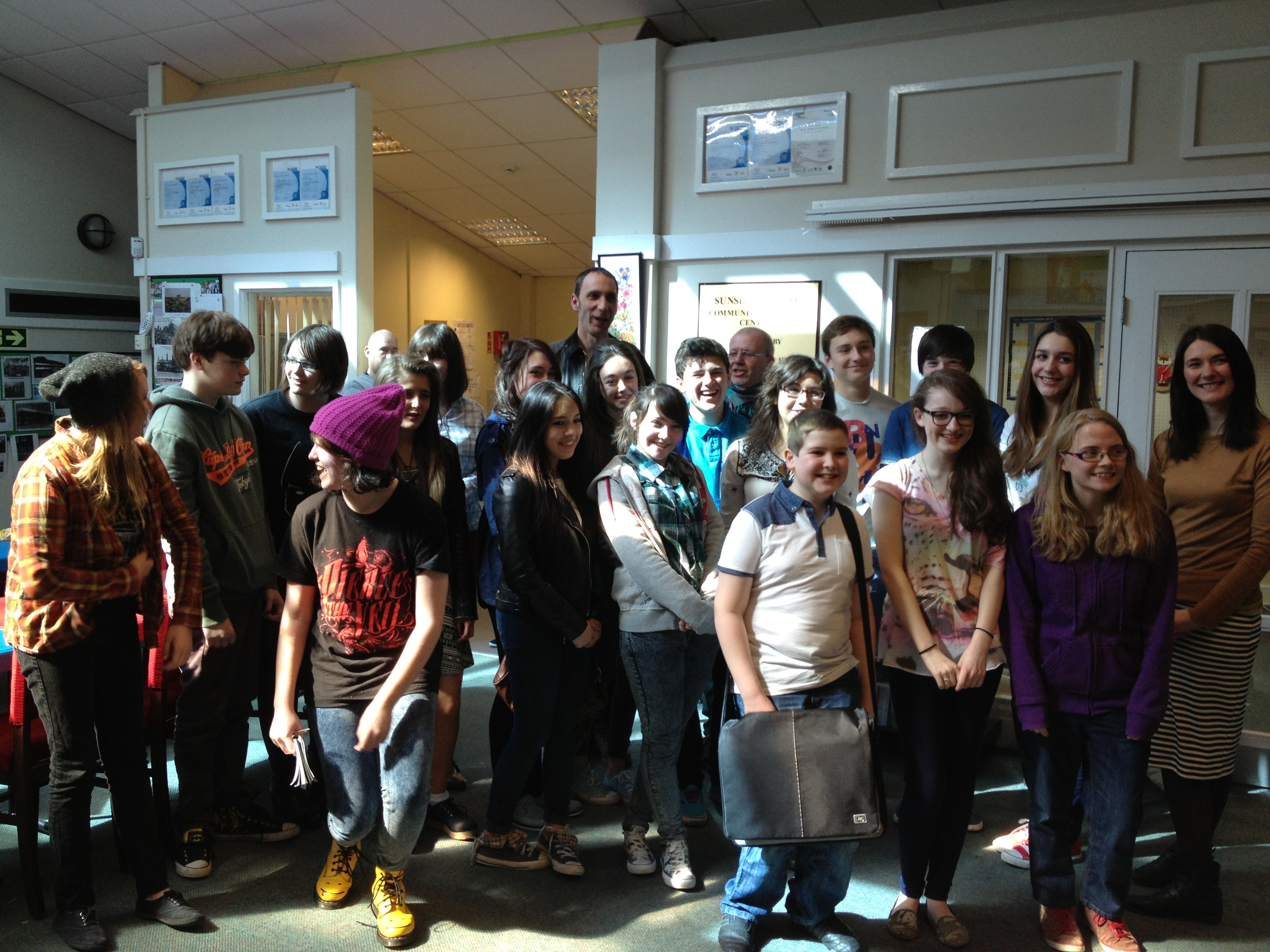
The Orwell Prize, Britain’s most prestigious prize for political writing, is supported by the Media Standards Trust, Political Quarterly, AM Heath and Richard Blair (Orwell’s son). Yesterday the Prize joined Will Self for a Wigan Pier Workshop at Sunshine Community Centre. “Allow your imagination to take flight,” Self said to the teenagers on his second visit to the project. The Wigan Pier workshops were set up early last year by Stephen Armstrong, journalist and writer of The Road to Wigan Pier Revisited, and Barbara Nettleton, director of Sunshine House. The Orwell Prize partnered with the project shortly after the pilot. We have since worked together to take the expertise of writers like Rosie Boycott to young people wanting to write in Wigan. Our next series of workshops will take place in the autumn and we look forward to telling you more about it over the summer. On Self’s talk yesterday, Stephen Armstrong said, “I’d like to see how many Booker prize shortlisted authors could entertain, inspire and enthuse 22 teenagers in a Wigan community centre who started the day restless about being inside on the first sunny day of the year in their Easter holidays. Watching Will Self shatter preconceptions and open young minds was a prize winning piece of work in its own right.”

Shortlist announcement and debate

Next week our judges will begin discussions to pick the six journalists and six books for our 2013 shortlists. On the evening of 17th April we will name these writers live at the University of Westminster. Following the announcement there’ll be a debate focused on the changing situation in Burma. A panel including Julia Farringdon of Index on Censorship, human rights activist Tayzar Moe Myint, Nita May OBE of the BBC Burmese world service and our Director Jean Seaton will discuss the question; “When censorship declines does freedom emerge?” We’d love to see lots of you there for our 20th anniversary year. Places are limited but you can register free here to join us for the announcement, debate and some drinks.

From elsewhere

  • Two Orwell Prize winners – Matthew Parris and Peter Hitchens – will be joining the new BBC Great Lives series
  • Journalism Prize winner Timothy Garton Ash on The euro survives, but where are the Europeans? for The Guardian
  • Kim Jong-Un, George Orwell and a Big Rocket for the Huffington Post by Olly Lennard
  • The diaries

    Don’t forget our other Orwell Diary blogs: his Wartime Diary, Hop-Picking Diary and The Road to Wigan Pier Diary. You can sign up to our newsletter If you’ve got any suggestions about our website(s), we’d love to hear from you – email us on katriona.lewis@mediastandardstrust.org. You can also follow us on Twitter and like us on Facebook.

    Taking Orwell back to Burma

    • The Orwell Prize goes to Burma
    • Leads panels and a lecture at Burma’s first international literary festival
    • Aung San Suu Kyi, Timothy Garton Ash, Rory Stewart and Fergal Keane to speak
    • Gives out hundreds of copies of Burmese Days, Animal Farm and Nineteen Eighty-Four

    The Orwell Prize is in Burma to support and participate in the Irrawaddy Literary Festival, to host debates on Burma’s future, and to give out hundreds of Orwell classics. Aung San Suu Kyi, the patron of the literary festival, will deliver a speech on the festival’s significance for the gradual opening of Burma, on Saturday 2nd February: “I am delighted” Aung San Suu Kyi has said, “to lend my support and personal participation to this first Irrawaddy Literary Festival. Literature has always been a big part of my life and I hope this festival, which brings together some of the finest talent from Burma, the UK and elsewhere will encourage more people to explore the world of literature and further their understanding of the English language” Past Orwell Prize winner Timothy Garton Ash will deliver an Orwell lecture. Zarganar, Rory Stewart, Fergal Keane and Timothy Garton Ash will participate in a panel – ‘Witness of violence’ – on writing under censorship. Jean Seaton, director of The Orwell Prize, will speak on Orwell and Burma. Hundreds of copies of Orwell’s Burmese Days, Animal Farm and Nineteen Eighty-Four, previously banned in Burma, will be given to Burmese attending the festival. The books – which arrived in Rangoon by special delivery on today, have been funded by The Orwell Prize’s ‘Buy a Book for Burma’ campaign as well as generous support from Penguin Books. The Irrawaddy Literary Festival is Burma’s first international literary festival and has been organised by the British Ambassador’s wife Jane Heyn: “The festival’s aim” Heyn says “is to provide a catalyst for the exchange of ideas across cultures, and the event will reflect the extraordinary vibrancy of a country in the midst of immense change”. Director of The Orwell Prize, Jean Seaton says; “Being asked to help at the first literary festival in Burma was impossible to refuse. Orwell would have wanted us to take something back to a place that he owed so much to is a very demanding exciting development for the prize as we wait expectantly for the entries to flood in. Orwell’s values of integrity, realism and clarity have never seemed more appropriate – both at home and abroad.” In 1922 Orwell was posted as a police officer for the British Imperial Service in Burma. He stayed five years and wrote ‘The Hanging’ and ‘Shooting an Elephant’. It was a formative experience and the inspiration for Orwell’s first novel, Burmese Days. Now in its 20th year, this is the Prize’s first trip abroad running panels with their writers. Later on in February they will also take Orwell back to Wigan for workshops with teens by writers including John Hegley and Rosie Boycott as part of a longer term initiative launched by Stephen Armstrong, with Will Self.

    ENDS

    1. The Orwell Prize is Britain’s most prestigious prize for political writing. Every year, prizes are awarded to the work – for the book and for the journalism – which comes closest to George Orwell’s ambition ‘to make political writing into an art’. 2. The Prize was founded by the late Professor Sir Bernard Crick in its present form in 1993, awarding its first prizes in 1994. The Media Standards Trust, Political Quarterly and Orwell Trust are partners in running the Prize, through the Council of the Orwell Prize. Richard Blair (Orwell’s son) is a sponsor, with support from A. M. Heath. 4. For further information, please contact the Operations Manager, Katriona Lewis, at katriona.lewis@mediastandardstrust.org, or on 0207 229 5722.

    Press release: Irrawaddy Literary Festival

    Burma’s first international literary festival featuring a host of renowned authors will take place in Rangoon in February. The Irrawaddy Literary festival at the Inya Lake Hotel will showcase the best of international and local writing from February 1-3. The patron of the event, Daw Aung San Suu Kyi, said: “I am delighted to lend my support and personal participation to this first Irrawaddy Literary Festival. Literature has always been a big part of my life and I hope this festival will encourage more people to explore the world of literature and further their understanding of the English language.” Among the authors lined up to take part are international best-sellers like Vikram Seth, Jung Chang, William Dalrymple and Fergal Keane. The Festival has also secured the attendance of Sudha Shah, Pascal Khoo Thwe, Thant Myint U and Akash Kapur, alongside a host of eminent local literary and cultural figures such as Zarganar, Dr Ma Thida and the celebrated librarian U Thaw Kaung and his son Dr Thant Thaw Kaung. The festival is the brainchild of Jane Heyn who has lived in Burma since 2009. She says: “The festival’s aim is to provide a catalyst for the exchange of ideas across cultures and literary genres and will reflect the extraordinary cultural vibrancy of a country in the midst of immense change”. The cool, airy rooms of the spacious Inya Lake Hotel, usually more accustomed to wedding parties and tourists feasting at the dining room buffet, will become a unique space for words and ideas with workshops, panel discussions and exhibitions of photo-journalism. The spreading lakeside lawns will be transformed to a colourful tented village teeming with bookstalls, handicrafts, and food.The phenomenally skilled Mandalay Theatre puppeteers are bringing their life-like puppetry to the festival. This is a special opportunity to see masters of an ancient entertainment display their artistry. The Festival is pleased to announce the presentation of the inaugural Yoma FMI Short Story Prize. The competition is now open. We invite stories from any young Burmese up to 25 years old. Interested students should submit a fictional story based on the theme of ‘Changing Lives’, not exceeding 2,000 words. There will be two awards of $1,000 – one for the best story written in English, one for the best story written in Burmese. Please send your entry to: info@irrawaddylitfest.com by Friday 18 January 2013. The prize is the initiative of Yoma Strategic Holdings and First Myanmar Holdings, one of the Irrawaddy Literary Festival’s sponsors. Other local backers are MPRL E&P, and the Today Media Group. The British Embassy and the British Council in Rangoon are also supporting the Festival to help strengthen existing cultural links and forge new bonds between the UK and Burma. And The Orwell Prize is lending valuable support, reflecting George Orwell’s close association with Burma, with its ‘Buy a book for Burma’ appeal on their website. Part of the Festival will be dedicated to British Council teachers giving English language workshops for parents and fun educational activities for schoolchildren. Festival tickets will be on sale from 7 January 2013 at the Inya Lake Hotel, the British Council and Today Bookstores. For further details please check the festival website.

    Open the curtains

    This is a guestpost by Jacqueline Crooks, Director of Befriend a Family In September I was invited to join an Orwell Prize panel to discuss poverty then and now in the 75th anniversary year of The Road to Wigan Pier. When reading the work in preparation for the event I was struck by the issues such as homelessness, isolation, and secrecy that Orwell wrote about the inability of the poor to believe in any kind of future. These are the same issues that are experienced by the families we support. I know something about the secrecy of poverty that Orwell wrote about. I grew up on the Havelock Estate in Southall, one of the estates featured in Gavin Knight’s seminal book, Hood Rat. I’ve seen poverty from two perspectives: the personal and the professional. From the 1960’s as a child growing up in a poor migrant family, to the sixteen years I have spent working with disadvantaged children and families in the voluntary sector. Fifty years watching the changing face of poverty. The one thing that hasn’t changed is the curtain of secrecy that occludes the poor. In my work, I spend a lot of time in the homes of vulnerable families. I have seen the desperate ways that they try to conceal the reality of their lives. They paste posters of golden landscapes over black mouldy walls. The posters last a month or so before falling away to reveal the rot and decay behind it. I go to homes on barren estates, stand outside doorways, hear children playing inside. When I knock on the door the house becomes silent. They will not open the door. The house is in no state to receive visitors, even if it is someone who has come to help. They don’t want the world to see how they live. They don’t want to go out into the world to see the good life that everyone else is living. They lock themselves in. They close the curtains. It was something my Mother was always shouting at us: “Close the curtains!” She didn’t want the neighbours to see our poverty. She didn’t want to look out into the world. Our charity took a group of mothers out for a coffee some months ago. Their children were attending our martial arts project and it was an opportunity for us to consult with the mothers informally. The mothers all said it was the first time they had been inside a café, sat at a table and drank ‘expensive’ coffee. They watched the everyday world coming in and out, buying lattes, espressos, cupcakes. They became animated, talked about their childhoods, their talents, their hopes. They were visible. We need to give voice to disadvantaged communities. Some years ago we ran a writing workshop for disadvantaged young people. The young people produced an anthology of short stories called Visible, detailing their lives in poems and short stories. It is a small step – we are a small charity – but an important one all the same. Books like Gwenton Sloley’s, From the streets to Scotland Yard, are important. We need to hear from individuals living in poverty, in their own words. Equally important, are books like Gavin Knight’s Hood Rat and Stephen Armstrong’s The Road to Wigan Pier Revisited. These books attack the secrecy of poverty and its deleterious effect on individuals, families and communities. We also need to hear from small local charities like Befriend a Family who are working hand-in-hand, inside the homes of people who are living in poverty. We raise substantial levels of funding to support families living in poverty. We channel resources from the business sector to families. It is important that the government continues to support small, local charities working at grass roots level. Orwell’s writing sought to open the curtains and it remains relevant as a legacy. Befriend a Family are a charity working with children living in poverty within Westminster, you can support them and see what they do at a special Christmas concert on the evening of Wednesday 5th December at Grosvenor Chapel in Mayfair where Gavin Knight will give a reading from Hood Rat. Proceeds will support families. Get your ticket here

    The Orwell Prize launches ‘Buy a book for Burma’ appeal

  • Buy a book for Burma
  • In its 20th year the Orwell Prize is retracing Orwell’s steps. We will be participating in in Wigan based writing project for youths and for the first time ever we are going abroad: to Burma. In 1922 Orwell was posted as a police officer for the British Imperial Service in Burma. He stayed five years and wrote ‘The Hanging’ and ‘Shooting an Elephant’. It was a formative experience and the inspiration for Orwell’s first novel, Burmese Days. We have been asked to help the Irrawaddy Literary Festival – the very first English language Burmese literary festival. The Irrawaddy Festival’s patron, Daw Aung San Suu Kyi, says: “Literature has always been a big part of my life and I hope this festival, which brings together some of the finest talent from Burma, the UK and elsewhere will encourage more people to explore the world of literature and further their understanding of the English language.” We will be running events on censorship, journalism and writing at the festival – always working with local voices. We are also taking Orwell’s writing to Burma where it is revered but unavailable. Today we have launched the ‘Buy a book for Burma’ appeal. Donors may nominate to send one of Orwell’s three classic novels, Nineteen Eighty-Four, Animal Farm and Burmese Days, to the festival. Director of The Orwell Prize, Jean Seaton says; “Being asked to help at the first literary festival in Burma was impossible to refuse. Orwell would have wanted us to take something back to a place that he owed so much to is a very demanding exciting development for the prize as we wait expectantly for the entries to flood in. Orwell’s values of integrity, realism and clarity have never seemed more appropriate – both at home and abroad.” You can by a book for Burma by visiting our justgiving page. ENDS 1. The Orwell Prize is Britain’s most prestigious prize for political writing. Every year, prizes are awarded to the work – for the book and for the journalism – which comes closest to George Orwell’s ambition ‘to make political writing into an art’. 2. The Prize was founded by the late Professor Sir Bernard Crick in its present form in 1993, awarding its first prizes in 1994. The Media Standards Trust, Political Quarterly and Orwell Trust are partners in running the Prize, through the Council of the Orwell Prize. Richard Blair (Orwell’s son) is a sponsor, with support from A. M. Heath. 4. For further information, please contact the Operations Manager, Katriona Lewis, at katriona.lewis@mediastandardstrust.org, or on 0207 229 5722.

    Coming Up for Air

    This week we celebrated the publication anniversary of Orwell’s novel Coming Up for Air. Written in 1938 and first published on 12th June 1939, Coming Up for Air is a story of a man’s journey home to the setting of his childhood. Imminent war, nostalgia and fear of a changing world set the tone of a philosophical book written by Orwell in the lead up to Nineteen Eighteen-Four. You can read more about Coming Up for Air including the first chapter on our website.

    Buxton Festival 2012

    We’re so excited to be returning to Buxton on 16th July. For 2012 we’ll be taking Paul Anderson, Jan Montifiore, Charles Allen, Tony Wright and Stuart Evers to row about who is the better writer; Orwell or Kipling. You can see full details on our website.

    From the archive

    In anticipation of our upcoming debate you can read Orwell’s writings on Kipling or watch our debate on the same topic last year at The Sunday Times Oxford Literary Festival on our website.

    From elsewhere

  • The Guardian have produced an eBook of Amelia Gentleman’s Orwell Prize winning features.
  • Connor Woodman, whose book Unfair Trade was longlisted for this year’s prize, spoke at Hay Festival on how Big Business Exploits the World’s Poor – and why it doesn’t have to.
  • We had a wonderful response to our Twitter competition this week with lots of people telling us why they write. Toby Harnden picked five winners to receive copies of his Orwell Prize 2012 winning book. You can see the tweets he chose on The Orwell Prize profile.
  • The wartime diaries

    This week’s entries were published on 11th, 13th and 15th June 1942. Next week’s entries will be published on 21st and 24th June 1942. Don’t forget our other Orwell Diary blogs: his Hop-Picking Diary and The Road to Wigan Pier Diary. If you’ve got any suggestions about our website(s), we’d love to hear from you – email us on katriona.lewis@mediastandardstrust.org. You can also follow us on Twitter and like us on Facebook.

    Gavin Kelly

    Gavin Kelly is chief executive of Resolution Foundation. He was Director of Research at the Institute of Public Policy Research and the Fabian Society, and taught economics and politics at the University of Sheffield where he received his doctorate. He is a regular commentator on issues of public policy and politics – his particular interests are economic policy, low pay, public services and social mobility.
    Taken from Resolution Foundation


    Submitted links

    The scandal of low-paid care workers

    Changing the conversation in 2012

    Why Britain’s households got richer – and why they stopped

    How seven years of cuts will transform the political landscape

    The onslaught against working families continues

    Learning the right lessons from Labour’s economic record

    Obama: Mr 99%?

    Minimum wage: The only way is up?

    The coalition’s woes with women

    Wanted: a new purpose for British capitalism

    Gavin Kelly

    Gavin Kelly is chief executive of Resolution Foundation. He was Director of Research at the Institute of Public Policy Research and the Fabian Society, and taught economics and politics at the University of Sheffield where he received his doctorate. He is a regular commentator on issues of public policy and politics – his particular interests are economic policy, low pay, public services and social mobility. Taken from Resolution Foundation

    Submitted links

    My Country Right or Left

    This material remains under copyright in some jurisdictions, including the US, and is reproduced here with the kind permission of the Orwell Estate. The Orwell Foundation is an independent charity – please consider making a donation or becoming a Friend of the Foundation to help us maintain these resources for readers everywhere. 

    Contrary to popular belief, the past was not more eventful than the present. If it seems so it is because when you look backward things that happened years apart are telescoped together, and because very few of your memories come to you genuinely virgin. It is largely because of the books, films and reminiscences that have come between that the war of 1914-18 is now supposed to have had some tremendous, epic quality that the present one lacks.

    But if you were alive during that war, and if you disentangle your real memories from their later accretions, you find that it was not usually the big events that stirred you at the time. I don’t believe that the Battle of the Marne, for instance, had for the general public the melodramatic quality that it was afterwards given. I do not ever remember hearing the phrase ‘Battle of the Marne’ till years later. It was merely that the Germans were twenty-two miles from Paris — and certainly that was terrifying enough, after the Belgian atrocity stories — and then for some reason they had turned back. I was eleven when the war started. If I honestly sort out my memories and disregard what I have learned since, I must admit that nothing in the whole war moved me so deeply as the loss of the Titanic had done a few years earlier. This comparatively petty disaster shocked the whole world, and the shock has not quite died away even yet. I remember the terrible, detailed accounts read out at the breakfast table (in those days it was a common habit to read the newspaper aloud), and I remember that in all the long list of horrors the one that most impressed me was that at the last the Titanic suddenly up-ended and sank bow foremost, so that the people clinging to the stern were lifted no less than three hundred feet into the air before they plunged into the abyss. It gave me a sinking sensation in the belly which I can still all but feel. Nothing in the war ever gave me quite that sensation.

    Of the outbreak of war I have three vivid memories which, being petty and irrelevant, are uninfluenced by anything that has come later. One is of the cartoon of the ‘German Emperor’ (I believe the hated name ‘Kaiser’ was not popularized till a little later) that appeared in the last days of July. People were mildly shocked by this guying of royalty (‘But he’s such a handsome man, really!’) although we were on the edge of war. Another is of the time when the army commandeered all the horses in our little country town, and a cabman burst into tears in the market-place when his horse, which had worked for him for years, was taken away from him. And another is of a mob of young men at the railway station, scrambling for the evening papers that had just arrived on the London train. And I remember the pile of peagreen papers (some of them were still green in those days), the high collars, the tightish trousers and the bowler hats, far better than I can remember the names of the terrific battles that were already raging on the French frontier.

    Of the middle years of the war, I remember chiefly the square shoulders, bulging calves and jingling spurs of the artillerymen, whose uniform I much preferred to that of the infantry. As for the final period, if you ask me to say truthfully what is my chief memory, I must answer simply — margarine. It is an instance of the horrible selfishness of children that by 1917 the war had almost ceased to affect us, except through our stomachs. In the school library a huge map of the Western Front was pinned on an easel, with a red silk thread running across on a zig-zag of drawing-pins. Occasionally the thread moved half an inch this way or that, each movement meaning a pyramid of corpses. I paid no attention. I was at school among boys who were above the average level of intelligence, and yet I do not remember that a single major event of the time appeared to us in its true significance. The Russian Revolution, for instance, made no impression, except on the few whose parents happened to have money invested in Russia. Among the very young the pacifist reaction had set in long before the war ended. To be as slack as you dared on O.T.C. parades, and to take no interest in the war was considered a mark of enlightenment. The young officers who had come back, hardened by their terrible experience and disgusted by the attitude of the younger generation to whom this experience meant just nothing, used to lecture us for our softness. Of course they could produce no argument that we were capable of understanding. They could only bark at you that war was ‘a good thing’, it ‘made you tough’, ‘kept you fit’, etc. etc. We merely sniggered at them. Ours was the one-eyed pacifism that is peculiar to sheltered countries with strong navies. For years after the war, to have any knowledge of or interest in military matters, even to know which end of a gun the bullet comes out of, was suspect in ‘enlightened’ circles. 1914-18 was written off as a meaningless slaughter, and even the men who had been slaughtered were held to be in some way to blame. I have often laughed to think of that recruiting poster, ‘What did you do in the Great War, daddy?’ (a child is asking this question of its shame-stricken father), and of all the men who must have been lured into the army by just that poster and afterwards despised by their children for not being Conscientious Objectors.

    But the dead men had their revenge after all. As the war fell back into the past, my particular generation, those who had been ‘just too young’, became conscious of the vastness of the experience they had missed. You felt yourself a little less than a man, because you had missed it. I spent the years 1922-7 mostly among men a little older than myself who had been through the war. They talked about it unceasingly, with horror, of course, but also with a steadily growing nostalgia. You can see this nostalgia perfectly clearly in the English war-books. Besides, the pacifist reaction was only a phase, and even the ‘just too young’ had all been trained for war. Most of the English middle class are trained for war from the cradle onwards, not technically but morally. The earliest political slogan I can remember is ‘We want eight (eight dreadnoughts) and we won’t wait’. At seven years old I was a member of the Navy League and wore a sailor suit with ‘H.M.S. Invincible’ on my cap. Even before my public-school O.T.C. I had been in a private-school cadet corps. On and off, I have been toting a rifle ever since I was ten, in preparation not only for war but for a particular kind of war, a war in which the guns rise to a frantic orgasm of sound, and at the appointed moment you clamber out of the trench, breaking your nails on the sandbags, and stumble across mud and wire into the machine-gun barrage. I am convinced that part of the reason for the fascination that the Spanish Civil War had for people of about my age was that it was so like the Great War. At certain moments Franco was able to scrape together enough aeroplanes to raise the war to a modern level, and these were the turning-points. But for the rest it was a bad copy of 1914-18, a positional war of trenches, artillery, raids, snipers, mud, barbed wire, lice and stagnation. In early 1937 the bit of the Aragon front that I was on must have been very like a quiet sector in France in 1915. It was only the artillery that was lacking. Even on the rare occasions when all the guns in Huesca and outside it were firing simultaneously, there were only enough of them to make a fitful unimpressive noise like the ending of a thunderstorm. The shells from Franco’s six-inch guns crashed loudly enough, but there were never more than a dozen of them at a time. I know that what I felt when I first heard artillery fired ‘in anger’, as they say, was at least partly disappointment. It was so different from the tremendous, unbroken roar that my senses had been waiting for for twenty years.

    I don’t quite know in what year I first knew for certain that the present war was coming. After 1936, of course, the thing was obvious to anyone except an idiot. For several years the coming war was a nightmare to me, and at times I even made speeches and wrote pamphlets against it. But the night before the Russo-German pact was announced I dreamed that the war had started. It was one of those dreams which, whatever Freudian inner meaning they may have, do sometimes reveal to you the real state of your feelings. It taught me two things, first, that I should be simply relieved when the long-dreaded war started, secondly, that I was patriotic at heart, would not sabotage or act against my own side, would support the war, would fight in it if possible. I came downstairs to find the newspaper announcing Ribbentrop’s flight to Moscow.[1] So war was coming, and the Government, even the Chamberlain Government, was assured of my loyalty. Needless to say this loyalty was and remains merely a gesture. As with almost everyone I know, the Government has flatly refused to employ me in any capacity whatever, even as a clerk or a private soldier. But that does not alter one’s feelings. Besides, they will be forced to make use of us sooner or later.

    If I had to defend my reasons for supporting the war, I believe I could do so. There is no real alternative between resisting Hitler and surrendering to him, and from a Socialist point of view I should say that it is better to resist; in any case I can see no argument for surrender that does not make nonsense of the Republican resistance in Spain, the Chinese resistance to Japan, etc. etc. But I don’t pretend that that is the emotional basis of my actions. What I knew in my dream that night was that the long drilling in patriotism which the middle classes go through had done its work, and that once England was in a serious jam it would be impossible for me to sabotage. But let no one mistake the meaning of this. Patriotism has nothing to do with conservatism. It is devotion to something that is changing but is felt to be mystically the same, like the devotion of the ex-White Bolshevik to Russia. To be loyal both to Chamberlain’s England and to the England of tomorrow might seem an impossibility, if one did not know it to be an everyday phenomenon. Only revolution can save England, that has been obvious for years, but now the revolution has started, and it may proceed quite quickly if only we can keep Hitler out. Within two years, maybe a year, if only we can hang on, we shall see changes that will surprise the idiots who have no foresight. I dare say the London gutters will have to run with blood. All right, let them, if it is necessary. But when the red militias are billeted in the Ritz I shall still feel that the England I was taught to love so long ago for such different reasons is somehow persisting.

    I grew up in an atmosphere tinged with militarism, and afterwards I spent five boring years within the sound of bugles. To this day it gives me a faint feeling of sacrilege not to stand to attention during ‘God save the King’. That is childish, of course, but I would sooner have had that kind of upbringing than be like the left-wing intellectuals who are so ‘enlightened’ that they cannot understand the most ordinary emotions. It is exactly the people whose hearts have never leapt at the sight of a Union Jack who will flinch from revolution when the moment comes. Let anyone compare the poem John Cornford wrote not long before he was killed (‘Before the Storming of Huesca’) with Sir Henry Newbolt’s ‘There’s a breathless hush in the Close tonight’. Put aside the technical differences, which are merely a matter of period, and it will be seen that the emotional content of the two poems is almost exactly the same. The young Communist who died heroically in the International Brigade was public school to the core. He had changed his allegiance but not his emotions. What does that prove? Merely the possibility of building a Socialist on the bones of a Blimp, the power of one kind of loyalty to transmute itself into another, the spiritual need for patriotism and the military virtues, for which, however little the boiled rabbits of the Left may like them, no substitute has yet been found.

    Folios of New Writing, Autumn 1940

    Notes

    On 21 August 1939 Ribbentrop was invited to Moscow and on 23 August he and Molotov signed the Russo-German Pact.

    Politics vs. Literature: An examination of Gulliver’s Travels

    This material remains under copyright in some jurisdictions, including the US, and is reproduced here with the kind permission of the Orwell Estate. The Orwell Foundation is an independent charity – please consider making a donation or becoming a Friend of the Foundation to help us maintain these resources for readers everywhere. 

    In Gulliver’s Travels humanity is attacked, or criticized, from at least three different angles, and the implied character of Gulliver himself necessarily changes somewhat in the process. In Part I he is the typical eighteenth-century voyager, bold, practical and unromantic, his homely outlook skilfully impressed on the reader by the biographical details at the beginning, by his age (he is a man of forty, with two children, when his adventures start), and by the inventory of the things in his pockets, especially his spectacles, which make several appearances. In Part II he has in general the same character, but at moments when the story demands it he has a tendency to develop into an imbecile who is capable of boasting of ‘our noble Country, the Mistress of Arts and Arms, the Scourge of France’, etc., etc., and at the same time of betraying every available scandalous fact about the country which he professes to love. In Part III he is much as he was in Part I, though, as he is consorting chiefly with courtiers and men of learning, one has the impression that he has risen in the social scale. In Part IV he conceives a horror of the human race which is not apparent, or only intermittently apparent, in the earlier books, and changes into a sort of unreligious anchorite whose one desire is to live in some desolate spot where he can devote himself to meditating on the goodness of the Houyhnhnms. However, these inconsistencies are forced upon Swift by the fact that Gulliver is there chiefly to provide a contrast. It is necessary, for instance, that he should appear sensible in Part I and at least intermittently silly in Part II, because in both books the essential manoeuvre is the same, i.e. to make the human being look ridiculous by imagining him as a creature six inches high. Whenever Gulliver is not acting as a stooge there is a sort of continuity in his character, which comes out especially in his resourcefulness and his observation of physical detail. He is much the same kind of person, with the same prose style, when he bears off the warships of Blefuscu, when he rips open the belly of the monstrous rat, and when he sails away upon the ocean in his frail coracle made from the skins of Yahoos. Moreover, it is difficult not to feel that in his shrewder moments Gulliver is simply Swift himself, and there is at least one incident in which Swift seems to be venting his private grievance against contemporary society. It will be remembered that when the Emperor of Lilliput’s palace catches fire, Gulliver puts it out by urinating on it. Instead of being congratulated on his presence of mind, he finds that he has committed a capital offence by making water in the precincts of the palace, and

    I was privately assured, that the Empress, conceiving the greatest Abhorrence of what I had done, removed to the most distant Side of the Court, firmly resolved that those buildings should never be repaired for her Use; and, in the Presence of her chief Confidents, could not forbear vowing Revenge.

    According to Professor G. M. Trevelyan (England Under Queen Anne), part of the reason for Swift’s failure to get preferment was that the Queen was scandalized by A Tale of a Tub – a pamphlet in which Swift probably felt that he had done a great service to the English Crown, since it scarifies the Dissenters and still more the Catholics while leaving the Established Church alone. In any case no one would deny that Gulliver’s Travels is a rancorous as well as a pessimistic book, and that especially in Parts I and III it often descends into political partisanship of a narrow kind. Pettiness and magnanimity, republicanism and authoritarianism, love of reason and lack of curiosity, are all mixed up in it. The hatred of the human body with which Swift is especially associated is only dominant in Part IV, but somehow this new preoccupation does not come as a surprise. One feels that all these adventures, and all these changes of mood, could have happened to the same person, and the inter-connection between Swift’s political loyalties and his ultimate despair is one of the most interesting features of the book.

    Politically, Swift was one of those people who are driven into a sort of perverse Toryism by the follies of the progressive party of the moment. Part I of Gulliver’s Travels, ostensibly a satire on human greatness, can be seen, if one looks a little deeper, to be simply an attack on England, on the dominant Whig Party, and on the war with France, which – however bad the motives of the Allies may have been – did save Europe from being tyrannized over by a single reactionary power. Swift was not a Jacobite nor strictly speaking a Tory, and his declared aim in the war was merely a moderate peace treaty and not the outright defeat of England. Nevertheless there is a tinge of quislingism in his attitude, which comes out in the ending of Part I and slightly interferes with the allegory. When Gulliver flees from Lilliput (England) to Blefuscu (France) the assumption that a human being six inches high is inherently contemptible seems to be dropped. Whereas the people of Lilliput have behaved towards Gulliver with the utmost treachery and meanness, those of Blefuscu behave generously and straightforwardly, and indeed this section of the book ends on a different note from the all-round disillusionment of the earlier chapters. Evidently Swift’s animus is, in the first place, against England. It is ‘your Natives’ (i.e. Gulliver’s fellow-countrymen) whom the King of Brobdingnag considers to be ‘the most pernicious Race of little odious vermin that Nature ever suffered to crawl upon the surface of the Earth’, and the long passage at the end, denouncing colonisation and foreign conquest, is plainly aimed at England, although the contrary is elaborately stated. The Dutch, England’s allies and target of one of Swift’s most famous pamphlets, are also more or less wantonly attacked in Part III. There is even what sounds like a personal note in the passage in which Gulliver records his satisfaction that the various countries he has discovered cannot be made colonies of the British Crown:

    The Houyhnhnms, indeed, appear not to be so well prepared for War, a Science to which they are perfect Strangers, and especially against missive Weapons. However, supposing myself to be a Minister of State, I could never give my advice for invading them. … Imagine twenty thousand of them breaking into the midst of an European army, confounding the Ranks, overturning the Carriages, battering the Warriors’ Faces into Mummy, by terrible Yerks from their hinder hoofs…

    Considering that Swift does not waste words, that phrase, ‘battering the warriors’ faces into mummy’, probably indicates a secret wish to see the invincible armies of the Duke of Marlborough treated in a like manner. There are similar touches elsewhere. Even the country mentioned in Part III, where ‘the Bulk of the People consist, in a Manner, wholly of Discoverers, Witnesses, Informers, Accusers, Prosecutors, Evidences, Swearers, together with their several subservient and subaltern Instruments, all under the Colours, the Conduct, and Pay of Ministers of State’, is called Langdon, which is within one letter of being an anagram of England. (As the early editions of the book contain misprints, it may perhaps have been intended as a complete anagram.) Swift’s physical repulsion from humanity is certainly real enough, but one has the feeling that his debunking of human grandeur, his diatribes against lords, politicians, court favourites, etc., has mainly a local application and springs from the fact that he belonged to the unsuccessful party. He denounces injustice and oppression, but he gives no evidence of liking democracy. In spite of his enormously greater powers, his implied position is very similar to that of the innumerable silly-clever Conservatives of our own day – people like Sir Alan Herbert, Professor G. M. Young, Lord Elton, the Tory Reform Committee or the long line of Catholic apologists from W. H. Mallock onwards: people who specialise in cracking neat jokes at the expense of whatever is ‘modern’ and ‘progressive’, and whose opinions are often all the more extreme because they know that they cannot influence the actual drift of events. After all, such a pamphlet as An Argument to prove that the Abolishing of Christianity etc. is very like ‘Timothy Shy’ having a bit of clean fun with the Brains Trust, or Father Ronald Knox exposing the errors of Bertrand Russell. And the ease with which Swift has been forgiven – and forgiven, sometimes, by devout believers – for the blasphemies of A Tale of a Tub demonstrates clearly enough the feebleness of religious sentiments as compared with political ones.

    However, the reactionary cast of Swift’s mind does not show itself chiefly in his political affiliations. The important thing is his attitude towards science, and, more broadly, towards intellectual curiosity. The famous Academy of Lagado, described in Part III of Gulliver’s Travels, is no doubt a justified satire on most of the so-called scientists of Swift’s own day. Significantly, the people at work in it are described as ‘Projectors’, that is, people not engaged in disinterested research but merely on the look-out for gadgets which will save labour and bring in money. But there is no sign – indeed, all through the book there are many signs to the contrary – that ‘pure’ science would have struck Swift as a worth-while activity. The more serious kind of scientist has already had a kick in the pants in Part II, when the ‘Scholars’ patronised by the King of Brobdingnag try to account for Gulliver’s small stature:

    After much Debate, they concluded unanimously that I was only Relplum Scalcath, which is interpreted literally, Lusus Naturae; a Determination exactly agreeable to the modern philosophy of Europe, whose Professors, disdaining the old Evasion of Occult Causes, whereby the followers of Aristotle endeavoured in vain to disguise their Ignorance, have invented this wonderful Solution of all Difficulties, to the unspeakable Advancement of human Knowledge.

    If this stood by itself one might assume that Swift is merely the enemy of sham science. In a number of places, however, he goes out of his way to proclaim the uselessness of all learning or speculation not directed towards some practical end:

    The learning of (the Brobdingnagians) is very defective, consisting only in Morality, History, Poetry, and Mathematics, wherein they must be allowed to excel. But, the last of these is wholly applied to what may be useful in Life, to the Improvement of Agriculture, and all mechanical Arts so that among us it would be little esteemed. And as to Ideas, Entities, Abstractions, and Transcendentals, I could never drive the least Conception into their Heads.

    The Houyhnhnms, Swift’s ideal beings, are backward even in a mechanical sense. They are unacquainted with metals, have never heard of boats, do not, properly speaking, practise agriculture (we are told that the oats which they live upon ‘grow naturally’), and appear not to have invented wheels.[1] They have no alphabet, and evidently have not much curiosity about the physical world. They do not believe that any inhabited country exists beside their own, and though they understand the motions of the sun and moon, and the nature of eclipses, ‘this is the utmost Progress of their Astronomy’. By contrast, the philosophers of the flying island of Laputa are so continuously absorbed in mathematical speculations that before speaking to them one has to attract their attention by flapping them on the ear with a bladder. They have catalogued ten thousand fixed stars, have settled the periods of ninety-three comets, and have discovered, in advance of the astronomers of Europe, that Mars has two moons – all of which information Swift evidently regards as ridiculous, useless and uninteresting. As one might expect, he believes that the scientist’s place, if he has a place, is in the laboratory, and that scientific knowledge has no bearing on political matters:

    What I… thought altogether unaccountable, was the strong Disposition I observed in them towards News and Politics, perpetually enquiring into Public Affairs, giving their judgments in Matters of State, and passionately disputing every inch of a Party Opinion. I have, indeed, observed the same Disposition among most of the Mathematicians I have known in Europe, though I could never discover the least Analogy between the two Sciences; unless those People suppose, that, because the smallest Circle hath as many Degrees as the largest, therefore the Regulation and Management of the World require no more Abilities, than the Handling and Turning of a Globe.

    Is there not something familiar in that phrase ‘I could never discover the least analogy between the two sciences’? It has precisely the note of the popular Catholic apologists who profess to be astonished when a scientist utters an opinion on such questions as the existence of God or the immortality of the soul. The scientist, we are told, is an expert only in one restricted field: why should his opinions be of value in any other? The implication is that theology is just as much an exact science as, for instance, chemistry, and that the priest is also an expert whose conclusions on certain subjects must be accepted. Swift in effect makes the same claim for the politician, but he goes one better in that he will not allow the scientist – either the ‘pure’ scientist or the ad-hoc investigator – to be a useful person in his own line. Even if he had not written Part III of Gulliver’s Travels, one could infer from the rest of the book that, like Tolstoy and like Blake, he hates the very idea of studying the processes of Nature. The ‘Reason’ which he so admires in the Houyhnhnms does not primarily mean the power of drawing logical inferences from observed facts. Although he never defines it, it appears in most contexts to mean either common sense – i.e. acceptance of the obvious and contempt for quibbles and abstractions – or absence of passion and superstition. In general he assumes that we know all that we need to know already, and merely use our knowledge incorrectly. Medicine, for instance, is a useless science, because if we lived in a more natural way, there would be no diseases. Swift, however, is not a simple-lifer or an admirer of the Noble Savage. He is in favour of civilisation and the arts of civilisation. Not only does he see the value of good manners, good conversation, and even learning of a literary and historical kind, he also sees that agriculture, navigation and architecture need to be studied and could with advantage be improved. But his implied aim is a static, incurious civilisation – the world of his own day, a little cleaner, a little saner, with no radical change and no poking into the unknowable. More than one would expect in anyone so free from accepted fallacies, he reveres the past, especially classical antiquity, and believes that modern man has degenerated sharply during the past hundred years.[2] In the island of sorcerers, where the spirits of the dead can be called up at will:

    I desired that the Senate of Rome might appear before me in one large Chamber, and a modern Representative in Counterview, in another. The first seemed to be an Assembly of Heroes and Demy-Gods, the other a Knot of Pedlars, Pick-pockets, Highwaymen, and Bullies.

    Although Swift uses this section of Part III to attack the truthfulness of recorded history, his critical spirit deserts him as soon as he is dealing with Greeks and Romans. He remarks, of course, upon the corruption of imperial Rome, but he has an almost unreasoning admiration for some of the leading figures of the ancient world:

    I was struck with profound Veneration at the sight of Brutus, and could easily discover the most consummate Virtue, the greatest Intrepidity and Firmness of Mind, the truest Love of his Country, and general Benevolence for mankind, in every Lineament of his Countenance. … I had the Honour to have much Conversation with Brutus, and was told, that his Ancestors Junius, Socrates, Epaminondas, Cato the younger, Sir Thomas More, and himself, were perpetually together: a Sextumvirate, to which all the Ages of the World cannot add a seventh.

    It will be noticed that of these six people, only one is a Christian. This is an important point. If one adds together Swift’s pessimism, his reverence for the past, his incuriosity and his horror of the human body, one arrives at an attitude common among religious reactionaries – that is, people who defend an unjust order of Society by claiming that this world cannot be substantially improved and only the ‘next world’ matters. However, Swift shows no sign of having any religious beliefs, at least in any ordinary sense of the words. He does not appear to believe seriously in life after death, and his idea of goodness is bound up with republicanism, love of liberty, courage, ‘benevolence’ (meaning in effect public spirit), ‘reason’ and other pagan qualities. This reminds one that there is another strain in Swift, not quite congruous with his disbelief in progress and his general hatred of humanity.

    To begin with, he has moments when he is ‘constructive’ and even ‘advanced’. To be occasionally inconsistent is almost a mark of vitality in Utopia books, and Swift sometimes inserts a word of praise into a passage that ought to be purely satirical. Thus, his ideas about the education of the young are fathered on to the Lilliputians, who have much the same views on this subject as the Houyhnhnms. The Lilliputians also have various social and legal institutions (for instance, there are old age pensions, and people are rewarded for keeping the law as well as punished for breaking it) which Swift would have liked to see prevailing in his own country. In the middle of this passage Swift remembers his satirical intention and adds, ‘In relating these and the following Laws, I would only be understood to mean the original Institutions, and not the most scandalous Corruptions into which these people are fallen by the degenerate Nature of Man’: but as Lilliput is supposed to represent England, and the laws he is speaking of have never had their parallel in England, it is clear that the impulse to make constructive suggestions has been too much for him. But Swift’s greatest contribution to political thought, in the narrower sense of the words, is his attack, especially in Part III, on what would now be called totalitarianism. He has an extraordinarily clear prevision of the spy-haunted ‘police State,’ with its endless heresy-hunts and treason trials, all really designed to neutralise popular discontent by changing it into war hysteria. And one must remember that Swift is here inferring the whole from a quite small part, for the feeble governments of his own day did not give him illustrations ready-made. For example, there is the professor at the School of Political Projectors who ‘shewed me a large Paper of Instructions for discovering Plots and Conspiracies’, and who claimed that one can find people’s secret thoughts by examining their excrement:

    Because Men are never so serious, thoughtful, and intent, as when they are at Stool, which he found by frequent Experiment: for in such Conjunctures, when he used meerly as a Trial to consider what was the best Way of murdering the King, his Ordure would have a Tincture of Green; but quite different when he thought only of raising an Insurrection, or burning the Metropolis.

    The professor and his theory are said to have been suggested to Swift by the – from our point of view – not particularly astonishing or disgusting fact that in a recent State trial some letters found in somebody’s privy had been put in evidence. Later in the same chapter we seem to be positively in the middle of the Russian purges:

    In the Kingdom of Tribnia, by the Natives called Langdon… the Bulk of the People consist, in a Manner, wholly of Discoverers, Witnesses, Informers, Accusers, Prosecutors, Evidences, Swearers. … It is first agreed, and settled among them, what suspected Persons shall be accused of a Plot: Then, effectual Care is taken to secure all their Letters and Papers, and put the Owners in Chains. These papers are delivered to a Sett of Artists, very dexterous in finding out the mysterious Meanings of Words, Syllables, and Letters. … Where this Method fails, they have two others more effectual, which the Learned among them call Acrostics and Anagrams. First, they can decypher all initial Letters into political Meanings: Thus, N shall signify a Plot, B a Regiment of Horse, L a Fleet at Sea: Or, Secondly, by transposing the Letters of the Alphabet in any suspected Paper, they can lay open the deepest Designs of a discontented Party. So, for Example if I should say in a Letter to a Friend, Our Brother Tom has just got the Piles, a skilful Decypherer would discover that the same Letters, which compose that Sentence, may be analysed in the following Words: Resist ­– a Plot is brought Home – The Tour.[3] And this is the anagrammatic Method.

    Other professors at the same school invent simplified languages, write books by machinery, educate their pupils by inscribing the lesson on a wafer and causing them to swallow it, or propose to abolish individuality altogether by cutting off part of the brain of one man and grafting it on to the head of another. There is something queerly familiar in the atmosphere of these chapters, because, mixed up with much fooling, there is a perception that one of the aims of totalitarianism is not merely to make sure that people will think the right thoughts, but actually to make them less conscious. Then, again, Swift’s account of the Leader who is usually to be found ruling over a tribe of Yahoos, and of the ‘favourite’ who acts first as a dirty-worker and later as a scapegoat, fits remarkably well into the pattern of our own times. But are we to infer from all this that Swift was first and foremost an enemy of tyranny and a champion of the free intelligence? No: his own views, so far as one can discern them, are not markedly liberal. No doubt he hates lords, kings, bishops, generals, ladies of fashion, orders, titles and flummery generally, but he does not seem to think better of the common people than of their rulers, or to be in favour of increased social equality, or to be enthusiastic about representative institutions. The Houyhnhnms are organised upon a sort of caste system which is racial in character, the horses which do the menial work being of different colours from their masters and not interbreeding with them. The educational system which Swift admires in the Lilliputians takes hereditary class distinctions for granted, and the children of the poorest classes do not go to school, because ‘their Business being only to till and cultivate the Earth… therefore their Education is of little Consequence to the Public’. Nor does he seem to have been strongly in favour of freedom of speech and the Press, in spite of the toleration which his own writings enjoyed. The King of Brobdingnag is astonished at the multiplicity of religious and political sects in England, and considers that those who hold ‘opinions prejudicial to the public’ (in the context this seems to mean simply heretical opinions), though they need not be obliged to change them, ought to be obliged to conceal them: for ‘as it was Tyranny in any Government to require the first, so it was Weakness not to enforce the second’. There is a subtler indication of Swift’s own attitude in the manner in which Gulliver leaves the land of the Houyhnhnms. Intermittently, at least, Swift was a kind of anarchist, and Part IV of Gulliver’s Travels is a picture of an anarchistic Society, not governed by law in the ordinary sense, but by the dictates of ‘Reason’, which arc voluntarily accepted by everyone. The General Assembly of the Houyhnhnms ‘exhorts’ Gulliver’s master to get rid of him, and his neighbours put pressure on him to make him comply. Two reasons are given. One is that the presence of this unusual Yahoo may unsettle the rest of the tribe, and the other is that a friendly relationship between a Houyhnhnm and a Yahoo is ‘not agreeable to Reason or Nature, or a Thing ever heard of before among them’. Gulliver’s master is somewhat unwilling to obey, but the ‘exhortation’ (a Houyhnhnm, we are told, is never compelled to do anything, he is merely ‘exhorted’ or ‘advised’) cannot be disregarded. This illustrates very well the totalitarian tendency which is explicit in the anarchist or pacifist vision of society. In a society in which there is no law, and in theory no compulsion, the only arbiter of behaviour is public opinion. But public opinion, because of the tremendous urge to conformity in gregarious animals, is less tolerant than any system of law. When human beings are governed by ‘thou shalt not’, the individual can practise a certain amount of eccentricity: when they are supposedly governed by ‘love’ or ‘reason’, he is under continuous pressure to make him behave and think in exactly the same way as everyone else. The Houyhnhnms, we are told, were unanimous on almost all subjects. The only question they ever discussed was how to deal with the Yahoos. Otherwise there was no room for disagreement among them, because the truth is always either self-evident, or else it is undiscoverable and unimportant. They had apparently no word for ‘opinion’ in their language, and in their conversations there was no ‘difference of sentiments’. They had reached, in fact, the highest stage of totalitarian organisation, the stage when conformity has become so general that there is no need for a police force. Swift approves of this kind of thing because among his many gifts neither curiosity nor good-nature was included. Disagreement would always seem to him sheer perversity. ‘Reason,’ among the Houyhnhnms, he says, ‘is not a Point Problematical, as with us, where men can argue with Plausibility on both Sides of a Question; but strikes you with immediate Conviction; as it must needs do, where it is not mingled, obscured, or discoloured by Passion and Interest.’ In other words, we know everything already, so why should dissident opinions be tolerated? The totalitarian Society of the Houyhnhnms, where there can be no freedom and no development, follows naturally from this.

    We are right to think of Swift as a rebel and iconoclast, but except in certain secondary matters, such as his insistence that women should receive the same education as men, he cannot be labelled ‘Left’. He is a Tory anarchist, despising authority while disbelieving in liberty, and preserving the aristocratic outlook while seeing clearly that the existing aristocracy is degenerate and contemptible. When Swift utters one of his characteristic diatribes against the rich and powerful, one must probably, as I said earlier, write off something for the fact that he himself belonged to the less successful party, and was personally disappointed. The ‘outs’, for obvious reasons, are always more radical than the ‘ins’.[4] But the most essential thing in Swift is his inability to believe that life – ordinary life on the solid earth, and not some rationalised, deodorised version of it – could be made worth living. Of course, no honest person claims that happiness is now a normal condition among adult human beings; but perhaps it could be made normal, and it is upon this question that all serious political controversy really turns. Swift has much in common – more, I believe, than has been noticed – with Tolstoy, another disbeliever in the possibility of happiness. In both men you have the same anarchistic outlook covering an authoritarian cast of mind; in both a similar hostility to Science, the same impatience with opponents, the same inability to see the importance of any question not interesting to themselves; and in both cases a sort of horror of the actual process of life, though in Tolstoy’s case it was arrived at later and in a different way. The sexual unhappiness of the two men was not of the same kind, but there was this in common, that in both of them a sincere loathing was mixed up with a morbid fascination. Tolstoy was a reformed rake who ended by preaching complete celibacy, while continuing to practise the opposite into extreme old age. Swift was presumably impotent, and had an exaggerated horror of human dung: he also thought about it incessantly, as is evident throughout his works. Such people are not likely to enjoy even the small amount of happiness that falls to most human beings, and, from obvious motives, are not likely to admit that earthly life is capable of much improvement. Their incuriosity, and hence their intolerance, spring from the same root.

    Swift’s disgust, rancour and pessimism would make sense against the background of a ‘next world’ to which this one is the prelude. As he does not appear to believe seriously in any such thing, it becomes necessary to construct a paradise supposedly existing on the surface of the earth, but something quite different from anything we know, with all that he disapproves of – lies, folly, change, enthusiasm, pleasure, love and dirt – eliminated from it. As his ideal being he chooses the horse, an animal whose excrement is not offensive. The Houyhnhnms are dreary beasts – this is so generally admitted that the point is not worth labouring. Swift’s genius can make them credible, but there can have been very few readers in whom they have excited any feeling beyond dislike. And this is not from wounded vanity at seeing animals preferred to men; for, of the two, the Houyhnhnms are much liker to human beings than are the Yahoos, and Gulliver’s horror of the Yahoos, together with his recognition that they are the same kind of creature as himself, contains a logical absurdity. This horror comes upon him at his very first sight of them. ‘I never beheld,’ he says, ‘in all my Travels, so disagreeable an Animal, nor one against which I naturally conceived so strong an Antipathy.’ But in comparison with what are the Yahoos disgusting? Not with the Houyhnhnms, because at this time Gulliver has not seen a Houyhnhnm. It can only be in comparison with himself, i.e. with a human being. Later, however, we are to be told that the Yahoos are human beings, and human society becomes insupportable to Gulliver because all men are Yahoos. In that case why did he not conceive his disgust of humanity earlier? In effect we are told that the Yahoos are fantastically different from men, and yet are the same. Swift has over-reached himself in his fury, and is shouting at his fellow-creatures; ‘You are filthier than you are!’ However, it is impossible to feel much sympathy with the Yahoos, and it is not because they oppress the Yahoos that the Houyhnhnms are unattractive. They are unattractive because the ‘Reason’ by which they are governed is really a desire for death. They are exempt from love, friendship, curiosity, fear, sorrow and ­– except in their feelings towards the Yahoos, who occupy rather the same place in their community as the Jews in Nazi Germany – anger and hatred. ‘They have no Fondness for their Colts or Foles, but the Care they take, in educating them, proceeds entirely from the Dictates of Reason.’ They lay store by ‘Friendship’ and ‘Benevolence’, but ‘these are not confined to particular Objects, but universal to the whole Race’. They also value conversation, but in their conversations there are no differences of opinion, and ‘nothing passed but what was useful, expressed in the fewest and most significant Words’. They practise strict birth control, each couple producing two offspring and thereafter abstaining from sexual intercourse. Their marriages are arranged for them by their elders, on eugenic principles, and their language contains no word for ‘love’, in the sexual sense. When somebody dies they carry on exactly as before, without feeling any grief. It will be seen that their aim is to be as like a corpse as is possible while retaining physical life. One or two of their characteristics, it is true, do not seem to be strictly ‘reasonable’ in their own usage of the word. Thus, they place a great value not only on physical hardihood but on athleticism, and they are devoted to poetry. But these exceptions may be less arbitrary than they seem. Swift probably emphasises the physical strength of the Houyhnhnms in order to make clear that they could never be conquered by the hated human race, while a taste for poetry may figure among their qualities because poetry appeared to Swift as the antithesis of Science, from his point of view the most useless of all pursuits. In Part III he names ‘Imagination, Fancy, and Invention’ as desirable faculties in which the Laputan mathematicians (in spite of their love of music) were wholly lacking. One must remember that although Swift was an admirable writer of comic verse, the kind of poetry he thought valuable would probably be didactic poetry. The poetry of the Houyhnhnms, he says,

    must be allowed to excel (that of) all other Mortals; wherein the Justness of their Similes, and the Minuteness, as well as exactness, of their Descriptions, are, indeed, inimitable. Their Verses abound very much in both of these; and usually contain either some exalted Notions of Friendship and Benevolence, or the Praises of those who were Victors in Races, and other bodily Exercises.

    Alas, not even the genius of Swift was equal to producing a specimen by which we could judge the poetry of the Houyhnhnms. But it sounds as though it were chilly stuff (in heroic couplets, presumably), and not seriously in conflict with the principles of ‘Reason’.

    Happiness is notoriously difficult to describe, and pictures of a just and well-ordered Society are seldom either attractive or convincing. Most creators of ‘favourable’ Utopias, however, are concerned to show what life could be like if it were lived more fully. Swift advocates a simple refusal of life, justifying this by the claim that ‘Reason’ consists in thwarting your instincts. The Houyhnhnms, creatures without a history, continue for generation after generation to live prudently, maintaining their population at exactly the same level, avoiding all passion, suffering from no diseases, meeting death indifferently, training up their young in the same principles – and all for what? In order that the same process may continue indefinitely. The notions that life here and now is worth living, or that it could be made worth living, or that it must be sacrificed for some future good, are all absent. The dreary world of the Houyhnhnms was about as good a Utopia as Swift could construct, granting that he neither believed in a ‘next world’ nor could get any pleasure out of certain normal activities. But it is not really set up as something desirable in itself, but as the justification for another attack on humanity. The aim, as usual, is to humiliate Man by reminding him that he is weak and ridiculous, and above all that he stinks; and the ultimate motive, probably, is a kind of envy, the envy of the ghost for the living, of the man who knows he cannot be happy for the others who – so he fears – may be a little happier than himself. The political expression of such an outlook must be either reactionary or nihilistic, because the person who holds it will want to prevent Society from developing in some direction in which his pessimism may be cheated. One can do this either by blowing everything to pieces, or by averting social change. Swift ultimately blew everything to pieces in the only way that was feasible before the atomic bomb – that is, he went mad – but, as I have tried to show, his political aims were on the whole reactionary ones.

    From what I have written it may have seemed that I am against Swift, and that my object is to refute him and even to belittle him. In a political and moral sense I am against him, so far as I understand him. Yet curiously enough he is one of the writers I admire with least reserve, and Gulliver’s Travels, in particular, is a book which it seems impossible for me to grow tired of. I read it first when I was eight – one day short of eight, to be exact, for I stole and furtively read the copy which was to be given me next day on my eighth birthday – and I have certainly not read it less than half a dozen times since. Its fascination seems inexhaustible. If I had to make a list of six books which were to be preserved when all others were destroyed, I would certainly put Gulliver’s Travels among them. This raises the question: what is the relationship between agreement with a writer’s opinions, and enjoyment of his work?

    If one is capable of intellectual detachment, one can perceive merit in a writer whom one deeply disagrees with, but enjoyment is a different matter. Supposing that there is such a thing as good or bad art, then the goodness or badness must reside in the work of art itself – not independently of the observer, indeed, but independently of the mood of the observer. In one sense, therefore, it cannot be true that a poem is good on Monday and bad on Tuesday. But if one judges the poem by the appreciation it arouses, then it can certainly be true, because appreciation, or enjoyment, is a subjective condition which cannot be commanded. For a great deal of his waking life, even the most cultivated person has no aesthetic feelings whatever, and the power to have aesthetic feelings is very easily destroyed. When you are frightened, or hungry, or are suffering from toothache or sea-sickness, King Lear is no better from your point of view than Peter Pan. You may know in an intellectual sense that it is better, but that is simply a fact which you remember: you will not feel the merit of King Lear until you are normal again. And aesthetic judgment can be upset just as disastrously – more disastrously, because the cause is less readily recognised – by political or moral disagreement. If a book angers, wounds or alarms you, then you will not enjoy it, whatever its merits may be. If it seems to you a really pernicious book, likely to influence other people in some undesirable way, then you will probably construct an aesthetic theory to show that it has no merits. Current literary criticism consists quite largely of this kind of dodging to and fro between two sets of standards. And yet the opposite process can also happen: enjoyment can overwhelm disapproval, even though one clearly recognises that one is enjoying something inimical. Swift, whose world-view is so peculiarly unacceptable, but who is nevertheless an extremely popular writer, is a good instance of this. Why is it that we don’t mind being called Yahoos, although firmly convinced that we are not Yahoos?

    It is not enough to make the usual answer that of course Swift was wrong, in fact he was insane, but he was ‘a good writer’. It is true that the literary quality of a book is to some small extent separable from its subject-matter. Some people have a native gift for using words, as some people have a naturally ‘good eye’ at games. It is largely a question of timing and of instinctively knowing how much emphasis to use. As an example near at hand, look back at the passage I quoted earlier, starting ‘In the Kingdom of Tribnia, by the Natives called Langdon’. It derives much of its force from the final sentence: ‘And this is the anagram-made Method.’ Strictly speaking this sentence is unnecessary, for we have already seen the anagram deciphered, but the mock-solemn repetition, in which one seems to hear Swift’s own voice uttering the words, drives home the idiocy of the activities described, like a final tap to a nail. But not all the power and simplicity of Swift’s prose, nor the imaginative effort that has been able to make not one but a whole series of impossible worlds more credible than the majority of history books – none of this would enable us to enjoy Swift if his world-view were truly wounding or shocking. Millions of people, in many countries, must have enjoyed Gulliver’s Travels while more or less seeing its anti-human implications: and even the child who accepts Parts I and II as a simple story gets a sense of absurdity from thinking of human beings six inches high. The explanation must be that Swift’s world-view is felt to be not altogether false – or it would probably be more accurate to say, not false all the time. Swift is a diseased writer. He remains permanently in a depressed mood which in most people is only intermittent, rather as though someone suffering from jaundice or the after-effects of influenza should have the energy to write books. But we all know that mood, and something in us responds to the expression of it. Take, for instance, one of his most characteristic works, The Lady’s Dressing Room: one might add the kindred poem, Upon a Beautiful Young Nymph Going to Bed. Which is truer, the viewpoint expressed in these poems, or the viewpoint implied in Blake’s phrase, ‘The naked female human form divine’? No doubt Blake is nearer the truth, and yet who can fail to feel a sort of pleasure in seeing that fraud, feminine delicacy, exploded for once? Swift falsifies his picture of the world by refusing to see anything in human life except dirt, folly and wickedness, but the part which he abstracts from the whole does exist, and it is something which we all know about while shrinking from mentioning it. Part of our minds – in any normal person it is the dominant part – believes that man is a noble animal and life is worth living: but there is also a sort of inner self which at least intermittently stands aghast at the horror of existence. In the queerest way, pleasure and disgust are linked together. The human body is beautiful: it is also repulsive and ridiculous, a fact which can be verified at any swimming pool. The sexual organs are objects of desire and also of loathing, so much so that in many languages, if not in all languages, their names are used as words of abuse. Meat is delicious, but a butcher’s shop makes one feel sick: and indeed all our food springs ultimately from dung and dead bodies, the two things which of all others seem to us the most horrible. A child, when it is past the infantile stage but still looking at the world with fresh eyes, is moved by horror almost as often as by wonder – horror of snot and spittle, of the dogs’ excrement on the pavement, the dying toad full of maggots, the sweaty smell of grown-ups, the hideousness of old men, with their bald heads and bulbous noses. In his endless harping on disease, dirt and deformity, Swift is not actually inventing anything, he is merely leaving something out. Human behaviour, too, especially in politics, is as he describes it, although it contains other more important factors which he refuses to admit. So far as we can see, both horror and pain are necessary to the continuance of life on this planet, and it is therefore open to pessimists like Swift to say: ‘If horror and pain must always be with us, how can life be significantly improved?’ His attitude is in effect the Christian attitude, minus the bribe of a ‘next world’ – which, however, probably has less hold upon the minds of believers than the conviction that this world is a vale of tears and the grave is a place of rest. It is, I am certain, a wrong attitude, and one which could have harmful effects upon behaviour; but something in us responds to it, as it responds to the gloomy words of the burial service and the sweetish smell of corpses in a country church.

    It is often argued, at least by people who admit the importance of subject-matter, that a book cannot be ‘good’ if it expresses a palpably false view of life. We are told that in our own age, for instance, any book that has genuine literary merit will also be more or less ‘progressive’ in tendency. This ignores the fact that throughout history a similar struggle between progress and reaction has been raging, and that the best books of any one age have always been written from several different viewpoints, some of them palpably more false than others. In so far as a writer is a propagandist, the most one can ask of him is that he shall genuinely believe in what he is saying, and that it shall not be something blazingly silly. Today, for example, one can imagine a good book being written by a Catholic, a Communist, a Fascist, pacifist, an anarchist, perhaps by an old-style Liberal or an ordinary Conservative: one cannot imagine a good book being written by a spiritualist, a Buchmanite or a member of the Ku Klux KIan. The views that a writer holds must be compatible with sanity, in the medical sense, and with the power of continuous thought: beyond that what we ask of him is talent, which is probably another name for conviction. Swift did not possess ordinary wisdom, but he did possess a terrible intensity of vision, capable of picking out a single hidden truth and then magnifying it and distorting it. The durability of Gulliver’s Travels goes to show that, if the force of belief is behind it, a world-view which only just passes the test of sanity is sufficient to produce a great work of art.


    Orwell’s Notes

    [1] Houyhnhnms too old to walk are described as being carried in ‘sledges’ or in ‘a kind of vehicle, drawn like a sledge’. Presumably these had no wheels.

    [2] The physical decadence which Swift claims to have observed may have been a reality at that date. He attributes it to syphilis, which was a new disease in Europe and may have been more virulent than it is now. Distilled liquors, also, were a novelty in the seventeenth century and must have led at first to a great increase in drunkenness.

    [3] Tower.

    [4] At the end of the book, as typical specimens of human folly and viciousness, Swift names ‘a Lawyer, a Pickpocket, a Colonel, a Fool, a Lord, a Gamester, a Politician, a Whore-master, a Physician, an Evidence, a Suborner, an Attorney, a Traitor, or the like’. One sees here the irresponsible violence of the powerless. The list lumps together those who break the conventional code, and those who keep it. For instance, if you automatically condemn a colonel, as such, on what grounds do you condemn a traitor? Or again, if you want to suppress pickpockets, you must have laws, which means that you must have lawyers. But the whole closing passage, in which the hatred is so authentic, and the reason given for it so inadequate, is somehow unconvincing. One has the feeling that personal animosity is at work.

    Polemic, No. 5, September–October 1946

    This material remains under copyright in some jurisdictions, including the United States, and is reproduced here with the kind assistance of the Orwell Estate.