Search Results for: george-orwell/by-orwell/coming-up-for-air

Resources

We hope teachers will find the Orwell Youth Prize a valuable way of introducing students to writing independently, as well as Orwell’s own work. But there are many other ways of using Orwell in the classroom.

Whatever your subject  – politics, English, history, citizenship, drama to name but a few – whatever the age group – the Orwell Foundation website also has a wealth of resources about Orwell and his work. Over the year’s, we’ve also produced a range of resources to accompany our Youth Prize themes. These are available free to everyone.

Our resources include works by George Orwell, works about George Orwell and video of events run by the Orwell Prize on politics and literature. Below we provide a useful guide to material that might be of particular interest in the classroom; much more is available through the publishers of Orwell, Penguin and Harvill Secker, and the works below are reproduced under copyright of them and the Orwell Estate and with their kind permission.

Works by Orwell

We have dedicated webpages for each of Orwell’s six novels – Burmese Days, A Clergyman’s Daughter, Keep the Aspidistra Flying, Coming Up for Air and of course Animal Farm and Nineteen Eighty-Four – and three major non-fiction works – Down and Out in Paris and London, The Road to Wigan Pier and Homage to Catalonia. Additionally, a selection of other essays and short works (including poetry) by Orwell is available.

Orwell Daily is our weekly Substack serial, picking out highlights and hidden gems from Orwell’s journalism, letters and diaries and sharing them with subscribers “on the day” that they were first published. Please not that the serial is pitched at adult readers.

Orwell and Journalism

In July 2022, the Orwell Youth Prize teamed up with University College London Special Collections and the Orwell Archive to run a summer school for Year 12s on ‘Orwell and Journalism: In Pursuit of Truth’. As part of this project, we also produced online resources, designed for students in Years 12 and 13, on Orwell’s work as a journalist and how his life experiences informed his work.

The written resource includes materials from the Orwell Archive, while the short film includes background about Orwell’s life, journalism and writing style, as well as insights from contemporary journalists.

Events and films

Many of our Orwell Foundation events based on Orwell’s life and work and might be useful: we keep a library of free-to-view recordings on our YouTube.

The Orwell Youth Prize also filmed our own exclusive interview with Richard Blair, which you can see here. Additionally, there are events based on themes Orwell wrote about and many events discussing different aspects of politics and society. In 2020, we also created a new resource on “Orwell and Empire” to accompany Dr Tristram Hunt’s Orwell Memorial Lecture.

Orwell in the Classroom

Below are a few examples of works, or combinations of works, which could work particularly well in the classroom or workshops. They have been selected based on the depth of what we have available, but also the sorts of exercises that they could be used for (e.g. comparing source material with the finished product) and curriculum relevance.

Individual essays that could prompt discussion – a few suggestions

Orwell wrote a number of compelling, accessible essays about language and literature: what do we think of Orwell’s rules? What should the role of literature be?

Eyewitness/descriptive essays: how does Orwell use imagery and other techniques?

Orwell’s essays about politics and ideas (these could be particularly useful in 20th century history – WWII; The Cold War; decolonization etc):

He was also a master at writing about the particular to make a more general point:

Other:

Reviews of authors on the curriculum

Orwell’s best-known pieces of criticism include his essays  on Charles Dickens and Rudyard Kipling; lesser-known reviews include an essay on W. B. Yeats.

Works about particular novels

We have a wealth of background material on all of Orwell’s works, many of which are curriculum stalwarts.

  • for Nineteen Eighty-Four we have Orwell’s essays about language, politics and culture, works by others adapting it, reviews and analysis which could all give a fresh perspective
  • for Animal Farm we have essays concerned with similar themes, Orwell’s proposed prefaces, reviews, analysis and the stories behind the rejections and adaptations

Related works by others

We have pieces about other works contemporary to Orwell. For example, how does Orwell’s reportage in Down and Out (e.g.) compare to other similar works? How was it received by similar authors? And how do Orwell’s dystopias/representations of politics compare to others? (Not least those, like Zamyatin and Koestler, whose works he reviewed.)

We have some material on adaptations. How have others adapted Orwell and his work? For example, Mike Radford and the BBC on Nineteen Eighty Four, Chris Durlacher on adapting Orwell’s life, the story about the cartoon film of Animal Farm. How would you adapt Orwell?

And we have pieces by those inspired by Orwell. How have others followed in Orwell’s footsteps? For example, Emma Larkin in Burma, Stephen Armstrong and others to Wigan. How would you approach a similar project?

The Diaries

For historical source analysis – especially World War II – we have Orwell’s 1938-42 diaries. These also include other interesting contemporary sources, or links to them, such as a public information leaflet on masking windows in July 1939. Most striking are the newspaper articles Orwell references (and which the Diaries blog includes) in the approach to war, summer 1939, e.g. the surprise as the Nazi Soviet Pact is signed in August 1939.

These could help pupils improve their reading of historical sources, contribute to their historical understanding and be used to stimulate wider discussion. Orwell’s diaries can also be read as preparatory work for his longer essays and work, which could be an engaging way of comparing rough drafts with finished products.

For instance, The Road to Wigan Pier diary and Orwell’s other notes (e.g. Barnsley) were obviously kept with The Road to Wigan Pier in mind. Orwell’s Morocco diary (September 1938 to March 1939, part of the 1938-42 diaries) provides the basis for the essay ‘Marrakech’, while the Hop-Picking diaries are used for Down and Out in Paris and London, A Clergyman’s Daughter and essays including ‘Hop-picking’, ‘A Day in the Life of a Tramp’ and ‘The Spike’ (and the links from the Hop-Picking blog include newsreel and other materials).

A simple question would be: how does Orwell turn this material into essays and books? More complex questions might touch on the motivations, ethics and effects of this editing is. This extract from chapter one of Wigan Pier could be a starting point, as is this Observer article, which considers Orwell’s fact and fiction, and articles by Orwell winners, Timothy Garton Ash and Neal Ascherson on journalist Ryszard Kapuściński.

English Language Practice Papers

We have prepared these GCSE AQA-style exam practice papers to give you a helping hand – and to promote the Orwell Youth Prize (registered charity 1156494).

For teachers

Whatever your subject  – politics, English, history, citizenship, drama to name but a few – whatever the age group you teach – the Orwell Foundation website has a wealth of resources. These are available free to everyone, regardless of whether you or your school are currently involved with the Youth Prize. If you are interested in learning more about our workshops in schools, please get in contact with the administrator at admin@orwellyouthprize.co.uk.

Our resources include works by George Orwell, works about George Orwell and video of events run by the Orwell Prize on politics and literature. Below we provide a useful guide to material that might be of particular interest in the classroom; much more is available through the publishers of Orwell, Penguin and Harvill Secker, and the works below are reproduced under copyright of them and the Orwell Estate and with their kind permission.

Works by Orwell

There is a dedicated webpage for each of Orwell’s six novels – Burmese Days, A Clergyman’s Daughter, Keep the Aspidistra Flying, Coming Up for Air and of course Animal Farm and Nineteen Eighty-Four – and three major non-fiction works – Down and Out in Paris and London, The Road to Wigan Pier and Homage to Catalonia.

Additionally, a selection of other essays and short works (including poetry) by Orwell is available.

There are also three blogs of diaries written by Orwell:

  • 1938-42, includes eyewitness accounts of the Blitz and the run up to WWII (as well as Orwell’s time in Morocco and his experiences of keeping animals and growing vegetables…)
  • Hop-picking (1931), follows some of Orwell’s tramping exploits and his experience of picking hops in Kent, which many urban workers and their families would do in the summer
  • The Road to Wigan Pier (1936), includes Orwell’s research for the book of the same name

Works about Orwell

We have links to analysis, reviews and other material based on Orwell’s life and work; the most relevant to individual novels and diaries should already be linked to from the relevant novel and diary pages.

Orwell Prize events

Many of our Orwell Prize events based on Orwell’s life and work and might be useful. These include:

The Orwell Youth Prize also filmed our own exclusive interview with Richard Blair, which you can see here. Additionally, there are events based on themes Orwell wrote about (such as 2012’s ‘Poverty then and now, Orwell and his successors’), events about political writing more generally (such as ‘Autopsy of a Story’ with three shortlisted journalists dissecting their work and debates like ‘What makes a good political novel?’ with a critic and political novelists), and many events discussing different aspects of politics and society.

Below are a few examples of works, or combinations of works, which could work particularly well in the classroom or workshops. They have been selected based on the depth of what we have available, but also the sorts of exercises that they could be used for (e.g. comparing source material with the finished product) and curriculum relevance.

The Diaries

For historical source analysis – especially World War II – we have Orwell’s 1938-42 diaries. These also include other interesting contemporary sources, or links to them, such as a public information leaflet on masking windows in July 1939. Most striking are the newspaper articles Orwell references (and which the Diaries blog includes) in the approach to war, summer 1939, e.g. the surprise as the Nazi Soviet Pact is signed in August 1939.

Thesecould help pupils improve their reading of historical sources, contribute to their historical understanding and be used to stimulate wider discussion. Orwell’s diaries can also be read as preparatory work for his longer essays and work, which could be an engaging way of comparing rough drafts with finished products.

For instance, The Road to Wigan Pier diary and Orwell’s other notes (e.g. Barnsley) were obviously kept with The Road to Wigan Pier in mind. Orwell’s Morocco diary (September 1938 to March 1939, part of the 1938-42 diaries) provides the basis for the essay ‘Marrakech’, while the Hop-Picking diaries are used for Down and Out in Paris and London, A Clergyman’s Daughter and essays including ‘Hop-picking’, ‘A Day in the Life of a Tramp’ and ‘The Spike’ (and the links from the Hop-Picking blog include newsreel and other materials).

A simple question would be: how does Orwell turn this material into essays and books? More complex questions might touch on the motivations, ethics and effects of this editing is. This extract from chapter one of Wigan Pier could be a starting point, as is this Observer article, which considers Orwell’s fact and fiction, and articles by Orwell winners, Timothy Garton Ash and Neal Ascherson on journalist Ryszard Kapuściński.

Individual essays that could prompt discussion – a few suggestions

Orwell wrote a number of compelling, accessible essays about language and literature: what do we think of Orwell’s rules? What should the role of literature be?

Eyewitness/descriptive essays: how does Orwell use imagery and other techniques?

Orwell’s essays about politics and ideas (these could be particularly useful in 20th century history – WWII; The Cold War; decolonization etc):

He was also a master at writing about the particular to make a more general point:

Other:

Reviews of authors on the curriculum

Orwell’s best-known pieces of criticism include his essays  on Charles Dickens and Rudyard Kipling; lesser-known reviews include an essay on W. B. Yeats.

Works about particular novels

We have a wealth of background material on all of Orwell’s works, many of which are curriculum stalwarts.

  • for Nineteen Eighty-Four we have Orwell’s essays about language, politics and culture, works by others adapting it, reviews and analysis which could all give a fresh perspective
  • for Animal Farm we have essays concerned with similar themes, Orwell’s proposed prefaces, reviews, analysis and the stories behind the rejections and adaptations

Related works by others

We have pieces about other works contemporary to Orwell. For example, how does Orwell’s reportage in Down and Out (e.g.) compare to other similar works? How was it received by similar authors? And how do Orwell’s dystopias/representations of politics compare to others? (Not least those, like Zamyatin and Koestler, whose works he reviewed.)

We have some material on adaptations. How have others adapted Orwell and his work? For example, Mike Radford and the BBC on Nineteen Eighty Four, Chris Durlacher on adapting Orwell’s life, the story about the cartoon film of Animal Farm. How would you adapt Orwell?

And we have pieces by those inspired by Orwell. How have others followed in Orwell’s footsteps? For example, Emma Larkin in Burma, Stephen Armstrong and others to Wigan. How would you approach a similar project?

English Language Practice Papers

We have prepared these GCSE AQA-style exam practice papers to give you a helping hand – and to promote the Orwell Youth Prize (registered charity 1156494).
Scripts – which would allow performance

Many radio scripts by Orwell exist, such as adaptations of Animal Farm and various fairy tales. These can be found in the Orwell Archive and in editions of the Complete Works.

However, online we have a Christmas edition of his radio poetry programme, Voice as well as his own poetry. We also have a short one scene piece by a young Orwell called ‘Free Will’. There is also one chapter of A Clergyman’s Daughter, set in Trafalgar Square, which is written entirely in dramatic form.

Subscribe to our mailing list

* indicates required


Great Lives

This week George Orwell was the subject of BBC Radio 4’s Great Lives. The show was presented by Matthew Parris who won the Orwell Prize for Journalism in 2005 and featured former MP Alan Johnson as well as our Orwell Prize Director, Professor Jean Seaton. “A tall thin man sits up in bed with a typewriter on his knees chain smoking,” the program opens on the scene of Orwell’s last months and traces his great life through Eton to Burma, Paris to Wigan, Spain to Jura. During the broadcast Alan Johnson says that Orwell was a crucial part of his political development and central to his education. Reflecting on production of the piece today Jean Seaton said; “People are made of the books they encounter. Alan Johnson is an autodidact; a wise and communicative man. One of the books that made him was Orwell’s.” You can listen to the programme here. George Orwell’s works have inspired many more by nurturing writers like Margaret Atwood. Many have turned their attention to the examination of Orwell’s life including DJ Taylor, Bernard Crick and Gordon Bowker. John Banville once said, ‘his must be the most picked-over illustrious literary corpse of the twentieth century’. On our website you can find a library of pieces on Orwell with words from Will Self, Salman Rushdie, Andrew Marr, Christopher Hitchens and many more.

The Orwell Lecture

We are delighted to announce that this year’s Orwell lecture will be delivered by Christopher Andrew on the subject of ‘The Most Important Year in British History, Secrets of the 1962 Missile Crisis’. You can see further details as well as a link on how to book tickets on our website.

Orwell Art

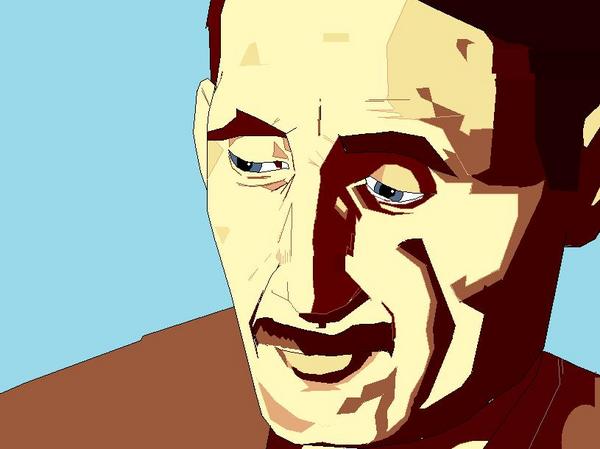
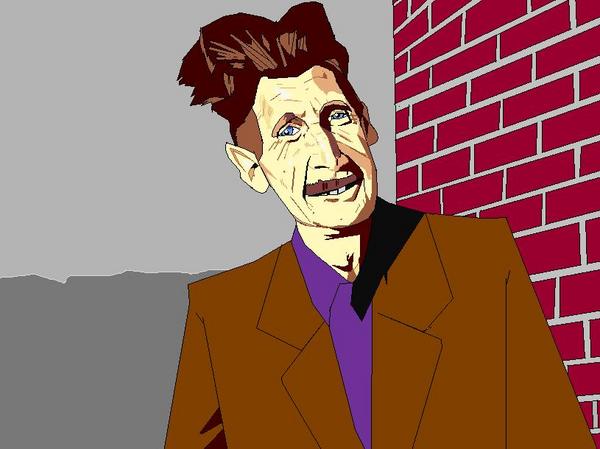
This week it’s a pleasure to share with you some wonderful artistic portraits of Orwell by Dean Noble who sent the pictures into us via Twitter and said that his inspiration was reading Orwell’s novels.

From the archive

While thinking about Orwell’s life and great work, remember The Orwell Prize are able to bring you the first chapter of all of Orwell’s books as well as many essays, courtesy of Penguin Books and AM Heath. See a snapshot of sheer destitution in Down and Out in Paris and London, experience his fight against Spanish fascism in Homage to Catalonia, feel George Bowling’s nostalgic despair in Coming Up for Air, read the scathing critique of totalitarianism that is Animal Farm, remember his stark, dystopian vision of a tyrannical future in Nineteen Eighty-Four and more, all available on our website.

From elsewhere

  • Sarah Burnside discussed Orwell’s legacy in a comment piece for Eureka Street, and spoke about the continuing ‘intellectual tug-of-war’ induced by the complexities of his political positions
  • Historian Simon Schama told the Financial Times that Orwell was the reason that he became a writer
  • Man Booker-shortlisted novelist Deborah Levy backed Orwell’s conclusions for why writers write during an interview with the Guardian; Deborah has been commissioned to write an essay in response to Orwell’s classic ‘Why I Write’
  • The Comet reported that the organisers of the Letchworth literary festival are ‘thrilled’ to be having The Orwell Prize tonight, where we will be hosting a panel on the topic of ‘Poverty Then and Now: Orwell and his Successors’.

  • The wartime diaries

    This week’s entries were published on 21st and 22nd August 1942. Next week’s entry will be published on 28th September 1942. This newsletter was written with contribution from Tom Webb Don’t forget our other Orwell Diary blogs: his Hop-Picking Diary and The Road to Wigan Pier Diary. You can sign up to our newsletter If you’ve got any suggestions about our website(s), we’d love to hear from you – email us on katriona.lewis@mediastandardstrust.org. You can also follow us on Twitter and like us on Facebook.

    Coming Up for Air

    This week we celebrated the publication anniversary of Orwell’s novel Coming Up for Air. Written in 1938 and first published on 12th June 1939, Coming Up for Air is a story of a man’s journey home to the setting of his childhood. Imminent war, nostalgia and fear of a changing world set the tone of a philosophical book written by Orwell in the lead up to Nineteen Eighteen-Four. You can read more about Coming Up for Air including the first chapter on our website.

    Buxton Festival 2012

    We’re so excited to be returning to Buxton on 16th July. For 2012 we’ll be taking Paul Anderson, Jan Montifiore, Charles Allen, Tony Wright and Stuart Evers to row about who is the better writer; Orwell or Kipling. You can see full details on our website.

    From the archive

    In anticipation of our upcoming debate you can read Orwell’s writings on Kipling or watch our debate on the same topic last year at The Sunday Times Oxford Literary Festival on our website.

    From elsewhere

  • The Guardian have produced an eBook of Amelia Gentleman’s Orwell Prize winning features.
  • Connor Woodman, whose book Unfair Trade was longlisted for this year’s prize, spoke at Hay Festival on how Big Business Exploits the World’s Poor – and why it doesn’t have to.
  • We had a wonderful response to our Twitter competition this week with lots of people telling us why they write. Toby Harnden picked five winners to receive copies of his Orwell Prize 2012 winning book. You can see the tweets he chose on The Orwell Prize profile.
  • The wartime diaries

    This week’s entries were published on 11th, 13th and 15th June 1942. Next week’s entries will be published on 21st and 24th June 1942. Don’t forget our other Orwell Diary blogs: his Hop-Picking Diary and The Road to Wigan Pier Diary. If you’ve got any suggestions about our website(s), we’d love to hear from you – email us on katriona.lewis@mediastandardstrust.org. You can also follow us on Twitter and like us on Facebook.

    Poverty and Political Blogging – Videos from Cheltenham

    We thoroughly enjoyed holding events at The Times Cheltenham Literature Festival for the first time – and we hope that, via video, you enjoy them too.

    You can watch our ‘Victorian Values’ debate, with social historian Jose Harris, author of Chavs Owen Jones and co-author of Jilted Generation Shiv Malik, chaired by Julia Wheeler, on our website and on our YouTube Channel. Our panellists look at the concepts of the deserving and undeserving poor, social mobility, and poverty through the ages – and much more besides – in an excellent hour of discussion.
    We also have video of this year’s Orwell Prize for Blogs winner, Graeme Archer, and previously longlisted Oliver Kamm of The Times, in another great conversation about political blogging. Is the left or right better at group blogging? Has blogging’s style ‘infected’ national newspapers? And would preventing anonymous commenting lead to higher quality, polite discussion? Watch Graeme and Oliver to see what they thought.

    Orwell Prize 2012 Launch

    It’s that time of year again – almost. We’ll be announcing full details of this year’s Orwell Prize launch next week. But you might want to keep 9 November free…

    George Orwell Memorial Lecture 2011

    Alan Rusbridger, editor-in-chief of Guardian News and Media, will be speaking on ‘Hacking away at the truth: an investigation and its consequences’ on 10th November at 6pm. Email events@bbk.ac.uk to book a free place, or visit our website for more information.
    The Orwell Lecture is organised by the Orwell Trust with Birkbeck College, University of London.

    From the archive

    Orwell’s ‘You and the Atom Bomb’ was first published this week in 1945, and is new to our website. The essay imagines a world carved up into three superstates with the threat of nuclear annihilation keeping them in perpetual war – not unlike Orwell’s Nineteen Eighty-Four. Other notable dates this week include the birth of Samuel Taylor Coleridge – whose Xanadu Orwell considers in his essay, ‘Pleasure Spots’ – and Trafalgar Day, Orwell writing of Trafalgar and patriotism in ‘The Lion and the Unicorn’.

    From elsewhere

    The Wartime Diaries

    The next entry will be published on 14th March.

    The Hop-Picking Diaries

    The final entry was published on 8th October.

    The Wigan Pier Diaries

    The final entry was published on 25th March.
    If you’ve got any suggestions about our website(s), we’d love to hear from you – email us on gavin.freeguard@mediastandardstrust.org or follow us on Twitter.

    And you can subscribe to this newsletter via email.

    Gordon Bowker: George Orwell and the Church of England

    George Orwell (Eric Blair) is not generally thought of as a religious man. His final novel, Nineteen Eighty-Four, is a tale of grim despair, hardly a message to cheer the true believer. It is both sadistic and nihilistic. And even in his famous fairy tale, Animal Farm, religion is represented cynically as ‘lies put about by Moses the tame Raven’ about a supposed animal paradise. In another novel (A Clergyman’s Daughter) he has a Satanic unfrocked priest reciting The Lord’s Prayer backwards while holding an inverted crucifix.

    Yet he retained a strong religious streak and a strange affection for the Anglican Church into which he was born, an affection that persisted to the end of his life.

    Blair’s paternal grandfather was Vicar of Milborne St. Andrew in Dorset.  He himself was born in Bengal in 1903 and baptised at the Anglican Church of St John in the Wilderness in Motihari. Aged four months he was brought to England, settling with his mother and elder sister at Henley-on-Thames.  Most biographers have him being first taught by Anglican nuns there, but diocesan and local records reveal that the only convent in Henley at that time was run by French Ursulines, forbidden to teach in France.

    Having been educated by Catholic nuns in an all-girls school probably explains Orwell’s lifelong antipathy to the Catholic Church and perhaps also his acknowledged misogyny.  Two fleeting and sardonic references seem to evoke the shadowy Ursulines, one (in A Clergyman’s Daughter) to ‘nuns in convents, scrubbing floors and singing Ave Marias, secretly unbelieving’, the other (in a letter to a girlfriend, Brenda Salkeld) rather more subversive:

    When we were children we had a story that after Robin Hood was done to death in the Priory, his men raped & murdered the nuns, & burned the priory to the ground. It seems this has no foundation in the ballads —  we must have made it up.  An instance of the human instinct for a happy ending.

    As he saw it, the Catholic Inquisition provided the model for both fascist and communist totalitarianism, and gauleiters and commissars were just the priests and emissaries of a new and cruel religion of power.  In Coming Up For Air he wrote, ‘You never read about a Spanish Inquisitor or one of these higher‑ups in the Russian Ogpu without being told that in private life he was such a good kind man, best of husbands and fathers, devoted to his tame canary and so forth.’ The parallel is more fully and closely drawn by O’Brien, Big Brother’s inquisitor, in Nineteen Eighty-Four.

    After an unhappy prep school education in Eastbourne, he won a scholarship to Eton, where he was finally prepared for confirmation by the headmaster, King George’s chaplain, Cyril Alington.  In the chapel at Eton in November 1918, he was confirmed by Charles Gore, Bishop of Oxford.  However, by this time, according to his friend Cyril Connolly, he had renounced not just God, but Empire, Kipling, Sussex, and Character, reading Butler and Shaw and embracing atheistic socialism in true Shavian style.  At Eton he became known as ‘the College Cynic’, a type denounced from the Chapel pulpit as ‘a real stinker’.

    In true ‘Orwellian’ fashion he satirized his tutors, claiming, ‘There are at least six masters on the staff who are making a very good living out of the Crucifixion.’ And, telling a green young Colleger that he was collecting the religions of new boys, he asked, ‘Are you Cyrenaic, Sceptic, Epicurean, Cynic, Neoplatonist, Confucian or Zoroastrian?’  ‘I’m a Christian,’ came the reply. ‘Oh,’ said Blair, ‘We haven’t had that before.’

    His Aunt Nellie, a Suffragette friend of Emmeline Pankhurst, ran a literary salon in Notting Hill, and there he met such left-wing luminaries as G.K. Chesterton and the children’s author, E. Nesbitt.  One friend made through Aunt Nellie was Conrad Noel, then a curate in Paddington, but famous later as the ‘Red’ Vicar of Thaxted who flew the Red Flag from his church tower.  Interestingly enough, Noel spent his spare time visiting the ‘spikes’ and lodging-houses used by London’s down-and-outs, a practise for which ‘George Orwell’ was to become famous in the 30s.

    From 1922 to 1927 he worked as an Imperial Policeman in Burma, finally resigning, sickened by the violence he was required to use to keep the native population in its place.  In search of expiation, he descended into the Lower Depths, and joined the tramps and down-and-outs who congregated around London.

    Gradually he got started as a writer, supplementing his income by teaching and afterwards by working in a bookshop.  Interestingly enough, wherever he was — with his family in Suffolk, teaching at a school in Middlesex, or running a village store in Hertfordshire — he invariably made friends with the local clergy.  They, after all, were often the most educated members of the community, and, according to Orwell, vicarages had some of the best libraries in England.

    In 1932, while teaching in Hayes and researching A Clergyman’s Daughter, his second novel, he became friendly with the curate of St Mary’s (Ernest Parker — ‘High Anglican but not a creeping Jesus,’ he told Eleanor Jaques). He organized a school play at the Church Hall and helped refurbish some church statuary, all of which found its way into his novel.

    In October that year, he told Brenda Salkeld, ‘I take in the Church Times regularly now & like it more every week.  I do so like to see that there is life in the old dog yet — I mean in the poor old C. of E.  I shall have to go to Holy Communion soon, hypocritical tho’ it is, because my curate friend is bound to think it funny if I always go to Church but never communicate. What is the procedure? I have almost forgotten it…You have to go fasting, do you not? And what about being in mortal sin? I wish you would prompt me. It seems rather mean to go to H.C. when one doesn’t believe, but I have passed myself off for pious & there is nothing for it but to keep up the deception.’

    In those pre-war years religion exercised him a great deal, and he especially enjoyed taunting Catholic apologists.  Reviewing Karl Adam’s The Spirit of Catholicism in June 1932, he wrote, ‘The contrast between the Catholic who simply believes, and the convert who must for ever be justifying his conversion, is like the contrast between a Buddha and a performing fakir.’  Afterwards, he told a girlfriend, ‘It was the first time I had been able to lay the bastinado on a professional R.C. at any length.’  By comparison with what he considered a cruelly-repressive and unforgiving Catholicism, he saw Anglicanism as a kinder, gentler more liberating faith.  He spoke of ‘the poor old inoffensive Church of England’, identified himself strongly with the sixteenth century Anglican martyrs and attributed the emergence of the novel (the highest manifestation of the liberated imagination, he thought) to the Protestant Reformation.

    He equated the extremes of Catholicism with those of Communism, and the bold attacks on Catholicism in which he took so much pleasure, demonstrated how focussed and intense this antipathy had become.  Jon Kimche, who worked with him at the Booklover’s Corner bookshop in 1935, recalled that Orwell’s conversation at that time were little more than diatribes against Roman Catholicism.  This antipathy at time bordered on paranoia, and he told his flatmate, Rayner Heppenstall, that ‘Vatican spies are everywhere’.  This fear of being spied upon was later transferred to the Communists — with good cause, it transpired.

    Later, he complained about the Times’s attacks on Bertrand Russell over birth control and its eulogizing of a certain Anglo-Catholic poet.  In 1936 he wrote mockingly in a book review: ‘The editorial staff of the “Church Times” gnash their false teeth and quake in their galoshes at the mention of “modern” (i.e., post-Tennysonian) poetry, but strange to say they make an exception of T. S. Eliot’ — its ‘spoiled darling’.  By 1943, however, he was applauding the paper, which had, he said, ‘for some years past been a mildly leftwing paper and politically quite intelligent’ — a plaudit indeed from one of the twentieth century’s shrewdest political commentators.

    In June 1936, he married Eileen O’Shaughnessy at St Mary’s Church at Wallington in Hertfordshire.  Eileen, an Oxford graduate who had been taught by J.R.R. Tolkien and had been Head Girl at the Sunderland Church High School for Girls, arranged for the clergyman she had known as a child in South Shields (John Woods, then Vicar of St Mark’s) to conduct the marriage ceremony.  To Orwell’s surprise, she had also arranged for the ceremony to be doctored so that she was not required to ‘obey’ her new husband. After marrying, they settled down to run the Wallington village store.

    He found the Church a continual source of amusement.  In August 1937 just after returning wounded from fighting with the anti-clerical Republicans in the Spanish Civil War, he wrote to an old comrade, ‘This afternoon Eileen and I had a visit from the vicar [Vernon Rossborough], who doesn’t at all approve of our having been on the Government side.  Of course we had to own up that it was true about the burning of the churches, but he cheered up a lot on hearing they were only Roman Catholic churches.’

    Orwell’s main argument against religion was that it turned individuals into pawns, hampered progress towards socialism, and opened the way to dictatorship.  ‘As long as supernatural beliefs persist, men can be exploited by cunning priests and oligarchs, and the technical progress which is the prerequisite of a just society cannot be achieved.’ Belief in God, he thought, was all too easily replaced by belief in a Stalin, a Hitler or Mussolini. Once the belief in an afterlife was lost, the alternative hope for an earthly Utopia played directly into the hands of cruel dictators. The omnipresent, omniscient, omnipotent Big Brother is the very symbolic of such a manufactured Deity.  He targeted other false gods, of course, including nationalism and racism, imperialism and, inevitably, capitalism.  Keep the Aspidistra Flying is a full-frontal assault on what he calls ‘the money-god and all its swinish priesthood’.

    Possessed of an acute social conscience, Orwell agonized over the proper basis for a modern morality.  He stressed what he thought was the highest moral value, human decency, sympathizing with Swift — ‘His attitude is in effect the Christian attitude, minus the bribe of a “next world”‘ — and citing Marx, who did not simply say that ‘Religion is the opium of the people’, but also that it was ‘the sigh of the soul in a soulless world’.  The idea of a soulless, meaningless, entirely materialist world, he found unacceptable.  ‘We have got to be the children of God,’ he concluded, ‘even though the God of the Prayer Book no longer exists.’

    His second marriage to Sonia Brownell was sadly a deathbed marriage. It was conducted three months before his death, ‘according to the Rites and Ceremonies of the Established Church of England’ in his private ward at London’s University College Hospital by the hospital chaplain, William Braine.  The cynical Malcolm Muggeridge observed ‘George had developed TB in order to be married by a clergyman which otherwise he’d never have had the face to do.’

    Many were surprised that in his will, signed just before his death from tuberculosis in January 1950, he asked to be buried according to the rites of the Church of England.  However, as he approached the Great Unknown, he could have been closer to his Creator than anyone imagined.  In late 1949, in a letter from his hospital bed to Malcolm Muggeridge, he enclosed a newspaper advertisement which had, he said, upset him. It was for Wolsey socks, and read, ‘Wolsey socks — Fit for the gods.’  Wasn’t  that blasphemous? he asked.   It is just conceivable that for Orwell, the atheist and Old Etonian Cynic, his relationship with the Almighty had suddenly mellowed.  One of his last hospital visitors noticed that he was reading the first volume of Dante’s Divine Comedy.

    His friends Muggeridge and Anthony Powell arranged a public funeral service for him at Christ Church, Albany Street.  Most of his friends who attended were unbelievers and the service was somewhat ragged, by all accounts.  There were readings from Ecclesiastes and the hymns, ‘All people that on earth do dwell’, ‘Guide me, O thou great Jehovah’, and ‘Ten thousand times ten thousand’, Orwell’s favourites, were sung.  Powell found the occasion ‘very harrowing’, and, because Orwell was so tall and the coffin therefore very long, Muggeridge thought it extremely poignant.

    David Astor, the Observer editor and close friend of Orwell’s, tried to have him buried at a church at Clivedon, his family seat, but the vicar refused him as an unbeliever.  Astor had better luck at Sutton Courtenay where he was a regular worshipper.  The vicar, Gordon Dunstan, however, felt that he must first consult his church wardens.  Initially, one, a farmer, was a bit reluctant until Dunstan showed him a copy of Animal Farm, and he agreed immediately.

    Now came the funeral of Eric Blair, the mystery man behind the famous name.  Only a handful attended, and he was duly interred between Herbert Asquith, the great Liberal Prime Minister and a family of local gypsies — a fitting resting place for a man who mingled with the poor and despised and yet whose writing was to make such a great political impact.

    On his gravestone is written the simple inscription, ‘Eric Blair 1903-1950’, but he wrote his own epitaph in a poem which seems to say more about his relationship with the Anglican Church than anything else he wrote, and reflects the fact that during ‘the low dishonest decade’ of the 1930s it became difficult for a man of conscience like Orwell to remain detached from the political fray.

    A happy vicar I might have been

    Two hundred years ago,

    To preach upon eternal doom

    And watch my walnuts grow;

    But born, alas, in an evil time,

    I missed that pleasant haven,

    For the hair has grown on my upper lip

    And the clergy are all clean-shaven.

    © Gordon Bowker 2003. Revised 2011. This is a modified version of an article originally published by the Church Times, and is reproduced by kind permission of the author.