Search Results for: george-orwell/by-orwell/essays-and-other-works/the-lion-and-the-unicorn-socialism-and-the-english-genius

Resources

We hope teachers will find the Orwell Youth Prize a valuable way of introducing students to writing independently, as well as Orwell’s own work. But there are many other ways of using Orwell in the classroom.

Whatever your subject  – politics, English, history, citizenship, drama to name but a few – whatever the age group – the Orwell Foundation website also has a wealth of resources about Orwell and his work. Over the year’s, we’ve also produced a range of resources to accompany our Youth Prize themes. These are available free to everyone.

Our resources include works by George Orwell, works about George Orwell and video of events run by the Orwell Prize on politics and literature. Below we provide a useful guide to material that might be of particular interest in the classroom; much more is available through the publishers of Orwell, Penguin and Harvill Secker, and the works below are reproduced under copyright of them and the Orwell Estate and with their kind permission.

Works by Orwell

We have dedicated webpages for each of Orwell’s six novels – Burmese Days, A Clergyman’s Daughter, Keep the Aspidistra Flying, Coming Up for Air and of course Animal Farm and Nineteen Eighty-Four – and three major non-fiction works – Down and Out in Paris and London, The Road to Wigan Pier and Homage to Catalonia. Additionally, a selection of other essays and short works (including poetry) by Orwell is available.

Orwell Daily is our weekly Substack serial, picking out highlights and hidden gems from Orwell’s journalism, letters and diaries and sharing them with subscribers “on the day” that they were first published. Please not that the serial is pitched at adult readers.

Orwell and Journalism

In July 2022, the Orwell Youth Prize teamed up with University College London Special Collections and the Orwell Archive to run a summer school for Year 12s on ‘Orwell and Journalism: In Pursuit of Truth’. As part of this project, we also produced online resources, designed for students in Years 12 and 13, on Orwell’s work as a journalist and how his life experiences informed his work.

The written resource includes materials from the Orwell Archive, while the short film includes background about Orwell’s life, journalism and writing style, as well as insights from contemporary journalists.

Events and films

Many of our Orwell Foundation events based on Orwell’s life and work and might be useful: we keep a library of free-to-view recordings on our YouTube.

The Orwell Youth Prize also filmed our own exclusive interview with Richard Blair, which you can see here. Additionally, there are events based on themes Orwell wrote about and many events discussing different aspects of politics and society. In 2020, we also created a new resource on “Orwell and Empire” to accompany Dr Tristram Hunt’s Orwell Memorial Lecture.

Orwell in the Classroom

Below are a few examples of works, or combinations of works, which could work particularly well in the classroom or workshops. They have been selected based on the depth of what we have available, but also the sorts of exercises that they could be used for (e.g. comparing source material with the finished product) and curriculum relevance.

Individual essays that could prompt discussion – a few suggestions

Orwell wrote a number of compelling, accessible essays about language and literature: what do we think of Orwell’s rules? What should the role of literature be?

Eyewitness/descriptive essays: how does Orwell use imagery and other techniques?

Orwell’s essays about politics and ideas (these could be particularly useful in 20th century history – WWII; The Cold War; decolonization etc):

He was also a master at writing about the particular to make a more general point:

Other:

Reviews of authors on the curriculum

Orwell’s best-known pieces of criticism include his essays  on Charles Dickens and Rudyard Kipling; lesser-known reviews include an essay on W. B. Yeats.

Works about particular novels

We have a wealth of background material on all of Orwell’s works, many of which are curriculum stalwarts.

  • for Nineteen Eighty-Four we have Orwell’s essays about language, politics and culture, works by others adapting it, reviews and analysis which could all give a fresh perspective
  • for Animal Farm we have essays concerned with similar themes, Orwell’s proposed prefaces, reviews, analysis and the stories behind the rejections and adaptations

Related works by others

We have pieces about other works contemporary to Orwell. For example, how does Orwell’s reportage in Down and Out (e.g.) compare to other similar works? How was it received by similar authors? And how do Orwell’s dystopias/representations of politics compare to others? (Not least those, like Zamyatin and Koestler, whose works he reviewed.)

We have some material on adaptations. How have others adapted Orwell and his work? For example, Mike Radford and the BBC on Nineteen Eighty Four, Chris Durlacher on adapting Orwell’s life, the story about the cartoon film of Animal Farm. How would you adapt Orwell?

And we have pieces by those inspired by Orwell. How have others followed in Orwell’s footsteps? For example, Emma Larkin in Burma, Stephen Armstrong and others to Wigan. How would you approach a similar project?

The Diaries

For historical source analysis – especially World War II – we have Orwell’s 1938-42 diaries. These also include other interesting contemporary sources, or links to them, such as a public information leaflet on masking windows in July 1939. Most striking are the newspaper articles Orwell references (and which the Diaries blog includes) in the approach to war, summer 1939, e.g. the surprise as the Nazi Soviet Pact is signed in August 1939.

These could help pupils improve their reading of historical sources, contribute to their historical understanding and be used to stimulate wider discussion. Orwell’s diaries can also be read as preparatory work for his longer essays and work, which could be an engaging way of comparing rough drafts with finished products.

For instance, The Road to Wigan Pier diary and Orwell’s other notes (e.g. Barnsley) were obviously kept with The Road to Wigan Pier in mind. Orwell’s Morocco diary (September 1938 to March 1939, part of the 1938-42 diaries) provides the basis for the essay ‘Marrakech’, while the Hop-Picking diaries are used for Down and Out in Paris and London, A Clergyman’s Daughter and essays including ‘Hop-picking’, ‘A Day in the Life of a Tramp’ and ‘The Spike’ (and the links from the Hop-Picking blog include newsreel and other materials).

A simple question would be: how does Orwell turn this material into essays and books? More complex questions might touch on the motivations, ethics and effects of this editing is. This extract from chapter one of Wigan Pier could be a starting point, as is this Observer article, which considers Orwell’s fact and fiction, and articles by Orwell winners, Timothy Garton Ash and Neal Ascherson on journalist Ryszard Kapuściński.

English Language Practice Papers

We have prepared these GCSE AQA-style exam practice papers to give you a helping hand – and to promote the Orwell Youth Prize (registered charity 1156494).

For teachers

Whatever your subject  – politics, English, history, citizenship, drama to name but a few – whatever the age group you teach – the Orwell Foundation website has a wealth of resources. These are available free to everyone, regardless of whether you or your school are currently involved with the Youth Prize. If you are interested in learning more about our workshops in schools, please get in contact with the administrator at admin@orwellyouthprize.co.uk.

Our resources include works by George Orwell, works about George Orwell and video of events run by the Orwell Prize on politics and literature. Below we provide a useful guide to material that might be of particular interest in the classroom; much more is available through the publishers of Orwell, Penguin and Harvill Secker, and the works below are reproduced under copyright of them and the Orwell Estate and with their kind permission.

Works by Orwell

There is a dedicated webpage for each of Orwell’s six novels – Burmese Days, A Clergyman’s Daughter, Keep the Aspidistra Flying, Coming Up for Air and of course Animal Farm and Nineteen Eighty-Four – and three major non-fiction works – Down and Out in Paris and London, The Road to Wigan Pier and Homage to Catalonia.

Additionally, a selection of other essays and short works (including poetry) by Orwell is available.

There are also three blogs of diaries written by Orwell:

  • 1938-42, includes eyewitness accounts of the Blitz and the run up to WWII (as well as Orwell’s time in Morocco and his experiences of keeping animals and growing vegetables…)
  • Hop-picking (1931), follows some of Orwell’s tramping exploits and his experience of picking hops in Kent, which many urban workers and their families would do in the summer
  • The Road to Wigan Pier (1936), includes Orwell’s research for the book of the same name

Works about Orwell

We have links to analysis, reviews and other material based on Orwell’s life and work; the most relevant to individual novels and diaries should already be linked to from the relevant novel and diary pages.

Orwell Prize events

Many of our Orwell Prize events based on Orwell’s life and work and might be useful. These include:

The Orwell Youth Prize also filmed our own exclusive interview with Richard Blair, which you can see here. Additionally, there are events based on themes Orwell wrote about (such as 2012’s ‘Poverty then and now, Orwell and his successors’), events about political writing more generally (such as ‘Autopsy of a Story’ with three shortlisted journalists dissecting their work and debates like ‘What makes a good political novel?’ with a critic and political novelists), and many events discussing different aspects of politics and society.

Below are a few examples of works, or combinations of works, which could work particularly well in the classroom or workshops. They have been selected based on the depth of what we have available, but also the sorts of exercises that they could be used for (e.g. comparing source material with the finished product) and curriculum relevance.

The Diaries

For historical source analysis – especially World War II – we have Orwell’s 1938-42 diaries. These also include other interesting contemporary sources, or links to them, such as a public information leaflet on masking windows in July 1939. Most striking are the newspaper articles Orwell references (and which the Diaries blog includes) in the approach to war, summer 1939, e.g. the surprise as the Nazi Soviet Pact is signed in August 1939.

Thesecould help pupils improve their reading of historical sources, contribute to their historical understanding and be used to stimulate wider discussion. Orwell’s diaries can also be read as preparatory work for his longer essays and work, which could be an engaging way of comparing rough drafts with finished products.

For instance, The Road to Wigan Pier diary and Orwell’s other notes (e.g. Barnsley) were obviously kept with The Road to Wigan Pier in mind. Orwell’s Morocco diary (September 1938 to March 1939, part of the 1938-42 diaries) provides the basis for the essay ‘Marrakech’, while the Hop-Picking diaries are used for Down and Out in Paris and London, A Clergyman’s Daughter and essays including ‘Hop-picking’, ‘A Day in the Life of a Tramp’ and ‘The Spike’ (and the links from the Hop-Picking blog include newsreel and other materials).

A simple question would be: how does Orwell turn this material into essays and books? More complex questions might touch on the motivations, ethics and effects of this editing is. This extract from chapter one of Wigan Pier could be a starting point, as is this Observer article, which considers Orwell’s fact and fiction, and articles by Orwell winners, Timothy Garton Ash and Neal Ascherson on journalist Ryszard Kapuściński.

Individual essays that could prompt discussion – a few suggestions

Orwell wrote a number of compelling, accessible essays about language and literature: what do we think of Orwell’s rules? What should the role of literature be?

Eyewitness/descriptive essays: how does Orwell use imagery and other techniques?

Orwell’s essays about politics and ideas (these could be particularly useful in 20th century history – WWII; The Cold War; decolonization etc):

He was also a master at writing about the particular to make a more general point:

Other:

Reviews of authors on the curriculum

Orwell’s best-known pieces of criticism include his essays  on Charles Dickens and Rudyard Kipling; lesser-known reviews include an essay on W. B. Yeats.

Works about particular novels

We have a wealth of background material on all of Orwell’s works, many of which are curriculum stalwarts.

  • for Nineteen Eighty-Four we have Orwell’s essays about language, politics and culture, works by others adapting it, reviews and analysis which could all give a fresh perspective
  • for Animal Farm we have essays concerned with similar themes, Orwell’s proposed prefaces, reviews, analysis and the stories behind the rejections and adaptations

Related works by others

We have pieces about other works contemporary to Orwell. For example, how does Orwell’s reportage in Down and Out (e.g.) compare to other similar works? How was it received by similar authors? And how do Orwell’s dystopias/representations of politics compare to others? (Not least those, like Zamyatin and Koestler, whose works he reviewed.)

We have some material on adaptations. How have others adapted Orwell and his work? For example, Mike Radford and the BBC on Nineteen Eighty Four, Chris Durlacher on adapting Orwell’s life, the story about the cartoon film of Animal Farm. How would you adapt Orwell?

And we have pieces by those inspired by Orwell. How have others followed in Orwell’s footsteps? For example, Emma Larkin in Burma, Stephen Armstrong and others to Wigan. How would you approach a similar project?

English Language Practice Papers

We have prepared these GCSE AQA-style exam practice papers to give you a helping hand – and to promote the Orwell Youth Prize (registered charity 1156494).

Scripts – which would allow performance

Many radio scripts by Orwell exist, such as adaptations of Animal Farm and various fairy tales. These can be found in the Orwell Archive and in editions of the Complete Works.

However, online we have a Christmas edition of his radio poetry programme, Voice as well as his own poetry. We also have a short one scene piece by a young Orwell called ‘Free Will’. There is also one chapter of A Clergyman’s Daughter, set in Trafalgar Square, which is written entirely in dramatic form.

Subscribe to our mailing list

* indicates required


Antisemitism in Britain

This material remains under copyright in some jurisdictions, including the US, and is reproduced here with the kind permission of the Orwell Estate. The Orwell Foundation is an independent charity – please consider making a donation or becoming a Friend of the Foundation to help us maintain these resources for readers everywhere. 

There are about 400,000 known Jews in Britain, and in addition some thousands or, at most, scores of thousands of Jewish refugees who have entered the country from 1934 onwards. The Jewish population is almost entirely concentrated in half a dozen big towns and is mostly employed in the food, clothing and furniture trades. A few of the big monopolies, such as the I.C.I., one or two leading newspapers and at least one big chain of department stores are Jewish-owned or partly Jewish-owned, but it would be very far from the truth to say that British business life is dominated by Jews. The Jews seem, on the contrary, to have failed to keep up with the modern tendency towards big amalgamations and to have remained fixed in those trades which are necessarily carried out on a small scale and by old-fashioned methods.

I start off with these background facts, which are already known to any well-informed person, in order to emphasize that there is no real Jewish ‘problem’ in England. The Jews are not numerous or powerful enough, and it is only in what are loosely called ‘intellectual circles’ that they have any noticeable influence. Yet it is generally admitted that antisemitism is on the increase, that it has been greatly exacerbated by the war, and that humane and enlightened people are not immune to it. It does not take violent forms (English people are almost invariably gentle and law-abiding), but it is ill-natured enough, and in favourable circumstances it could have political results. Here are some samples of antisemitic remarks that have been made to me during the past year or two:

Middle-aged office employee: ‘I generally come to work by bus. It takes longer, but I don’t care about using the Underground from Golders Green nowadays. There’s too many of the Chosen Race travelling on that line.’

Tobacconist (woman): ‘No, I’ve got no matches for you. I should try the lady down the street. She’s always got matches. One of the Chosen Race, you see.’

Young intellectual, Communist or near-Communist: ‘No, I do not like Jews. I’ve never made any secret of that. I can’t stick them. Mind you, I’m not antisemitic, of course.’

Middle-class woman: ‘Well, no one could call me antisemitic, but I do think the way these Jews behave is too absolutely stinking. The way they push their way to the head of queues, and so on. They’re so abominably selfish. I think they’re responsible for a lot of what happens to them.’

Milk roundsman: ‘A Jew don’t do no work, not the same as what an Englishman does. ‘E’s too clever. We work with this ‘ere’ (flexes his biceps). ‘They work with that there’ (taps his forehead).

Chartered accountant, intelligent, left-wing in an undirected way: ‘These bloody Yids are all pro-German. They’d change sides tomorrow if the Nazis got here. I see a lot of them in my business. They admire Hitler at the bottom of their hearts. They’ll always suck up to anyone who kicks them.’

Intelligent woman, on being offered a book dealing with antisemitism and German atrocities: ‘Don’t show it to me, please don’t show it to me. It’ll only make me hate the Jews more than ever.’

I could fill pages with similar remarks, but these will do to go on with. Two facts emerge from them. One – which is very important and which I must return to in a moment – is that above a certain intellectual level people are ashamed of being antisemitic and are careful to draw a distinction between ‘antisemitism’ and ‘disliking Jews’. The other is that antisemitism is an irrational thing. The Jews are accused of specific offences (for instance, bad behaviour in food queues) which the person speaking feels strongly about, but it is obvious that these accusations merely rationalize some deep-rooted prejudice. To attempt to counter them with facts and statistics is useless, and may sometimes be worse than useless. As the last of the above-quoted remarks shows, people can remain antisemitic, or at least anti-Jewish, while being fully aware that their outlook is indefensible. If you dislike somebody, you dislike him and there is an end of it: your feelings are not made any better by a recital of his virtues.

It so happens that the war has encouraged the growth of antisemitism and even, in the eyes of many ordinary people, given some justification for it. To begin with, the Jews are one people of whom it can be said with complete certainty that they will benefit by an Allied victory. Consequently the theory that ‘this is a Jewish war’ has a certain plausibility, all the more so because the Jewish war effort seldom gets its fair share of recognition. The British Empire is a huge heterogeneous organization held together largely by mutual consent, and it is often necessary to flatter the less reliable elements at the expense of the more loyal ones. To publicize the exploits of Jewish soldiers, or even to admit the existence of a considerable Jewish army in the Middle East, rouses hostility in South Africa, the Arab countries and elsewhere: it is easier to ignore the whole subject and allow the man in the street to go on thinking that Jews are exceptionally clever at dodging military service. Then again, Jews are to be found in exactly those trades which are bound to incur unpopularity with the civilian public in war-time. Jews are mostly concerned with selling food, clothes, furniture and tobacco – exactly the commodities of which there is a chronic shortage, with consequent overcharging, black-marketing and favouritism. And again, the common charge that Jews behave in an exceptionally cowardly way during air raids was given a certain amount of colour by the big raids of 1940. As it happened, the Jewish quarter of Whitechapel was one of the first areas to be heavily blitzed, with the natural result that swarms of Jewish refugees distributed themselves all over London. If one judged merely from these war-time phenomena, it would be easy to imagine that antisemitism is a quasi-rational thing, founded on mistaken premises. And naturally the antisemite thinks of himself as a reasonable being. Whenever I have touched on this subject in a newspaper article, I have always had a considerable ‘come-back’, and invariably some of the letters are from well-balanced, middling people – doctors, for example – with no apparent economic grievance. These people always say (as Hitler says in Mein Kampf) that they started out with no anti-Jewish prejudice but were driven into their present position by mere observation of the facts. Yet one of the marks of antisemitism is an ability to believe stories that could not possibly be true. One could see a good example of this in the strange accident that occurred in London in 1942, when a crowd, frightened by a bomb-burst nearby, fled into the mouth of an Underground station, with the result that something over a hundred people were crushed to death. The very same day it was repeated all over London that ‘the Jews were responsible’. Clearly, if people will believe this kind of thing, one will not get much further by arguing with them. The only useful approach is to discover why they can swallow absurdities on one particular subject while remaining sane on others.

But now let me come back to that point I mentioned earlier – that there is widespread awareness of the prevalence of antisemitic feeling, and unwillingness to admit sharing it. Among educated people, antisemitism is held to be an unforgivable sin and in a quite different category from other kinds of racial prejudice. People will go to remarkable lengths to demonstrate that they are not antisemitic. Thus, in 1943 an intercession service on behalf of the Polish Jews was held in a synagogue in St John’s Wood. The local authorities declared themselves anxious to participate in it, and the service was attended by the mayor of the borough in his robes and chain, by representatives of all the churches, and by detachments of R.A.F., Home Guards, nurses, Boy Scouts and what-not. On the surface it was a touching demonstration of solidarity with the suffering Jews. But it was essentially a conscious effort to behave decently by people whose subjective feelings must in many cases have been very different. That quarter of London is partly Jewish, antisemitism is rife there, and, as I well knew, some of the men sitting round me in the synagogue were tinged by it. Indeed, the commander of my own platoon of Home Guards, who had been especially keen beforehand that we should ‘make a good show’ at the intercession service, was an ex-member of Mosley’s Blackshirts. While this division of feeling exists, tolerance of mass violence against Jews, or, what is more important, antisemitic legislation, are not possible in England. It is not at present possible, indeed, that antisemitism should become respectable. But this is less of an advantage than it might appear.

One effect of the persecutions in Germany has been to prevent antisemitism from being seriously studied. In England a brief inadequate survey was made by Mass Observation a year or two ago, but if there has been any other investigation of the subject, then its findings have been kept strictly secret. At the same time there has been conscious suppression, by all thoughtful people, of anything likely to wound Jewish susceptibilities. After 1934 the ‘Jew joke’ disappeared as though by magic from postcards, periodicals and the music-hall stage, and to put an unsympathetic Jewish character into a novel or short story came to be regarded as antisemitism. On the Palestine issue, too, it was de rigueur among enlightened people to accept the Jewish case as proved and avoid examining the claims of the Arabs – a decision which might be correct on its own merits, but which was adopted primarily because the Jews were in trouble and it was felt that one must not criticize them. Thanks to Hitler, therefore, you had a situation in which the press was in effect censored in favour of the Jews while in private antisemitism was on the up-grade, even, to some extent, among sensitive and intelligent people. This was particularly noticeable in 1940 at the time of the internment of the refugees. Naturally, every thinking person felt that it was his duty to protest against the wholesale locking-up of unfortunate foreigners who for the most part were only in England because they were opponents of Hitler. Privately, however, one heard very different sentiments expressed. A minority of the refugees behaved in an exceedingly tactless way, and the feeling against them necessarily had an antisemitic undercurrent, since they were largely Jews. A very eminent figure in the Labour Party – I won’t name him, but he is one of the most respected people in England – said to me quite violently: ‘We never asked these people to come to this country. If they choose to come here, let them take the consequences.’ Yet this man would as a matter of course have associated himself with any kind of petition or manifesto against the internment of aliens. This feeling that antisemitism is something sinful and disgraceful, something that a civilized person does not suffer from, is unfavourable to a scientific approach, and indeed many people will admit that they are frightened of probing too deeply into the subject. They are frightened, that is to say, of discovering not only that antisemitism is spreading, but that they themselves are infected by it.

To see this in perspective one must look back a few decades, to the days when Hitler was an out-of-work house-painter whom nobody had heard of. One would then find that though antisemitism is sufficiently in evidence now, it is probably less prevalent in England than it was thirty years ago. It is true that antisemitism as a fully thought-out racial or religious doctrine has never flourished in England. There has never been much feeling against intermarriage, or against Jews taking a prominent part in public life. Nevertheless, thirty years ago it was accepted more or less as a law of nature that a Jew was a figure of fun and – though superior in intelligence – slightly deficient in ‘character’. In theory a Jew suffered from no legal disabilities, but in effect he was debarred from certain professions. He would probably not have been accepted as an officer in the navy, for instance, nor in what is called a ‘smart’ regiment in the army. A Jewish boy at a public school almost invariably had a bad time. He could, of course, live down his Jewishness if he was exceptionally charming or athletic, but it was an initial disability comparable to a stammer or a birthmark. Wealthy Jews tended to disguise themselves under aristocratic English or Scottish names, and to the average person it seemed quite natural that they should do this, just as it seems natural for a criminal to change his identity if possible. About twenty years ago, in Rangoon, I was getting into a taxi with a friend when a small ragged boy of fair complexion rushed up to us and began a complicated story about having arrived from Colombo on a ship and wanting money to get back. His manner and appearance were difficult to ‘place’, and I said to him:

‘You speak very good English. What nationality are you?’

He answered eagerly in his chi-chi accent: ‘I am a Joo, sir!’

And I remember turning to my companion and saying, only partly in joke, ‘He admits it openly.’ All the Jews I had known till then were people who were ashamed of being Jews, or at any rate preferred not to talk about their ancestry, and if forced to do so tended to use the word ‘Hebrew’.

The working-class attitude was no better. The Jew who grew up in Whitechapel took it for granted that he would be assaulted, or at least hooted at, if he ventured into one of the Christian slums nearby, and the ‘Jew joke’ of the music halls and the comic papers was almost consistently ill-natured.[1] There was also literary Jew-baiting, which in the hands of Belloc, Chesterton and their followers reached an almost continental level of scurrility. Non-Catholic writers were sometimes guilty of the same thing in a milder form. There has been a perceptible antisemitic strain in English literature from Chaucer onwards, and without even getting up from this table to consult a book I can think of passages which if written now would be stigmatized as antisemitism, in the works of Shakespeare, Smollett, Thackeray, Bernard Shaw, H. G. Wells, T. S. Eliot, Aldous Huxley and various others. Offhand, the only English writers I can think of who, before the days of Hitler, made a definite effort to stick up for Jews are Dickens and Charles Reade. And however little the average intellectual may have agreed with the opinions of Belloc and Chesterton, he did not acutely disapprove of them. Chesterton’s endless tirades against Jews, which he thrust into stories and essays upon the flimsiest pretexts, never got him into trouble – indeed Chesterton was one of the most generally respected figures in English literary life. Anyone who wrote in that strain now would bring down a storm of abuse upon himself, or more probably would find it impossible to get his writings published.

If, as I suggest, prejudice against Jews has always been pretty widespread in England, there is no reason to think that Hitler has genuinely diminished it. He has merely caused a sharp division between the politically conscious person who realizes that this is not a time to throw stones at the Jews, and the unconscious person whose native antisemitism is increased by the nervous strain of the war. One can assume, therefore, that many people who would perish rather than admit to antisemitic feelings are secretly prone to them. I have already indicated that I believe antisemitism to be essentially a neurosis, but of course it has its rationalizations, which are sincerely believed in and are partly true. The rationalization put forward by the common man is that the Jew is an exploiter. The partial justification for this is that the Jew, in England, is generally a small businessman – that is to say a person whose depredations are more obvious and intelligible than those of, say, a bank or an insurance company. Higher up the intellectual scale, antisemitism is rationalized by saying that the Jew is a person who spreads disaffection and weakens national morale. Again there is some superficial justification for this. During the past twenty-five years the activities of what are called ‘intellectuals’ have been largely mischievous. I do not think it an exaggeration to say that if the ‘intellectuals’ had done their work a little more thoroughly, Britain would have surrendered in 1940. But the disaffected intelligentsia inevitably included a large number of Jews. With some plausibility it can be said that the Jews are the enemies of our native culture and our national morale. Carefully examined, the claim is seen to be nonsense, but there are always a few prominent individuals who can be cited to support it. During the past few years there has been what amounts to a counter-attack against the rather shallow Leftism which was fashionable in the previous decade and which was exemplified by such organizations as the Left Book Club. This counter-attack (see for instance such books as Arnold Lunn’s The Good Gorilla or Evelyn Waugh’s Put Out More Flags) has an antisemitic strain, and it would probably be more marked if the subject were not so obviously dangerous. It so happens that for some decades past Britain has had no nationalist intelligentsia worth bothering about. But British nationalism, i.e. nationalism of an intellectual kind, may revive, and probably will revive if Britain comes out of the present war greatly weakened. The young intellectuals of 1950 may be as naïvely patriotic as those of 1914. In that case the kind of antisemitism which flourished among the anti-Dreyfusards in France, and which Chesterton and Belloc tried to import into this country, might get a foothold.

I have no hard-and-fast theory about the origins of antisemitism. The two current explanations, that it is due to economic causes, or on the other hand, that it is a legacy from the Middle Ages, seem to me unsatisfactory, though I admit that if one combines them they can be made to cover the facts. All I would say with confidence is that antisemitism is part of the larger problem of nationalism, which has not yet been seriously examined, and that the Jew is evidently a scapegoat, though for what he is a scapegoat we do not yet know. In this essay I have relied almost entirely on my own limited experience, and perhaps every one of my conclusions would be negatived by other observers. The fact is that there are almost no data on this subject. But for what they are worth I will summarize my opinions. Boiled down, they amount to this:

There is more antisemitism in England than we care to admit, and the war has accentuated it, but it is not certain that it is on the increase if one thinks in terms of decades rather than years.

It does not at present lead to open persecution, but it has the effect of making people callous to the sufferings of Jews in other countries.

It is at bottom quite irrational and will not yield to argument.

The persecutions in Germany have caused much concealment of antisemitic feeling and thus obscured the whole picture.

The subject needs serious investigation.

Only the last point is worth expanding. To study any subject scientifically one needs a detached attitude, which is obviously harder when one’s own interests or emotions are involved. Plenty of people who are quite capable of being objective about sea urchins, say, or the square root of 2, become schizophrenic if they have to think about the sources of their own income. What vitiates nearly all that is written about antisemitism is the assumption in the writer’s mind that he himself is immune to it. ‘Since I know that antisemitism is irrational,’ he argues, ‘it follows that I do not share it.’ He thus fails to start his investigation in the one place where he could get hold of some reliable evidence – that is, in his own mind.

It seems to me a safe assumption that the disease loosely called nationalism is now almost universal. Antisemitism is only one manifestation of nationalism, and not everyone will have the disease in that particular form. A Jew, for example, would not be antisemitic: but then many Zionist Jews seem to me to be merely antisemites turned upside-down, just as many Indians and Negroes display the normal colour prejudices in an inverted form. The point is that something, some psychological vitamin, is lacking in modern civilization, and as a result we are all more or less subject to this lunacy of believing that whole races or nations are mysteriously good or mysteriously evil. I defy any modern intellectual to look closely and honestly into his own mind without coming upon nationalistic loyalties and hatreds of one kind or another. It is the fact that he can feel the emotional tug of such things, and yet see them dispassionately for what they are, that gives him his status as an intellectual. It will be seen, therefore that the starting point for any investigation of antisemitism should not be ‘Why does this obviously irrational belief appeal to other people?’ but ‘Why does antisemitism appeal to me? What is there about it that I feel to be true?’ If one asks this question one at least discovers one’s own rationalizations, and it may be possible to find out what lies beneath them. Antisemitism should be investigated – and I will not say by antisemites, but at any rate by people who know that they are not immune to that kind of emotion. When Hitler has disappeared a real enquiry into this subject will be possible, and it would probably be best to start not by debunking antisemitism, but by marshalling all the justifications for it that can be found, in one’s own mind or anybody else’s. In that way one might get some clues that would lead to its psychological roots. But that antisemitism will be definitively cured, without curing the larger disease of nationalism, I do not believe.

Contemporary Jewish Record, April 1945 (written February 1945)

Orwell’s Note

[1] It is interesting to compare the ‘Jew joke’ with that other stand-by of the music halls, the ‘Scotch joke’, which superficially it resembles. Occasionally a story is told (e.g. the Jew and the Scotsman who went into a pub together and both died of thirst) which puts both races on an equality, but in general the Jew is credited merely with cunning and avarice while the Scotsman is credited with physical hardihood as well. This is seen, for example, in the story of the Jew and the Scotsman who go together to a meeting which has been advertised as free. Unexpectedly there is a collection, and to avoid this the Jew faints and the Scotsman carries him out. Here the Scotsman performs the athletic feat of carrying the other. It would seem vaguely wrong if it were the other way about.

Further reading

Poverty and Political Blogging – Videos from Cheltenham

We thoroughly enjoyed holding events at The Times Cheltenham Literature Festival for the first time – and we hope that, via video, you enjoy them too.

You can watch our ‘Victorian Values’ debate, with social historian Jose Harris, author of Chavs Owen Jones and co-author of Jilted Generation Shiv Malik, chaired by Julia Wheeler, on our website and on our YouTube Channel. Our panellists look at the concepts of the deserving and undeserving poor, social mobility, and poverty through the ages – and much more besides – in an excellent hour of discussion.
We also have video of this year’s Orwell Prize for Blogs winner, Graeme Archer, and previously longlisted Oliver Kamm of The Times, in another great conversation about political blogging. Is the left or right better at group blogging? Has blogging’s style ‘infected’ national newspapers? And would preventing anonymous commenting lead to higher quality, polite discussion? Watch Graeme and Oliver to see what they thought.

Orwell Prize 2012 Launch

It’s that time of year again – almost. We’ll be announcing full details of this year’s Orwell Prize launch next week. But you might want to keep 9 November free…

George Orwell Memorial Lecture 2011

Alan Rusbridger, editor-in-chief of Guardian News and Media, will be speaking on ‘Hacking away at the truth: an investigation and its consequences’ on 10th November at 6pm. Email events@bbk.ac.uk to book a free place, or visit our website for more information.
The Orwell Lecture is organised by the Orwell Trust with Birkbeck College, University of London.

From the archive

Orwell’s ‘You and the Atom Bomb’ was first published this week in 1945, and is new to our website. The essay imagines a world carved up into three superstates with the threat of nuclear annihilation keeping them in perpetual war – not unlike Orwell’s Nineteen Eighty-Four. Other notable dates this week include the birth of Samuel Taylor Coleridge – whose Xanadu Orwell considers in his essay, ‘Pleasure Spots’ – and Trafalgar Day, Orwell writing of Trafalgar and patriotism in ‘The Lion and the Unicorn’.

From elsewhere

The Wartime Diaries

The next entry will be published on 14th March.

The Hop-Picking Diaries

The final entry was published on 8th October.

The Wigan Pier Diaries

The final entry was published on 25th March.
If you’ve got any suggestions about our website(s), we’d love to hear from you – email us on gavin.freeguard@mediastandardstrust.org or follow us on Twitter.

And you can subscribe to this newsletter via email.

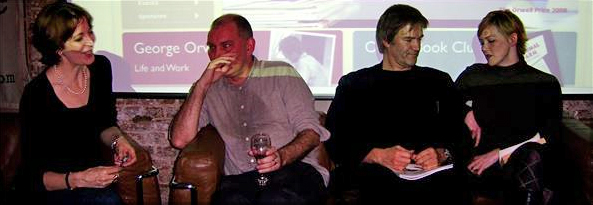
Gavin Freeguard: Orwell, ID Cards, the Citizen and the State

A brief summary of the Orwell Prize 2008 Launch Debate.

‘Nosey Parker’

Heather Brooke was surprised at the prevalence of CCTV cameras in the UK compared to the US. As a journalist, she said, she always tried to ‘turn the camera around’ on to herself, but ‘as soon as you turn the camera onto the state, you find it completely obstructive’, and contrary to its own ideas of social control. Orwell’s The Lion and the Unicorn, still ‘the best way to understand the English’, argued that the worst thing one could be called was a ‘nosey parker’, which is exactly what the British state now is. She agreed that there is a great dependence on the state in modern Britain, and argued that this was harmful in terms of crime and antisocial behaviour; this monopoly of security led to an abdication of responsibility, with people not intervening in the street because they think to themselves, ‘but that’s the state’s role’. This compared unfavourably with the United States (Heather Brooke being half-American).

‘Will Not Have a Welfare State in 20 Years’

David Goodhart noted Orwell’s history of attacking the hypocrisies of the British left, which he felt was a good subject for an Orwellian critique today. He suggested that most libertarians were on the left, and wanted a huge social state – a ‘perfectly decent aim’ – but they were unwilling to give the state help to do this. This ‘help’, in his opinion, was the introduction of ID cards. ‘If the civil libertarian squeamishness gets to you… [such a state] simply won’t be able to happen.’ ID cards could act as an entitlement to services, a way of reassuring citizens worried about ‘free-riders’ on their taxes; while the practicality of such a scheme was undoubtedly a ‘big question’, there didn’t seem to be anything wrong with the principle. We make ‘massive demands’ on the state: ‘the state in return can reasonably ask for us to hand over some information about ourselves’. In any technologically advanced society, the state must be reasonably strong; Britain ‘will not have a welfare state in 20 years’ if they do not feel their information is safe. The ‘hugely disproportionate’ civil libertarian argument had been present in the ‘absolutely unjustified hysteria’ surrounding the loss of data from Revenue and Customs in the last ten days. Contrary to the malign and malevolent image often painted, the state is ‘essentially benign’ because ‘the state, ultimately, is people’. People’s rights are considerably better protected now than 15 years ago.

‘You Will Be Flagged Up as a Deviant’

Jenni Russell was troubled by the fact that it was those opposing ID cards who had to make their case, rather than those in favour of them. Proponents had to make the case because of the fundamental change in the relationship between citizen and state that would result. In the four main areas where ID cards were said to be beneficial, identity was not the problem: with terrorism, it was intention and not identity; with fraud, it was again intention, with only 2% of fraud occurring due to identity theft; with crime, it was proof and not identity that posed a problem for police; and viability remained a serious concern, with most experts saying there was no evidence that Britain would be able to operate such a complex computer system. Taking child protection and the ContactPoint system as an example, she said that the problem faced was one of getting people to do things and respond to crises, not information. She was concerned by the idea that information collection would solve problems: ‘I don’t see that it will improve business, or lives, or safety.’ Contrary to David Goodhart, she argued that the issue did not divide along party lines, but that ‘virtuous individuals’ of all backgrounds trotted out the line that they had nothing to fear because the state was essentially benign. This is ‘a very naïve view of the way power changes people’s behaviour’. After passionately relating a number of examples – the diabetic man having a fit on a bus in Leeds who was tasered and arrested, the M1 protesters this April whose homes were searched and property confiscated (and yet to be returned), the IPCC report into the de Menezes shooting – she suggested that databases would highlight anyone standing out in any way: ‘you will be flagged up as a deviant, because that’s what computer systems do’. ‘We cannot trust the government of the day to be the guardians of public morality.’

‘Beyond the Competence of the Government’

Nick Cohen was against ID cards primarily on the grounds of practicality: they are ‘beyond the competence of the government… they simply won’t be able to do it’. When similar information technology schemes had failed, they had affected those on the margins of society the most. He accepted that if ID cards worked, there would be many benefits, and that those wanting to implement the scheme were not wicked people, but were swept up in the IT industry: ‘Orwell would have mocked those who can’t see the difference between Gordon Brown and Joseph Stalin.’ The information that would be held had always been held: the fundamental, and worrying, difference with the proposed scheme was that all of this information would no longer be in separate piles, but in one system. If such a scheme failed, it would be affect, and be obvious to, everyone, and the trouble for the state was not that it was too powerful, but too incompetent. On CCTV cameras, he noted that, against all expectations, people had become more exhibitionist: strangely, the more information about us that is widely available, the worse we behave. Nick Cohen also warned against the temptation to ask, ‘what would Orwell think?’ By ‘robbing his grave’, we ignore the fact that Orwell, like all great writers, contains multitudes. Nevertheless, it was possible to see two sides of Orwell relevant to this debate – the first despising the susceptibility of the middle classes to ‘going along with’ totalitarianism, and the second the romanticism of English decency, even though this view as applied to the working classes had declined in recent years (‘in three generations, we’ve gone from the British working classes as being seen as the salt of the earth to them being the scum of the earth’). He did admit this, however: ‘I want ID cards to go ahead because it’ll keep me in work for years.’