Search Results for: george-orwell/by-orwell/essays-and-other-works/you-and-the-atom-bomb

Resources

We hope teachers will find the Orwell Youth Prize a valuable way of introducing students to writing independently, as well as Orwell’s own work. But there are many other ways of using Orwell in the classroom.

Whatever your subject  – politics, English, history, citizenship, drama to name but a few – whatever the age group – the Orwell Foundation website also has a wealth of resources about Orwell and his work. Over the year’s, we’ve also produced a range of resources to accompany our Youth Prize themes. These are available free to everyone.

Our resources include works by George Orwell, works about George Orwell and video of events run by the Orwell Prize on politics and literature. Below we provide a useful guide to material that might be of particular interest in the classroom; much more is available through the publishers of Orwell, Penguin and Harvill Secker, and the works below are reproduced under copyright of them and the Orwell Estate and with their kind permission.

Works by Orwell

We have dedicated webpages for each of Orwell’s six novels – Burmese Days, A Clergyman’s Daughter, Keep the Aspidistra Flying, Coming Up for Air and of course Animal Farm and Nineteen Eighty-Four – and three major non-fiction works – Down and Out in Paris and London, The Road to Wigan Pier and Homage to Catalonia. Additionally, a selection of other essays and short works (including poetry) by Orwell is available.

Orwell Daily is our weekly Substack serial, picking out highlights and hidden gems from Orwell’s journalism, letters and diaries and sharing them with subscribers “on the day” that they were first published. Please not that the serial is pitched at adult readers.

Orwell and Journalism

In July 2022, the Orwell Youth Prize teamed up with University College London Special Collections and the Orwell Archive to run a summer school for Year 12s on ‘Orwell and Journalism: In Pursuit of Truth’. As part of this project, we also produced online resources, designed for students in Years 12 and 13, on Orwell’s work as a journalist and how his life experiences informed his work.

The written resource includes materials from the Orwell Archive, while the short film includes background about Orwell’s life, journalism and writing style, as well as insights from contemporary journalists.

Events and films

Many of our Orwell Foundation events based on Orwell’s life and work and might be useful: we keep a library of free-to-view recordings on our YouTube.

The Orwell Youth Prize also filmed our own exclusive interview with Richard Blair, which you can see here. Additionally, there are events based on themes Orwell wrote about and many events discussing different aspects of politics and society. In 2020, we also created a new resource on “Orwell and Empire” to accompany Dr Tristram Hunt’s Orwell Memorial Lecture.

Orwell in the Classroom

Below are a few examples of works, or combinations of works, which could work particularly well in the classroom or workshops. They have been selected based on the depth of what we have available, but also the sorts of exercises that they could be used for (e.g. comparing source material with the finished product) and curriculum relevance.

Individual essays that could prompt discussion – a few suggestions

Orwell wrote a number of compelling, accessible essays about language and literature: what do we think of Orwell’s rules? What should the role of literature be?

Eyewitness/descriptive essays: how does Orwell use imagery and other techniques?

Orwell’s essays about politics and ideas (these could be particularly useful in 20th century history – WWII; The Cold War; decolonization etc):

He was also a master at writing about the particular to make a more general point:

Other:

Reviews of authors on the curriculum

Orwell’s best-known pieces of criticism include his essays  on Charles Dickens and Rudyard Kipling; lesser-known reviews include an essay on W. B. Yeats.

Works about particular novels

We have a wealth of background material on all of Orwell’s works, many of which are curriculum stalwarts.

  • for Nineteen Eighty-Four we have Orwell’s essays about language, politics and culture, works by others adapting it, reviews and analysis which could all give a fresh perspective
  • for Animal Farm we have essays concerned with similar themes, Orwell’s proposed prefaces, reviews, analysis and the stories behind the rejections and adaptations

Related works by others

We have pieces about other works contemporary to Orwell. For example, how does Orwell’s reportage in Down and Out (e.g.) compare to other similar works? How was it received by similar authors? And how do Orwell’s dystopias/representations of politics compare to others? (Not least those, like Zamyatin and Koestler, whose works he reviewed.)

We have some material on adaptations. How have others adapted Orwell and his work? For example, Mike Radford and the BBC on Nineteen Eighty Four, Chris Durlacher on adapting Orwell’s life, the story about the cartoon film of Animal Farm. How would you adapt Orwell?

And we have pieces by those inspired by Orwell. How have others followed in Orwell’s footsteps? For example, Emma Larkin in Burma, Stephen Armstrong and others to Wigan. How would you approach a similar project?

The Diaries

For historical source analysis – especially World War II – we have Orwell’s 1938-42 diaries. These also include other interesting contemporary sources, or links to them, such as a public information leaflet on masking windows in July 1939. Most striking are the newspaper articles Orwell references (and which the Diaries blog includes) in the approach to war, summer 1939, e.g. the surprise as the Nazi Soviet Pact is signed in August 1939.

These could help pupils improve their reading of historical sources, contribute to their historical understanding and be used to stimulate wider discussion. Orwell’s diaries can also be read as preparatory work for his longer essays and work, which could be an engaging way of comparing rough drafts with finished products.

For instance, The Road to Wigan Pier diary and Orwell’s other notes (e.g. Barnsley) were obviously kept with The Road to Wigan Pier in mind. Orwell’s Morocco diary (September 1938 to March 1939, part of the 1938-42 diaries) provides the basis for the essay ‘Marrakech’, while the Hop-Picking diaries are used for Down and Out in Paris and London, A Clergyman’s Daughter and essays including ‘Hop-picking’, ‘A Day in the Life of a Tramp’ and ‘The Spike’ (and the links from the Hop-Picking blog include newsreel and other materials).

A simple question would be: how does Orwell turn this material into essays and books? More complex questions might touch on the motivations, ethics and effects of this editing is. This extract from chapter one of Wigan Pier could be a starting point, as is this Observer article, which considers Orwell’s fact and fiction, and articles by Orwell winners, Timothy Garton Ash and Neal Ascherson on journalist Ryszard Kapuściński.

English Language Practice Papers

We have prepared these GCSE AQA-style exam practice papers to give you a helping hand – and to promote the Orwell Youth Prize (registered charity 1156494).

For teachers

Whatever your subject  – politics, English, history, citizenship, drama to name but a few – whatever the age group you teach – the Orwell Foundation website has a wealth of resources. These are available free to everyone, regardless of whether you or your school are currently involved with the Youth Prize. If you are interested in learning more about our workshops in schools, please get in contact with the administrator at admin@orwellyouthprize.co.uk.

Our resources include works by George Orwell, works about George Orwell and video of events run by the Orwell Prize on politics and literature. Below we provide a useful guide to material that might be of particular interest in the classroom; much more is available through the publishers of Orwell, Penguin and Harvill Secker, and the works below are reproduced under copyright of them and the Orwell Estate and with their kind permission.

Works by Orwell

There is a dedicated webpage for each of Orwell’s six novels – Burmese Days, A Clergyman’s Daughter, Keep the Aspidistra Flying, Coming Up for Air and of course Animal Farm and Nineteen Eighty-Four – and three major non-fiction works – Down and Out in Paris and London, The Road to Wigan Pier and Homage to Catalonia.

Additionally, a selection of other essays and short works (including poetry) by Orwell is available.

There are also three blogs of diaries written by Orwell:

  • 1938-42, includes eyewitness accounts of the Blitz and the run up to WWII (as well as Orwell’s time in Morocco and his experiences of keeping animals and growing vegetables…)
  • Hop-picking (1931), follows some of Orwell’s tramping exploits and his experience of picking hops in Kent, which many urban workers and their families would do in the summer
  • The Road to Wigan Pier (1936), includes Orwell’s research for the book of the same name

Works about Orwell

We have links to analysis, reviews and other material based on Orwell’s life and work; the most relevant to individual novels and diaries should already be linked to from the relevant novel and diary pages.

Orwell Prize events

Many of our Orwell Prize events based on Orwell’s life and work and might be useful. These include:

The Orwell Youth Prize also filmed our own exclusive interview with Richard Blair, which you can see here. Additionally, there are events based on themes Orwell wrote about (such as 2012’s ‘Poverty then and now, Orwell and his successors’), events about political writing more generally (such as ‘Autopsy of a Story’ with three shortlisted journalists dissecting their work and debates like ‘What makes a good political novel?’ with a critic and political novelists), and many events discussing different aspects of politics and society.

Below are a few examples of works, or combinations of works, which could work particularly well in the classroom or workshops. They have been selected based on the depth of what we have available, but also the sorts of exercises that they could be used for (e.g. comparing source material with the finished product) and curriculum relevance.

The Diaries

For historical source analysis – especially World War II – we have Orwell’s 1938-42 diaries. These also include other interesting contemporary sources, or links to them, such as a public information leaflet on masking windows in July 1939. Most striking are the newspaper articles Orwell references (and which the Diaries blog includes) in the approach to war, summer 1939, e.g. the surprise as the Nazi Soviet Pact is signed in August 1939.

Thesecould help pupils improve their reading of historical sources, contribute to their historical understanding and be used to stimulate wider discussion. Orwell’s diaries can also be read as preparatory work for his longer essays and work, which could be an engaging way of comparing rough drafts with finished products.

For instance, The Road to Wigan Pier diary and Orwell’s other notes (e.g. Barnsley) were obviously kept with The Road to Wigan Pier in mind. Orwell’s Morocco diary (September 1938 to March 1939, part of the 1938-42 diaries) provides the basis for the essay ‘Marrakech’, while the Hop-Picking diaries are used for Down and Out in Paris and London, A Clergyman’s Daughter and essays including ‘Hop-picking’, ‘A Day in the Life of a Tramp’ and ‘The Spike’ (and the links from the Hop-Picking blog include newsreel and other materials).

A simple question would be: how does Orwell turn this material into essays and books? More complex questions might touch on the motivations, ethics and effects of this editing is. This extract from chapter one of Wigan Pier could be a starting point, as is this Observer article, which considers Orwell’s fact and fiction, and articles by Orwell winners, Timothy Garton Ash and Neal Ascherson on journalist Ryszard Kapuściński.

Individual essays that could prompt discussion – a few suggestions

Orwell wrote a number of compelling, accessible essays about language and literature: what do we think of Orwell’s rules? What should the role of literature be?

Eyewitness/descriptive essays: how does Orwell use imagery and other techniques?

Orwell’s essays about politics and ideas (these could be particularly useful in 20th century history – WWII; The Cold War; decolonization etc):

He was also a master at writing about the particular to make a more general point:

Other:

Reviews of authors on the curriculum

Orwell’s best-known pieces of criticism include his essays  on Charles Dickens and Rudyard Kipling; lesser-known reviews include an essay on W. B. Yeats.

Works about particular novels

We have a wealth of background material on all of Orwell’s works, many of which are curriculum stalwarts.

  • for Nineteen Eighty-Four we have Orwell’s essays about language, politics and culture, works by others adapting it, reviews and analysis which could all give a fresh perspective
  • for Animal Farm we have essays concerned with similar themes, Orwell’s proposed prefaces, reviews, analysis and the stories behind the rejections and adaptations

Related works by others

We have pieces about other works contemporary to Orwell. For example, how does Orwell’s reportage in Down and Out (e.g.) compare to other similar works? How was it received by similar authors? And how do Orwell’s dystopias/representations of politics compare to others? (Not least those, like Zamyatin and Koestler, whose works he reviewed.)

We have some material on adaptations. How have others adapted Orwell and his work? For example, Mike Radford and the BBC on Nineteen Eighty Four, Chris Durlacher on adapting Orwell’s life, the story about the cartoon film of Animal Farm. How would you adapt Orwell?

And we have pieces by those inspired by Orwell. How have others followed in Orwell’s footsteps? For example, Emma Larkin in Burma, Stephen Armstrong and others to Wigan. How would you approach a similar project?

English Language Practice Papers

We have prepared these GCSE AQA-style exam practice papers to give you a helping hand – and to promote the Orwell Youth Prize (registered charity 1156494).

Scripts – which would allow performance

Many radio scripts by Orwell exist, such as adaptations of Animal Farm and various fairy tales. These can be found in the Orwell Archive and in editions of the Complete Works.

However, online we have a Christmas edition of his radio poetry programme, Voice as well as his own poetry. We also have a short one scene piece by a young Orwell called ‘Free Will’. There is also one chapter of A Clergyman’s Daughter, set in Trafalgar Square, which is written entirely in dramatic form.

Subscribe to our mailing list

* indicates required


Animal Farm

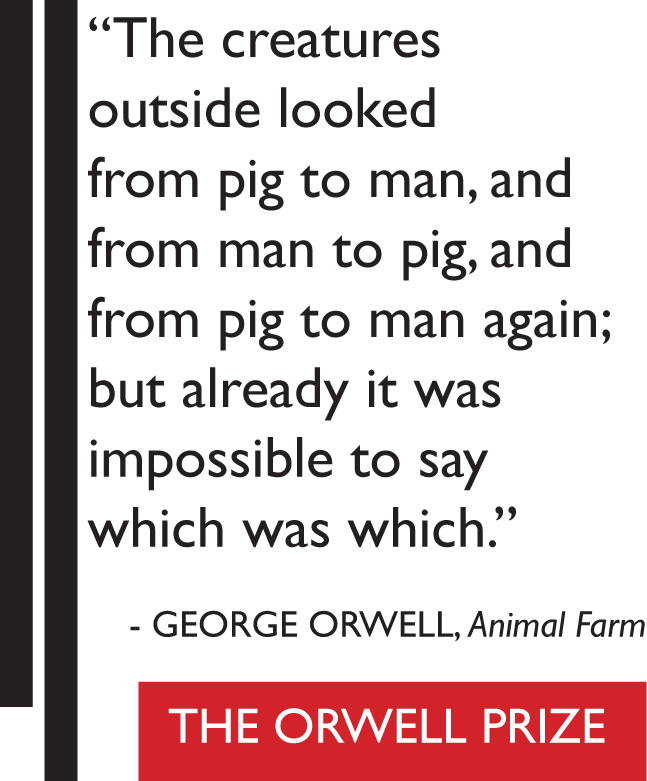
Today we celebrate the anniversary of the publication of Animal Farm which was first available in 1945. In the same month Orwell began work as the Literary Editor of The Tribune, he also began writing one of the works his name would be most remembered for. The satirical novel chronicles the revolution of animals against Mr Jones at Manor Farm; an allegory on the Soviet regime. This year we added the preface to the Ukranian edition of Animal Farm to our website. We also have a special Animal Farm page with links to much more including the first chapter, the original preface and writers pieces on how the book has influenced them. To celebrate today our online fans have been tweeting their first memory of reading the classic and we have been posting quotes from the work on our Facebook page. The most popular quote today was, “The creatures outside looked from pig to man,and from man to pig,and from pig to man again;but it was already impossible to say which was which”.

The Orwell Project

Next week The Orwell Project will be hosting an event at the Camden Arts Centre. The project is working with artists, writers and performers to create new work responding to or inspired by Orwell’s minor work, life and musings inspired by his essay ‘British Cookery’. In 1946, the British Council commissioned Orwell to write the essay in which he presented six of his own recipes, exploring class-distinctive eating, championing local produce and the home kitchen as the beating heart of British cuisine. A eulogy to sugar, fats and the three-course breakfast, the resulting essay was considered extravagant and anachronistic in the context of post-war rationing, and went unpublished, as it remains to this day. The Orwell Project say; “Distinct from Orwell’s familiar dystopian reputation, there is a wealth of idiosyncratic observation, epicureanism and cultural questioning across his non-fiction. His essays, letters and journalism explore pop culture, art criticism, entertainment, broadcast, class and society in a seminal period for state revision and the rise of media; Bevin published his bill on the NHS, the coal industry nationalised, new town centres opened and TV crept slowly into British homes.” From Autumn 2012 they will be presenting a brand new series of events and projects exploring fresh, unfamiliar perspectives on the influence of one of our most celebrated writers.

From the archive

This week we observe the anniversary of the death of the writer H.G. Wells who was a contemporary of Orwell’s he references in many of his essays. You can read ‘You and the atom bomb’, ‘Can socialists be happy?’ and ‘Notes on Nationalism’ as well as many more on our website.

From elsewhere

  • This week Peter Beaumont, winner of the 2007 Orwell Prize for Journalism, had a piece in the Guardian about the implications of the Julian Assange asylum row
  • We spotted a wonderful feature in the Telegraph on a writer’s journey to trace her ancestory in Burma with the aid of her Mother’s diaries
  • ABC’s Lateline posted a video of Anatol Leiven, the first winner of The Orwell Prize for books and also longlisted for this year’s prize, speaking about the developments of Syria’s civil war
  • Today Publishers Weekly posted The Troubled History Behind George Orwell’s Complete Works by Peter Davison
  • The New York Times have published a review of the American edition of ‘Diaries’ with a forward from Christopher Hitchens
  • The wartime diaries

    This week’s entries were published on 14th, 18th and 19th August 1942. Next week’s entries will be published on 22nd and 25th August 1942. Don’t forget our other Orwell Diary blogs: his Hop-Picking Diary and The Road to Wigan Pier Diary. You can sign up to our newsletter If you’ve got any suggestions about our website(s), we’d love to hear from you – email us on katriona.lewis@mediastandardstrust.org. You can also follow us on Twitter and like us on Facebook.

    Poverty and Political Blogging – Videos from Cheltenham

    We thoroughly enjoyed holding events at The Times Cheltenham Literature Festival for the first time – and we hope that, via video, you enjoy them too.

    You can watch our ‘Victorian Values’ debate, with social historian Jose Harris, author of Chavs Owen Jones and co-author of Jilted Generation Shiv Malik, chaired by Julia Wheeler, on our website and on our YouTube Channel. Our panellists look at the concepts of the deserving and undeserving poor, social mobility, and poverty through the ages – and much more besides – in an excellent hour of discussion.
    We also have video of this year’s Orwell Prize for Blogs winner, Graeme Archer, and previously longlisted Oliver Kamm of The Times, in another great conversation about political blogging. Is the left or right better at group blogging? Has blogging’s style ‘infected’ national newspapers? And would preventing anonymous commenting lead to higher quality, polite discussion? Watch Graeme and Oliver to see what they thought.

    Orwell Prize 2012 Launch

    It’s that time of year again – almost. We’ll be announcing full details of this year’s Orwell Prize launch next week. But you might want to keep 9 November free…

    George Orwell Memorial Lecture 2011

    Alan Rusbridger, editor-in-chief of Guardian News and Media, will be speaking on ‘Hacking away at the truth: an investigation and its consequences’ on 10th November at 6pm. Email events@bbk.ac.uk to book a free place, or visit our website for more information.
    The Orwell Lecture is organised by the Orwell Trust with Birkbeck College, University of London.

    From the archive

    Orwell’s ‘You and the Atom Bomb’ was first published this week in 1945, and is new to our website. The essay imagines a world carved up into three superstates with the threat of nuclear annihilation keeping them in perpetual war – not unlike Orwell’s Nineteen Eighty-Four. Other notable dates this week include the birth of Samuel Taylor Coleridge – whose Xanadu Orwell considers in his essay, ‘Pleasure Spots’ – and Trafalgar Day, Orwell writing of Trafalgar and patriotism in ‘The Lion and the Unicorn’.

    From elsewhere

    The Wartime Diaries

    The next entry will be published on 14th March.

    The Hop-Picking Diaries

    The final entry was published on 8th October.

    The Wigan Pier Diaries

    The final entry was published on 25th March.
    If you’ve got any suggestions about our website(s), we’d love to hear from you – email us on gavin.freeguard@mediastandardstrust.org or follow us on Twitter.

    And you can subscribe to this newsletter via email.

    Essays and other works

    The Orwell Foundation is delighted to make available a selection of essays, articles, sketches, reviews and scripts written by Orwell.

    This material remains under copyright in some jurisdictions, including the US, and is reproduced here with the kind permission of the Orwell Estate. All queries regarding rights should be addressed to the Estate’s representatives at A. M. Heath literary agency.

    The Orwell Foundation is an independent charity – please consider making a donation to help us maintain these resources for readers everywhere.

    Sketches For Burmese Days

    Essays and articles

    Reviews by Orwell

    Letters and other material

    External links are being provided for informational purposes only; they do not constitute an endorsement or an approval by The Orwell Foundation of any of the products, services or opinions of the corporation or organisation or individual. The Foundation bears no responsibility for the accuracy, legality or content of the external site or for that of subsequent links. Contact the external site for answers to questions regarding its content.