Search Results for: george-orwell/by-orwell/burmese-days

Resources

We hope teachers will find the Orwell Youth Prize a valuable way of introducing students to writing independently, as well as Orwell’s own work. But there are many other ways of using Orwell in the classroom.

Whatever your subject  – politics, English, history, citizenship, drama to name but a few – whatever the age group – the Orwell Foundation website also has a wealth of resources about Orwell and his work. Over the year’s, we’ve also produced a range of resources to accompany our Youth Prize themes. These are available free to everyone.

Our resources include works by George Orwell, works about George Orwell and video of events run by the Orwell Prize on politics and literature. Below we provide a useful guide to material that might be of particular interest in the classroom; much more is available through the publishers of Orwell, Penguin and Harvill Secker, and the works below are reproduced under copyright of them and the Orwell Estate and with their kind permission.

Works by Orwell

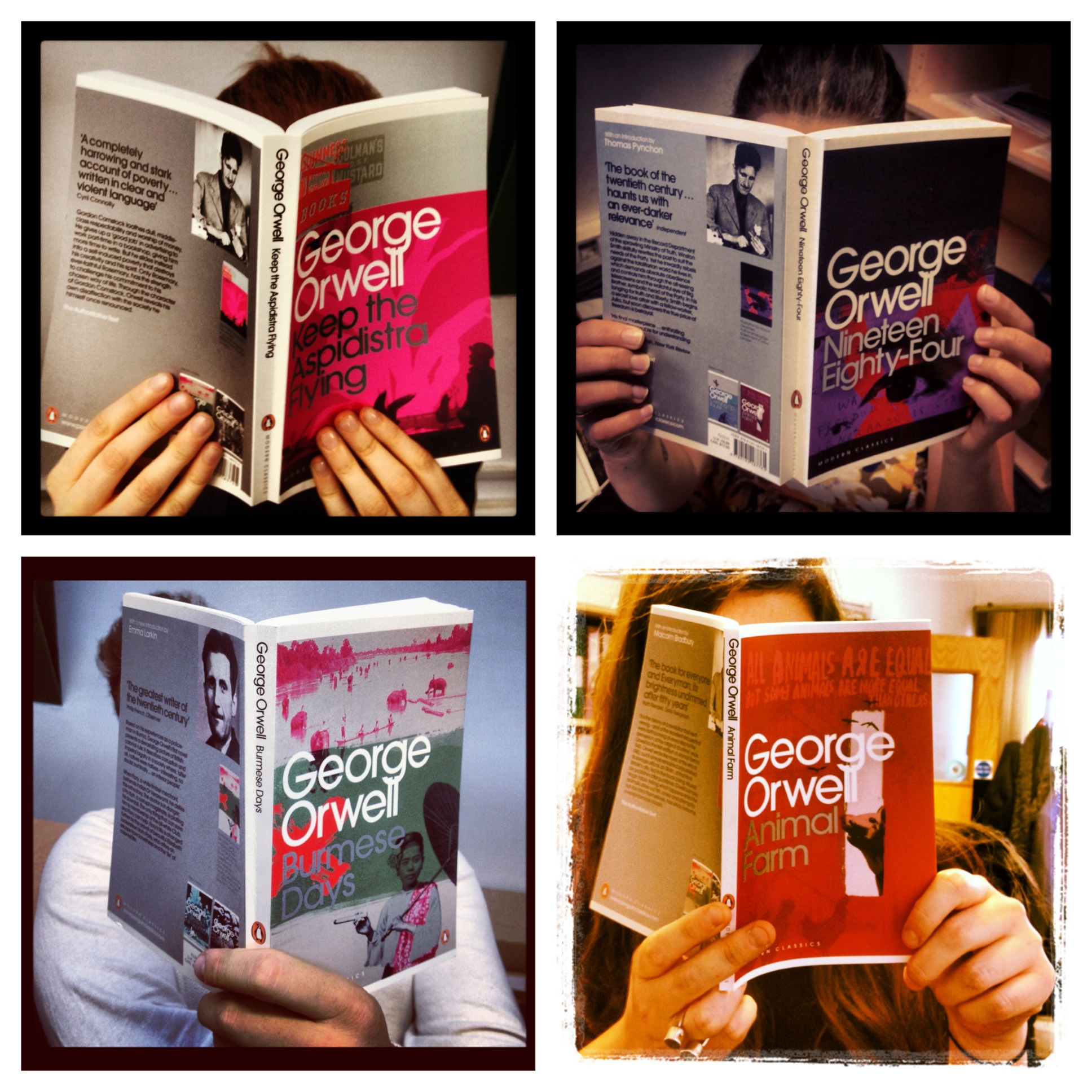
We have dedicated webpages for each of Orwell’s six novels – Burmese Days, A Clergyman’s Daughter, Keep the Aspidistra Flying, Coming Up for Air and of course Animal Farm and Nineteen Eighty-Four – and three major non-fiction works – Down and Out in Paris and London, The Road to Wigan Pier and Homage to Catalonia. Additionally, a selection of other essays and short works (including poetry) by Orwell is available.

Orwell Daily is our weekly Substack serial, picking out highlights and hidden gems from Orwell’s journalism, letters and diaries and sharing them with subscribers “on the day” that they were first published. Please not that the serial is pitched at adult readers.

Orwell and Journalism

In July 2022, the Orwell Youth Prize teamed up with University College London Special Collections and the Orwell Archive to run a summer school for Year 12s on ‘Orwell and Journalism: In Pursuit of Truth’. As part of this project, we also produced online resources, designed for students in Years 12 and 13, on Orwell’s work as a journalist and how his life experiences informed his work.

The written resource includes materials from the Orwell Archive, while the short film includes background about Orwell’s life, journalism and writing style, as well as insights from contemporary journalists.

Events and films

Many of our Orwell Foundation events based on Orwell’s life and work and might be useful: we keep a library of free-to-view recordings on our YouTube.

The Orwell Youth Prize also filmed our own exclusive interview with Richard Blair, which you can see here. Additionally, there are events based on themes Orwell wrote about and many events discussing different aspects of politics and society. In 2020, we also created a new resource on “Orwell and Empire” to accompany Dr Tristram Hunt’s Orwell Memorial Lecture.

Orwell in the Classroom

Below are a few examples of works, or combinations of works, which could work particularly well in the classroom or workshops. They have been selected based on the depth of what we have available, but also the sorts of exercises that they could be used for (e.g. comparing source material with the finished product) and curriculum relevance.

Individual essays that could prompt discussion – a few suggestions

Orwell wrote a number of compelling, accessible essays about language and literature: what do we think of Orwell’s rules? What should the role of literature be?

Eyewitness/descriptive essays: how does Orwell use imagery and other techniques?

Orwell’s essays about politics and ideas (these could be particularly useful in 20th century history – WWII; The Cold War; decolonization etc):

He was also a master at writing about the particular to make a more general point:

Other:

Reviews of authors on the curriculum

Orwell’s best-known pieces of criticism include his essays  on Charles Dickens and Rudyard Kipling; lesser-known reviews include an essay on W. B. Yeats.

Works about particular novels

We have a wealth of background material on all of Orwell’s works, many of which are curriculum stalwarts.

  • for Nineteen Eighty-Four we have Orwell’s essays about language, politics and culture, works by others adapting it, reviews and analysis which could all give a fresh perspective
  • for Animal Farm we have essays concerned with similar themes, Orwell’s proposed prefaces, reviews, analysis and the stories behind the rejections and adaptations

Related works by others

We have pieces about other works contemporary to Orwell. For example, how does Orwell’s reportage in Down and Out (e.g.) compare to other similar works? How was it received by similar authors? And how do Orwell’s dystopias/representations of politics compare to others? (Not least those, like Zamyatin and Koestler, whose works he reviewed.)

We have some material on adaptations. How have others adapted Orwell and his work? For example, Mike Radford and the BBC on Nineteen Eighty Four, Chris Durlacher on adapting Orwell’s life, the story about the cartoon film of Animal Farm. How would you adapt Orwell?

And we have pieces by those inspired by Orwell. How have others followed in Orwell’s footsteps? For example, Emma Larkin in Burma, Stephen Armstrong and others to Wigan. How would you approach a similar project?

The Diaries

For historical source analysis – especially World War II – we have Orwell’s 1938-42 diaries. These also include other interesting contemporary sources, or links to them, such as a public information leaflet on masking windows in July 1939. Most striking are the newspaper articles Orwell references (and which the Diaries blog includes) in the approach to war, summer 1939, e.g. the surprise as the Nazi Soviet Pact is signed in August 1939.

These could help pupils improve their reading of historical sources, contribute to their historical understanding and be used to stimulate wider discussion. Orwell’s diaries can also be read as preparatory work for his longer essays and work, which could be an engaging way of comparing rough drafts with finished products.

For instance, The Road to Wigan Pier diary and Orwell’s other notes (e.g. Barnsley) were obviously kept with The Road to Wigan Pier in mind. Orwell’s Morocco diary (September 1938 to March 1939, part of the 1938-42 diaries) provides the basis for the essay ‘Marrakech’, while the Hop-Picking diaries are used for Down and Out in Paris and London, A Clergyman’s Daughter and essays including ‘Hop-picking’, ‘A Day in the Life of a Tramp’ and ‘The Spike’ (and the links from the Hop-Picking blog include newsreel and other materials).

A simple question would be: how does Orwell turn this material into essays and books? More complex questions might touch on the motivations, ethics and effects of this editing is. This extract from chapter one of Wigan Pier could be a starting point, as is this Observer article, which considers Orwell’s fact and fiction, and articles by Orwell winners, Timothy Garton Ash and Neal Ascherson on journalist Ryszard Kapuściński.

English Language Practice Papers

We have prepared these GCSE AQA-style exam practice papers to give you a helping hand – and to promote the Orwell Youth Prize (registered charity 1156494).

For teachers

Whatever your subject  – politics, English, history, citizenship, drama to name but a few – whatever the age group you teach – the Orwell Foundation website has a wealth of resources. These are available free to everyone, regardless of whether you or your school are currently involved with the Youth Prize. If you are interested in learning more about our workshops in schools, please get in contact with the administrator at admin@orwellyouthprize.co.uk.

Our resources include works by George Orwell, works about George Orwell and video of events run by the Orwell Prize on politics and literature. Below we provide a useful guide to material that might be of particular interest in the classroom; much more is available through the publishers of Orwell, Penguin and Harvill Secker, and the works below are reproduced under copyright of them and the Orwell Estate and with their kind permission.

Works by Orwell

There is a dedicated webpage for each of Orwell’s six novels – Burmese Days, A Clergyman’s Daughter, Keep the Aspidistra Flying, Coming Up for Air and of course Animal Farm and Nineteen Eighty-Four – and three major non-fiction works – Down and Out in Paris and London, The Road to Wigan Pier and Homage to Catalonia.

Additionally, a selection of other essays and short works (including poetry) by Orwell is available.

There are also three blogs of diaries written by Orwell:

  • 1938-42, includes eyewitness accounts of the Blitz and the run up to WWII (as well as Orwell’s time in Morocco and his experiences of keeping animals and growing vegetables…)
  • Hop-picking (1931), follows some of Orwell’s tramping exploits and his experience of picking hops in Kent, which many urban workers and their families would do in the summer
  • The Road to Wigan Pier (1936), includes Orwell’s research for the book of the same name

Works about Orwell

We have links to analysis, reviews and other material based on Orwell’s life and work; the most relevant to individual novels and diaries should already be linked to from the relevant novel and diary pages.

Orwell Prize events

Many of our Orwell Prize events based on Orwell’s life and work and might be useful. These include:

The Orwell Youth Prize also filmed our own exclusive interview with Richard Blair, which you can see here. Additionally, there are events based on themes Orwell wrote about (such as 2012’s ‘Poverty then and now, Orwell and his successors’), events about political writing more generally (such as ‘Autopsy of a Story’ with three shortlisted journalists dissecting their work and debates like ‘What makes a good political novel?’ with a critic and political novelists), and many events discussing different aspects of politics and society.

Below are a few examples of works, or combinations of works, which could work particularly well in the classroom or workshops. They have been selected based on the depth of what we have available, but also the sorts of exercises that they could be used for (e.g. comparing source material with the finished product) and curriculum relevance.

The Diaries

For historical source analysis – especially World War II – we have Orwell’s 1938-42 diaries. These also include other interesting contemporary sources, or links to them, such as a public information leaflet on masking windows in July 1939. Most striking are the newspaper articles Orwell references (and which the Diaries blog includes) in the approach to war, summer 1939, e.g. the surprise as the Nazi Soviet Pact is signed in August 1939.

Thesecould help pupils improve their reading of historical sources, contribute to their historical understanding and be used to stimulate wider discussion. Orwell’s diaries can also be read as preparatory work for his longer essays and work, which could be an engaging way of comparing rough drafts with finished products.

For instance, The Road to Wigan Pier diary and Orwell’s other notes (e.g. Barnsley) were obviously kept with The Road to Wigan Pier in mind. Orwell’s Morocco diary (September 1938 to March 1939, part of the 1938-42 diaries) provides the basis for the essay ‘Marrakech’, while the Hop-Picking diaries are used for Down and Out in Paris and London, A Clergyman’s Daughter and essays including ‘Hop-picking’, ‘A Day in the Life of a Tramp’ and ‘The Spike’ (and the links from the Hop-Picking blog include newsreel and other materials).

A simple question would be: how does Orwell turn this material into essays and books? More complex questions might touch on the motivations, ethics and effects of this editing is. This extract from chapter one of Wigan Pier could be a starting point, as is this Observer article, which considers Orwell’s fact and fiction, and articles by Orwell winners, Timothy Garton Ash and Neal Ascherson on journalist Ryszard Kapuściński.

Individual essays that could prompt discussion – a few suggestions

Orwell wrote a number of compelling, accessible essays about language and literature: what do we think of Orwell’s rules? What should the role of literature be?

Eyewitness/descriptive essays: how does Orwell use imagery and other techniques?

Orwell’s essays about politics and ideas (these could be particularly useful in 20th century history – WWII; The Cold War; decolonization etc):

He was also a master at writing about the particular to make a more general point:

Other:

Reviews of authors on the curriculum

Orwell’s best-known pieces of criticism include his essays  on Charles Dickens and Rudyard Kipling; lesser-known reviews include an essay on W. B. Yeats.

Works about particular novels

We have a wealth of background material on all of Orwell’s works, many of which are curriculum stalwarts.

  • for Nineteen Eighty-Four we have Orwell’s essays about language, politics and culture, works by others adapting it, reviews and analysis which could all give a fresh perspective
  • for Animal Farm we have essays concerned with similar themes, Orwell’s proposed prefaces, reviews, analysis and the stories behind the rejections and adaptations

Related works by others

We have pieces about other works contemporary to Orwell. For example, how does Orwell’s reportage in Down and Out (e.g.) compare to other similar works? How was it received by similar authors? And how do Orwell’s dystopias/representations of politics compare to others? (Not least those, like Zamyatin and Koestler, whose works he reviewed.)

We have some material on adaptations. How have others adapted Orwell and his work? For example, Mike Radford and the BBC on Nineteen Eighty Four, Chris Durlacher on adapting Orwell’s life, the story about the cartoon film of Animal Farm. How would you adapt Orwell?

And we have pieces by those inspired by Orwell. How have others followed in Orwell’s footsteps? For example, Emma Larkin in Burma, Stephen Armstrong and others to Wigan. How would you approach a similar project?

English Language Practice Papers

We have prepared these GCSE AQA-style exam practice papers to give you a helping hand – and to promote the Orwell Youth Prize (registered charity 1156494).

Scripts – which would allow performance

Many radio scripts by Orwell exist, such as adaptations of Animal Farm and various fairy tales. These can be found in the Orwell Archive and in editions of the Complete Works.

However, online we have a Christmas edition of his radio poetry programme, Voice as well as his own poetry. We also have a short one scene piece by a young Orwell called ‘Free Will’. There is also one chapter of A Clergyman’s Daughter, set in Trafalgar Square, which is written entirely in dramatic form.

Subscribe to our mailing list

* indicates required


The Real George Orwell and the BBC

It’s been a phenomenal week for the Prize and Orwell fans everywhere. The inaugural launch of George Orwell Day on Monday 21st spawned a mass celebration of his works. The Orwell Prize ran a read-in of ‘Politics and the English Language’ by offering the consummate essay to read on our website. While Penguin launched their new covers designed by David Pearson which included a special release of the essay in pamphlet form for just 99p. Lots of newspapers got into the spirit of the event; Shami Chakrabarti told us what she thinks Orwell would have written about today, Prospect Magazine celebrated with their best articles on Orwell, the New Statesman looked back on their encounters with Orwell and Stuart Jeffries of the Guardian asked What would Orwell have made of the world in 2013? The Prize also made friends with a few new fans including BBC 6 Music DJ Lauren Laverne who pointed out to us that her twitter biography quotes Orwell. The excitement continues with the BBC Radio 4 season of ‘The Real George Orwell’ which will run on into February with programmes on Animal Farm, Homage to Catalonia, Down and Out in London and Paris and Nineteen Eighty-Four as well as some very special biographical dramatisations of his life. There’s lots of information as well as very interesting blog posts and interviews on the BBC website for the season. The next play is aptly on his time in Burma and will broadcast at 2.15pm today.

The Irrawaddy Literary Festival

We’ll be listening to the BBC’s Burma from Burma as the Orwell Prize has now arrived in Rangoon to set up for the first international literary festival here. From Friday we will be disseminating books raised from the ‘Buy a Book for Burma’ campaign, with generous support from our good friends at Penguin Books. We’re bringing along past Prize winner Timothy Garton Ash as well as our Director Jean Seaton to speak on panels at the festival which will include an Orwell lecture as well as talks on censorship and witnessing violence. We’ll be collecting interviews from writers here as well as capturing the essence of Burma and it’s feel for Orwell all these year’s on, to bring back to you soon.

From the archive

To join in with the festival why not have a read of one of the three novels we will be giving out. The first chapters of Animal Farm, Burmese Days and Nineteen Eighty-Four are all available on our website. You can also find Orwell’s two big essays on his time in Burma as a police officer; ‘A Hanging’ and ‘Shooting an Elephant‘.

From elsewhere BBC Special

  • Who was the Real George Orwell? Biographer DJ Taylor speculates on the man himself
  • George Orwell and the BBC by Mark Lawson
  • Animal Farm narrated by Tamsin Greig
  • Homage to Catalonia Part 1 starring Joseph Milne as Eric Blair
  • Burma: a biographical play by Mike Walker
  • George Orwell’s resignation letter to the BBC
  • Aung Sun Suu Kyi on BBC Radio 4 desert island discs
  • The diaries

    Don’t forget our other Orwell Diary blogs: his Wartime Diary, Hop-Picking Diary and The Road to Wigan Pier Diary. You can sign up to our newsletter If you’ve got any suggestions about our website(s), we’d love to hear from you – email us on katriona.lewis@mediastandardstrust.org. You can also follow us on Twitter and like us on Facebook.

    The Orwell Prize and the Green Dragon

    This newsletter was written by Dulcie Lee Last week the Orwell Prize visited The Green Dragon School in Brentford where our Operations Manager held a press conference for 60 nine-year-old delegates on the subject of A day in the life of a journalist. The room was packed with aspiring sports journalists, news reporters and foreign correspondents emerging with very interesting and thoughtful questions. Questions like; where does news come from, how do you start writing a feature, what kinds of different jobs are there for journalists to do and how do I become a journalist? Mr Veazey, the teacher who oversaw the morning, said “It was incredible to have The Orwell Prize visit, the children were so engaged and inspired. It made journalism real for them, explaining the ins and outs of the industry and they are desperate to find out more” After the press conference, the children were eager to discuss what they had learnt; one budding journalist said “I’m going to watch the news more often now!” and several decided they wanted to become a reporter. The nine-year-olds will be using the press conference to support a school project. Mr Veazey told us, “The children are now creating their own magazine, using some of the techniques that were discussed last week.” Only last month, during an episode of Radio 4’s Great Lives, Alan Johnson MP spoke to winner of the 2005 Orwell Prize for Journalism, Matthew Paris, saying “I wish I’d put Orwell on the national curriculum”. During the programme, Mr Johnson recalled purchasing Orwell’s Keep the Aspidistra Flying at age 14 and attributed it as the catalyst for his political awakening. During last year’s Orwell lecture, Alan Rusbridger, editor of The Guardian, also said “I’m pretty sure I wouldn’t have become a journalist were it not for George Orwell.”

    2013 launch

    The launch of the Orwell Prize 2013 – our 20th birthday year – will take place on the evening of Wednesday 24th October at the Frontline Club. There will be a launch debate as well as several exciting announcements about the Orwell Prize in 2013. To reserve your free place RSVP now to katriona.lewis@mediastandardstrust.org

    From the archive

    Yesterday was World Homeless Day. Much of Orwell’s work focused on the working class and homeless people in society and in 1928 and 1929 Orwell wrote three articles as part of ‘An Inquiry into “Civic Progress” in England’. Two of the three articles were ‘A Day in the Life of a Tramp’ and ‘Beggars in London’ in which he discuss the timeless issues surrounding homelessness. Orwell’s experiences of homelessness in London and Paris would lead him to write his book Down and Out in Paris and London four years later. You can read the first chapter of Down and Out in Paris and London here. ‘Shooting an Elephant’, the essay in which Orwell explores an experience from his time in Burma, was broadcast on the BBC Home Service on 12th October 1948. The essay, which is available on our website, became one of a collection of Orwell’s works on Burma. As well as ‘A Hanging’, Orwell wrote several preliminary sketches on Burma that would later be used to form his book Burmese Days. You can read the first chapter of the Burmese Days here.

    From elsewhere

  • Camilla Cavendish, 2012 Journalism Prize longlister, has written a fantastic piece for The Times discussing the modern influx of tribal career politicians and their unwillingness to tackle the bigger societal issues
  • 2011 Journalism Prize longlister, Dominic Lawson, wrote an insightful article on the politics surrounding abortion laws for The Independent
  • Yesterday Daniel Finkelstein, 2012 Journalism Prize shortlister, wrote a brilliant piece highlighting the importance of the economy in the next election for The Times
  • The Independent are running a competition to win the top 10 books in the Everyman’s Library, including Orwell’s Nineteen Eighty-Four
  • The wartime diaries

    This week’s entries was published on 10th and 11th October 1942. Next week’s entry will be published on 15th October 1942. Don’t forget our other Orwell Diary blogs: his Hop-Picking Diary and The Road to Wigan Pier Diary. You can sign up to our newsletter If you’ve got any suggestions about our website(s), we’d love to hear from you – email us on katriona.lewis@mediastandardstrust.org. You can also follow us on Twitter and like us on Facebook.

    The Sporting Spirit

    The London 2012 Olympic games has dominated all UK media outlets for the last fortnight. At the time of writing a Journalisted search reveals that since the opening ceremony there have been 6,427 articles published in the national press. We know from letters home to his Mother that the young George Orwell enjoyed sport at school. In fact, Orwell expert Peter Davison says that at that point it is difficult to guage whether he would become internationally famous as a goalkeeper or a writer. In Bernard Crick’s biography George Orwell: A Life he points out that at Orwell’s Prep school, St Cyprians, the academic scores were mixed with success in team sports as if they were seemingly equal importance. He said that ‘this weird synthesis of team spirit and individual competitiveness could truly be said to epitomize the blending of a capitalist and an aristocratic ethic’. Over time Orwell developed his own perspective of parallels between sport and politics. In 1945, three years before the last time London hosted the Olympic games, The Tribune published ‘The Sporting Spirit’ which revealed his repugnance for the evolution of competitive sport; “Serious sport has nothing to do with fair play. It is bound up with hatred, jealousy, boastfulness, disregard of all rules and sadistic pleasure in witnessing violence: in other words it is war minus the shooting.” Peter Davison explores this further in his essay ‘Orwell and Sport’.

    Letchworth 2012

    It gives us great pleasure to announce that we will be returning to the Letchworth Orwell Festival in September for a debate celebrating the 75th anniversary of The Road to Wigan Pier. The subject for discussion is ‘Poverty then and now: Orwell and his successors’ and we are very fortunate to have a wonderful set of speakers. The panel is made up of author of Road to Wigan Pier Revisited, Stephen Armstrong; Dr Michael Sayeau a member of the Board of trustees for the Orwell Archive at UCL; Director of Befriend a Family, Jacqueline Crooks; 2012 Orwell Prize for Books shortlistee Gavin Knight. They will be chaired by Katriona Lewis, Operations Manager of The Orwell Prize. You can see more information about the event and how to book tickets here.

    From the archive

    Orwell’s essay, ‘A hanging’ was first published in The Adelphi in August 1931. The piece is set in Burma where Orwell was stationed as an officer from 1922 and describes the execution of a criminal. Orwell’s experiences in Burma after Eton formed the basis for his 1934 novel Burmese Days. On our website you can find Emma Larkin’s introduction to Burmese Days, Douglas Kerr on Orwell, Kipling and the Empire as well as a video of our own What next for Burma? 2010 launch debate and much much more.

    From elsewhere

  • We had a fantastic response to last week’s guest post by Rangers Tax-Case on ‘writing politics’. Standby for many more guestposts by friends of The Orwell Prize including Stephen Armstrong and Toby Harnden
  • Earlier this week Scottish writer Gerry Hassan wrote a piece in praise of investigative journalism on the football scandal for The Scotsman
  • .

  • This week Orwell Prize for Books longlistee wrote a comment piece for The Guardian on London Mayor Boris Johnson’s mishap with a zip line
  • 2008 winner of The Orwell Prize for Books, Raja Shehadeh celebrated the release of his latest book Occupation Diaries which tells tales of life on the West Bank. You can read a review here
  • Yesterday it was National Book Lovers Day and we received dozens of wonderful tweets from followers telling us their favourite Orwell novel. We were particularly pleased that the usually less noticed Keep the Aspidistra Flying was well sited with a ‘#Comstock!’ tag. Below you can see some of our Media Standards Trust favourites.
  • The wartime diaries

    This week’s entries were published on 7th, 9th, 10th and 12th August 1942. Next week’s entry will be published on 14th, 18th and 19th August 1942. Don’t forget our other Orwell Diary blogs: his Hop-Picking Diary and The Road to Wigan Pier Diary. If you’ve got any suggestions about our website(s), we’d love to hear from you – email us on katriona.lewis@mediastandardstrust.org. You can also follow us on Twitter and like us on Facebook.

    Buxton 2012: Orwell vs. Kipling

      Speakers

      For Orwell;

    • Paul Anderson (journalist, author, academic, editor of Orwell in Tribune: ‘As I Please and other writings 1943-7’)
    • Stuart Evers (Author of ‘Ten Stories about Smoking’ and ‘If This is Home’; book reviewer)
    • For Kipling;

    • Charles Allen (historian, author of Orwell Prize-longlisted ‘Kipling Sahib’)
    • Jan Montefiore (Professor at University of Kent, author of ‘Kipling’ and editor of Kipling’s forthcoming ‘The Man Who Would be King and other stories’)
    • Chaired by Tony Wright (Former MP for Cannock Chase, Professor of Government and Public Policy at UCL, co-editor of Political Quarterly)

    Details

    Both Orwell and Kipling wrote about the British Empire, having both been born in India. Both are known to people who haven’t read a word of their work, whether through Nineteen Eighty-Four or The Jungle Book. Both were intensely political writers, who wrote poetry, prose and for the press. But was Orwell or Kipling the greater writer? Whose work resonates more today? And for whom will you vote after our panel have made their respective cases?

    Links

  • Buxton 2011: Is politics corrupted by corrupted language
  • George Orwell: Burmese Days (1934)
  • George Orwell: Rudyard Kipling (New English Weekly, 1936)
  • George Orwell: Rudyard Kipling (Horizon, 1942)
  • Douglas Kerr: Orwell, Kipling and Empire
  • Video

    Burmese Days

    This week Myanmar democracy advocate and Nobel Peace Prize winner Aung San Suu Kyi became the first non-head of state to address both houses of Britain’s parliament. “We have an opportunity to re-establish true democracy in Burma. It is an opportunity for which we have waited decades,” she said. It is therefore wonderfully appropriate that Orwell’s first novel Burmese Days was published first in the UK 77 years ago on Sunday. Set in a 1920s Burma undergoing waning imperialism, the novel was inspired by Orwell’s time as a police officer there. You can read more about Burmese Days including the first chapter on our website. In 2010 we launch the Prize on the debate What next for Burma? you can watch a video of the event here.

    Buxton Festival 2012

    We’re so excited to be returning to Buxton on 16th July. For 2012 we’ll be taking Paul Anderson, Jan Montifiore, Charles Allen, Tony Wright and Stuart Evers to row about who is the better writer; Orwell or Kipling. You can see full details on our website.

    From the archive

    Since today is Take Your Dog to Work Day. We’re reading Orwell’s essay A hanging. Also set in Burma, the piece describes a scene in which a criminal is executed. Just as they are ready to begin the hanging a dog wonders into the courtyard in front of the crowd; “It was a large woolly dog, half Airedale, half pariah. For a moment it pranced round us, and then, before anyone could stop it, it had made a dash for the prisoner, and jumping up tried to lick his face. Everyone stood aghast, too taken aback even to grab at the dog.” You can read the full piece on our website.

    From elsewhere

  • Congratulations to Paul Lewis for his win at the Online Media Awards for the Best Twitter Feed. Paul was shortlisted for this year’s Orwell Prize for Journalism, you can read his submitted pieces on our website.
  • The Guardian have produced an eBook of Amelia Gentleman’s Orwell Prize winning features.
  • As part of their ‘A brief summary of the short story’ series yesterday The Guardian focused on Rudyard Kipling which might be an especially good read in the lead up to our event at Buxton.

  • The wartime diaries

    This week’s entries were published on 21st and 24th June 1942. Next week’s entry will be published on 26th June 1942. Don’t forget our other Orwell Diary blogs: his Hop-Picking Diary and The Road to Wigan Pier Diary. If you’ve got any suggestions about our website(s), we’d love to hear from you – email us on katriona.lewis@mediastandardstrust.org. You can also follow us on Twitter and like us on Facebook.

    Happy Easter

    Aged eight a young George Orwell wrote to his mother Ida while studying at boarding school during Easter break 100 years ago. “Thank you for that letter you sent me, but I couldent read it somewon tore it up before I red it, so if you had anything you specialy wanted me to know you had better put it in your next letter and I hope that wont get torn up…” We’re very grateful to George Orwell Novels for publishing the letter in full along with a drawing, you can read it here.

    Shortlist announcement

    We will be announcing our shortlists for The Orwell Prize 2012 on 24th April at the University of Westminster. Standby for further details.

    From the archive

    On Monday Aung San Suu Kyi won the Burmese presidential election in what was described as a ‘landslide victory’. George Orwell’s first novel, Burmese Days tells the story of a 1920s Burma. Emma Larkin’s introduction to this work looks at his time there. At our 2010 Orwell Prize launch debate we asked, ‘What is next for Burma?’ The Observer published an article entitled ‘Future of a ruined Germany’ written by their war correspondent George Orwell on 8th April 1945.

    From elsewhere

    This week The World did a lovely podcast on the resonance of Animal Farm with Ukrainian refugees. Orwell didn’t ask for royalties for foreign language editions where the people were oppressed and he wrote a tailored preface for the Ukrainian edition you can read here. Lee Hall, the BBC writer who penned the original script for Billy Eliot, is working on a screenplay for a Down and Out in London and Paris film. “It’s a very timely book because it’s about people in the midst of a depression,” Hall told the BBC. “The destitution and poverty and hopelessness of those people… chimes with the anger that was displayed during the [English] riots last year.” He went on to explain that he believes that this is the real story of when Eric Blair became George Orwell.

    Diaries

    This week, entries were published on 1st and 3rd April and today. Over the next week, entries will be published on 10th and 11th April. Don’t forget our other Orwell Diary blogs: his Hop-Picking Diary and The Road to Wigan Pier Diary. If you’ve got any suggestions about our website(s), we’d love to hear from you – email us on katriona.lewis@mediastandardstrust.org or follow us on Twitter. And you can subscribe to this newsletter via email.

    Antisemitism in Britain

    This material remains under copyright in some jurisdictions, including the US, and is reproduced here with the kind permission of the Orwell Estate. The Orwell Foundation is an independent charity – please consider making a donation or becoming a Friend of the Foundation to help us maintain these resources for readers everywhere. 

    There are about 400,000 known Jews in Britain, and in addition some thousands or, at most, scores of thousands of Jewish refugees who have entered the country from 1934 onwards. The Jewish population is almost entirely concentrated in half a dozen big towns and is mostly employed in the food, clothing and furniture trades. A few of the big monopolies, such as the I.C.I., one or two leading newspapers and at least one big chain of department stores are Jewish-owned or partly Jewish-owned, but it would be very far from the truth to say that British business life is dominated by Jews. The Jews seem, on the contrary, to have failed to keep up with the modern tendency towards big amalgamations and to have remained fixed in those trades which are necessarily carried out on a small scale and by old-fashioned methods.

    I start off with these background facts, which are already known to any well-informed person, in order to emphasize that there is no real Jewish ‘problem’ in England. The Jews are not numerous or powerful enough, and it is only in what are loosely called ‘intellectual circles’ that they have any noticeable influence. Yet it is generally admitted that antisemitism is on the increase, that it has been greatly exacerbated by the war, and that humane and enlightened people are not immune to it. It does not take violent forms (English people are almost invariably gentle and law-abiding), but it is ill-natured enough, and in favourable circumstances it could have political results. Here are some samples of antisemitic remarks that have been made to me during the past year or two:

    Middle-aged office employee: ‘I generally come to work by bus. It takes longer, but I don’t care about using the Underground from Golders Green nowadays. There’s too many of the Chosen Race travelling on that line.’

    Tobacconist (woman): ‘No, I’ve got no matches for you. I should try the lady down the street. She’s always got matches. One of the Chosen Race, you see.’

    Young intellectual, Communist or near-Communist: ‘No, I do not like Jews. I’ve never made any secret of that. I can’t stick them. Mind you, I’m not antisemitic, of course.’

    Middle-class woman: ‘Well, no one could call me antisemitic, but I do think the way these Jews behave is too absolutely stinking. The way they push their way to the head of queues, and so on. They’re so abominably selfish. I think they’re responsible for a lot of what happens to them.’

    Milk roundsman: ‘A Jew don’t do no work, not the same as what an Englishman does. ‘E’s too clever. We work with this ‘ere’ (flexes his biceps). ‘They work with that there’ (taps his forehead).

    Chartered accountant, intelligent, left-wing in an undirected way: ‘These bloody Yids are all pro-German. They’d change sides tomorrow if the Nazis got here. I see a lot of them in my business. They admire Hitler at the bottom of their hearts. They’ll always suck up to anyone who kicks them.’

    Intelligent woman, on being offered a book dealing with antisemitism and German atrocities: ‘Don’t show it to me, please don’t show it to me. It’ll only make me hate the Jews more than ever.’

    I could fill pages with similar remarks, but these will do to go on with. Two facts emerge from them. One – which is very important and which I must return to in a moment – is that above a certain intellectual level people are ashamed of being antisemitic and are careful to draw a distinction between ‘antisemitism’ and ‘disliking Jews’. The other is that antisemitism is an irrational thing. The Jews are accused of specific offences (for instance, bad behaviour in food queues) which the person speaking feels strongly about, but it is obvious that these accusations merely rationalize some deep-rooted prejudice. To attempt to counter them with facts and statistics is useless, and may sometimes be worse than useless. As the last of the above-quoted remarks shows, people can remain antisemitic, or at least anti-Jewish, while being fully aware that their outlook is indefensible. If you dislike somebody, you dislike him and there is an end of it: your feelings are not made any better by a recital of his virtues.

    It so happens that the war has encouraged the growth of antisemitism and even, in the eyes of many ordinary people, given some justification for it. To begin with, the Jews are one people of whom it can be said with complete certainty that they will benefit by an Allied victory. Consequently the theory that ‘this is a Jewish war’ has a certain plausibility, all the more so because the Jewish war effort seldom gets its fair share of recognition. The British Empire is a huge heterogeneous organization held together largely by mutual consent, and it is often necessary to flatter the less reliable elements at the expense of the more loyal ones. To publicize the exploits of Jewish soldiers, or even to admit the existence of a considerable Jewish army in the Middle East, rouses hostility in South Africa, the Arab countries and elsewhere: it is easier to ignore the whole subject and allow the man in the street to go on thinking that Jews are exceptionally clever at dodging military service. Then again, Jews are to be found in exactly those trades which are bound to incur unpopularity with the civilian public in war-time. Jews are mostly concerned with selling food, clothes, furniture and tobacco – exactly the commodities of which there is a chronic shortage, with consequent overcharging, black-marketing and favouritism. And again, the common charge that Jews behave in an exceptionally cowardly way during air raids was given a certain amount of colour by the big raids of 1940. As it happened, the Jewish quarter of Whitechapel was one of the first areas to be heavily blitzed, with the natural result that swarms of Jewish refugees distributed themselves all over London. If one judged merely from these war-time phenomena, it would be easy to imagine that antisemitism is a quasi-rational thing, founded on mistaken premises. And naturally the antisemite thinks of himself as a reasonable being. Whenever I have touched on this subject in a newspaper article, I have always had a considerable ‘come-back’, and invariably some of the letters are from well-balanced, middling people – doctors, for example – with no apparent economic grievance. These people always say (as Hitler says in Mein Kampf) that they started out with no anti-Jewish prejudice but were driven into their present position by mere observation of the facts. Yet one of the marks of antisemitism is an ability to believe stories that could not possibly be true. One could see a good example of this in the strange accident that occurred in London in 1942, when a crowd, frightened by a bomb-burst nearby, fled into the mouth of an Underground station, with the result that something over a hundred people were crushed to death. The very same day it was repeated all over London that ‘the Jews were responsible’. Clearly, if people will believe this kind of thing, one will not get much further by arguing with them. The only useful approach is to discover why they can swallow absurdities on one particular subject while remaining sane on others.

    But now let me come back to that point I mentioned earlier – that there is widespread awareness of the prevalence of antisemitic feeling, and unwillingness to admit sharing it. Among educated people, antisemitism is held to be an unforgivable sin and in a quite different category from other kinds of racial prejudice. People will go to remarkable lengths to demonstrate that they are not antisemitic. Thus, in 1943 an intercession service on behalf of the Polish Jews was held in a synagogue in St John’s Wood. The local authorities declared themselves anxious to participate in it, and the service was attended by the mayor of the borough in his robes and chain, by representatives of all the churches, and by detachments of R.A.F., Home Guards, nurses, Boy Scouts and what-not. On the surface it was a touching demonstration of solidarity with the suffering Jews. But it was essentially a conscious effort to behave decently by people whose subjective feelings must in many cases have been very different. That quarter of London is partly Jewish, antisemitism is rife there, and, as I well knew, some of the men sitting round me in the synagogue were tinged by it. Indeed, the commander of my own platoon of Home Guards, who had been especially keen beforehand that we should ‘make a good show’ at the intercession service, was an ex-member of Mosley’s Blackshirts. While this division of feeling exists, tolerance of mass violence against Jews, or, what is more important, antisemitic legislation, are not possible in England. It is not at present possible, indeed, that antisemitism should become respectable. But this is less of an advantage than it might appear.

    One effect of the persecutions in Germany has been to prevent antisemitism from being seriously studied. In England a brief inadequate survey was made by Mass Observation a year or two ago, but if there has been any other investigation of the subject, then its findings have been kept strictly secret. At the same time there has been conscious suppression, by all thoughtful people, of anything likely to wound Jewish susceptibilities. After 1934 the ‘Jew joke’ disappeared as though by magic from postcards, periodicals and the music-hall stage, and to put an unsympathetic Jewish character into a novel or short story came to be regarded as antisemitism. On the Palestine issue, too, it was de rigueur among enlightened people to accept the Jewish case as proved and avoid examining the claims of the Arabs – a decision which might be correct on its own merits, but which was adopted primarily because the Jews were in trouble and it was felt that one must not criticize them. Thanks to Hitler, therefore, you had a situation in which the press was in effect censored in favour of the Jews while in private antisemitism was on the up-grade, even, to some extent, among sensitive and intelligent people. This was particularly noticeable in 1940 at the time of the internment of the refugees. Naturally, every thinking person felt that it was his duty to protest against the wholesale locking-up of unfortunate foreigners who for the most part were only in England because they were opponents of Hitler. Privately, however, one heard very different sentiments expressed. A minority of the refugees behaved in an exceedingly tactless way, and the feeling against them necessarily had an antisemitic undercurrent, since they were largely Jews. A very eminent figure in the Labour Party – I won’t name him, but he is one of the most respected people in England – said to me quite violently: ‘We never asked these people to come to this country. If they choose to come here, let them take the consequences.’ Yet this man would as a matter of course have associated himself with any kind of petition or manifesto against the internment of aliens. This feeling that antisemitism is something sinful and disgraceful, something that a civilized person does not suffer from, is unfavourable to a scientific approach, and indeed many people will admit that they are frightened of probing too deeply into the subject. They are frightened, that is to say, of discovering not only that antisemitism is spreading, but that they themselves are infected by it.

    To see this in perspective one must look back a few decades, to the days when Hitler was an out-of-work house-painter whom nobody had heard of. One would then find that though antisemitism is sufficiently in evidence now, it is probably less prevalent in England than it was thirty years ago. It is true that antisemitism as a fully thought-out racial or religious doctrine has never flourished in England. There has never been much feeling against intermarriage, or against Jews taking a prominent part in public life. Nevertheless, thirty years ago it was accepted more or less as a law of nature that a Jew was a figure of fun and – though superior in intelligence – slightly deficient in ‘character’. In theory a Jew suffered from no legal disabilities, but in effect he was debarred from certain professions. He would probably not have been accepted as an officer in the navy, for instance, nor in what is called a ‘smart’ regiment in the army. A Jewish boy at a public school almost invariably had a bad time. He could, of course, live down his Jewishness if he was exceptionally charming or athletic, but it was an initial disability comparable to a stammer or a birthmark. Wealthy Jews tended to disguise themselves under aristocratic English or Scottish names, and to the average person it seemed quite natural that they should do this, just as it seems natural for a criminal to change his identity if possible. About twenty years ago, in Rangoon, I was getting into a taxi with a friend when a small ragged boy of fair complexion rushed up to us and began a complicated story about having arrived from Colombo on a ship and wanting money to get back. His manner and appearance were difficult to ‘place’, and I said to him:

    ‘You speak very good English. What nationality are you?’

    He answered eagerly in his chi-chi accent: ‘I am a Joo, sir!’

    And I remember turning to my companion and saying, only partly in joke, ‘He admits it openly.’ All the Jews I had known till then were people who were ashamed of being Jews, or at any rate preferred not to talk about their ancestry, and if forced to do so tended to use the word ‘Hebrew’.

    The working-class attitude was no better. The Jew who grew up in Whitechapel took it for granted that he would be assaulted, or at least hooted at, if he ventured into one of the Christian slums nearby, and the ‘Jew joke’ of the music halls and the comic papers was almost consistently ill-natured.[1] There was also literary Jew-baiting, which in the hands of Belloc, Chesterton and their followers reached an almost continental level of scurrility. Non-Catholic writers were sometimes guilty of the same thing in a milder form. There has been a perceptible antisemitic strain in English literature from Chaucer onwards, and without even getting up from this table to consult a book I can think of passages which if written now would be stigmatized as antisemitism, in the works of Shakespeare, Smollett, Thackeray, Bernard Shaw, H. G. Wells, T. S. Eliot, Aldous Huxley and various others. Offhand, the only English writers I can think of who, before the days of Hitler, made a definite effort to stick up for Jews are Dickens and Charles Reade. And however little the average intellectual may have agreed with the opinions of Belloc and Chesterton, he did not acutely disapprove of them. Chesterton’s endless tirades against Jews, which he thrust into stories and essays upon the flimsiest pretexts, never got him into trouble – indeed Chesterton was one of the most generally respected figures in English literary life. Anyone who wrote in that strain now would bring down a storm of abuse upon himself, or more probably would find it impossible to get his writings published.

    If, as I suggest, prejudice against Jews has always been pretty widespread in England, there is no reason to think that Hitler has genuinely diminished it. He has merely caused a sharp division between the politically conscious person who realizes that this is not a time to throw stones at the Jews, and the unconscious person whose native antisemitism is increased by the nervous strain of the war. One can assume, therefore, that many people who would perish rather than admit to antisemitic feelings are secretly prone to them. I have already indicated that I believe antisemitism to be essentially a neurosis, but of course it has its rationalizations, which are sincerely believed in and are partly true. The rationalization put forward by the common man is that the Jew is an exploiter. The partial justification for this is that the Jew, in England, is generally a small businessman – that is to say a person whose depredations are more obvious and intelligible than those of, say, a bank or an insurance company. Higher up the intellectual scale, antisemitism is rationalized by saying that the Jew is a person who spreads disaffection and weakens national morale. Again there is some superficial justification for this. During the past twenty-five years the activities of what are called ‘intellectuals’ have been largely mischievous. I do not think it an exaggeration to say that if the ‘intellectuals’ had done their work a little more thoroughly, Britain would have surrendered in 1940. But the disaffected intelligentsia inevitably included a large number of Jews. With some plausibility it can be said that the Jews are the enemies of our native culture and our national morale. Carefully examined, the claim is seen to be nonsense, but there are always a few prominent individuals who can be cited to support it. During the past few years there has been what amounts to a counter-attack against the rather shallow Leftism which was fashionable in the previous decade and which was exemplified by such organizations as the Left Book Club. This counter-attack (see for instance such books as Arnold Lunn’s The Good Gorilla or Evelyn Waugh’s Put Out More Flags) has an antisemitic strain, and it would probably be more marked if the subject were not so obviously dangerous. It so happens that for some decades past Britain has had no nationalist intelligentsia worth bothering about. But British nationalism, i.e. nationalism of an intellectual kind, may revive, and probably will revive if Britain comes out of the present war greatly weakened. The young intellectuals of 1950 may be as naïvely patriotic as those of 1914. In that case the kind of antisemitism which flourished among the anti-Dreyfusards in France, and which Chesterton and Belloc tried to import into this country, might get a foothold.

    I have no hard-and-fast theory about the origins of antisemitism. The two current explanations, that it is due to economic causes, or on the other hand, that it is a legacy from the Middle Ages, seem to me unsatisfactory, though I admit that if one combines them they can be made to cover the facts. All I would say with confidence is that antisemitism is part of the larger problem of nationalism, which has not yet been seriously examined, and that the Jew is evidently a scapegoat, though for what he is a scapegoat we do not yet know. In this essay I have relied almost entirely on my own limited experience, and perhaps every one of my conclusions would be negatived by other observers. The fact is that there are almost no data on this subject. But for what they are worth I will summarize my opinions. Boiled down, they amount to this:

    There is more antisemitism in England than we care to admit, and the war has accentuated it, but it is not certain that it is on the increase if one thinks in terms of decades rather than years.

    It does not at present lead to open persecution, but it has the effect of making people callous to the sufferings of Jews in other countries.

    It is at bottom quite irrational and will not yield to argument.

    The persecutions in Germany have caused much concealment of antisemitic feeling and thus obscured the whole picture.

    The subject needs serious investigation.

    Only the last point is worth expanding. To study any subject scientifically one needs a detached attitude, which is obviously harder when one’s own interests or emotions are involved. Plenty of people who are quite capable of being objective about sea urchins, say, or the square root of 2, become schizophrenic if they have to think about the sources of their own income. What vitiates nearly all that is written about antisemitism is the assumption in the writer’s mind that he himself is immune to it. ‘Since I know that antisemitism is irrational,’ he argues, ‘it follows that I do not share it.’ He thus fails to start his investigation in the one place where he could get hold of some reliable evidence – that is, in his own mind.

    It seems to me a safe assumption that the disease loosely called nationalism is now almost universal. Antisemitism is only one manifestation of nationalism, and not everyone will have the disease in that particular form. A Jew, for example, would not be antisemitic: but then many Zionist Jews seem to me to be merely antisemites turned upside-down, just as many Indians and Negroes display the normal colour prejudices in an inverted form. The point is that something, some psychological vitamin, is lacking in modern civilization, and as a result we are all more or less subject to this lunacy of believing that whole races or nations are mysteriously good or mysteriously evil. I defy any modern intellectual to look closely and honestly into his own mind without coming upon nationalistic loyalties and hatreds of one kind or another. It is the fact that he can feel the emotional tug of such things, and yet see them dispassionately for what they are, that gives him his status as an intellectual. It will be seen, therefore that the starting point for any investigation of antisemitism should not be ‘Why does this obviously irrational belief appeal to other people?’ but ‘Why does antisemitism appeal to me? What is there about it that I feel to be true?’ If one asks this question one at least discovers one’s own rationalizations, and it may be possible to find out what lies beneath them. Antisemitism should be investigated – and I will not say by antisemites, but at any rate by people who know that they are not immune to that kind of emotion. When Hitler has disappeared a real enquiry into this subject will be possible, and it would probably be best to start not by debunking antisemitism, but by marshalling all the justifications for it that can be found, in one’s own mind or anybody else’s. In that way one might get some clues that would lead to its psychological roots. But that antisemitism will be definitively cured, without curing the larger disease of nationalism, I do not believe.

    Contemporary Jewish Record, April 1945 (written February 1945)

    Orwell’s Note

    [1] It is interesting to compare the ‘Jew joke’ with that other stand-by of the music halls, the ‘Scotch joke’, which superficially it resembles. Occasionally a story is told (e.g. the Jew and the Scotsman who went into a pub together and both died of thirst) which puts both races on an equality, but in general the Jew is credited merely with cunning and avarice while the Scotsman is credited with physical hardihood as well. This is seen, for example, in the story of the Jew and the Scotsman who go together to a meeting which has been advertised as free. Unexpectedly there is a collection, and to avoid this the Jew faints and the Scotsman carries him out. Here the Scotsman performs the athletic feat of carrying the other. It would seem vaguely wrong if it were the other way about.

    Further reading

    My Country Right or Left

    This material remains under copyright in some jurisdictions, including the US, and is reproduced here with the kind permission of the Orwell Estate. The Orwell Foundation is an independent charity – please consider making a donation or becoming a Friend of the Foundation to help us maintain these resources for readers everywhere. 

    Contrary to popular belief, the past was not more eventful than the present. If it seems so it is because when you look backward things that happened years apart are telescoped together, and because very few of your memories come to you genuinely virgin. It is largely because of the books, films and reminiscences that have come between that the war of 1914-18 is now supposed to have had some tremendous, epic quality that the present one lacks.

    But if you were alive during that war, and if you disentangle your real memories from their later accretions, you find that it was not usually the big events that stirred you at the time. I don’t believe that the Battle of the Marne, for instance, had for the general public the melodramatic quality that it was afterwards given. I do not ever remember hearing the phrase ‘Battle of the Marne’ till years later. It was merely that the Germans were twenty-two miles from Paris — and certainly that was terrifying enough, after the Belgian atrocity stories — and then for some reason they had turned back. I was eleven when the war started. If I honestly sort out my memories and disregard what I have learned since, I must admit that nothing in the whole war moved me so deeply as the loss of the Titanic had done a few years earlier. This comparatively petty disaster shocked the whole world, and the shock has not quite died away even yet. I remember the terrible, detailed accounts read out at the breakfast table (in those days it was a common habit to read the newspaper aloud), and I remember that in all the long list of horrors the one that most impressed me was that at the last the Titanic suddenly up-ended and sank bow foremost, so that the people clinging to the stern were lifted no less than three hundred feet into the air before they plunged into the abyss. It gave me a sinking sensation in the belly which I can still all but feel. Nothing in the war ever gave me quite that sensation.

    Of the outbreak of war I have three vivid memories which, being petty and irrelevant, are uninfluenced by anything that has come later. One is of the cartoon of the ‘German Emperor’ (I believe the hated name ‘Kaiser’ was not popularized till a little later) that appeared in the last days of July. People were mildly shocked by this guying of royalty (‘But he’s such a handsome man, really!’) although we were on the edge of war. Another is of the time when the army commandeered all the horses in our little country town, and a cabman burst into tears in the market-place when his horse, which had worked for him for years, was taken away from him. And another is of a mob of young men at the railway station, scrambling for the evening papers that had just arrived on the London train. And I remember the pile of peagreen papers (some of them were still green in those days), the high collars, the tightish trousers and the bowler hats, far better than I can remember the names of the terrific battles that were already raging on the French frontier.

    Of the middle years of the war, I remember chiefly the square shoulders, bulging calves and jingling spurs of the artillerymen, whose uniform I much preferred to that of the infantry. As for the final period, if you ask me to say truthfully what is my chief memory, I must answer simply — margarine. It is an instance of the horrible selfishness of children that by 1917 the war had almost ceased to affect us, except through our stomachs. In the school library a huge map of the Western Front was pinned on an easel, with a red silk thread running across on a zig-zag of drawing-pins. Occasionally the thread moved half an inch this way or that, each movement meaning a pyramid of corpses. I paid no attention. I was at school among boys who were above the average level of intelligence, and yet I do not remember that a single major event of the time appeared to us in its true significance. The Russian Revolution, for instance, made no impression, except on the few whose parents happened to have money invested in Russia. Among the very young the pacifist reaction had set in long before the war ended. To be as slack as you dared on O.T.C. parades, and to take no interest in the war was considered a mark of enlightenment. The young officers who had come back, hardened by their terrible experience and disgusted by the attitude of the younger generation to whom this experience meant just nothing, used to lecture us for our softness. Of course they could produce no argument that we were capable of understanding. They could only bark at you that war was ‘a good thing’, it ‘made you tough’, ‘kept you fit’, etc. etc. We merely sniggered at them. Ours was the one-eyed pacifism that is peculiar to sheltered countries with strong navies. For years after the war, to have any knowledge of or interest in military matters, even to know which end of a gun the bullet comes out of, was suspect in ‘enlightened’ circles. 1914-18 was written off as a meaningless slaughter, and even the men who had been slaughtered were held to be in some way to blame. I have often laughed to think of that recruiting poster, ‘What did you do in the Great War, daddy?’ (a child is asking this question of its shame-stricken father), and of all the men who must have been lured into the army by just that poster and afterwards despised by their children for not being Conscientious Objectors.

    But the dead men had their revenge after all. As the war fell back into the past, my particular generation, those who had been ‘just too young’, became conscious of the vastness of the experience they had missed. You felt yourself a little less than a man, because you had missed it. I spent the years 1922-7 mostly among men a little older than myself who had been through the war. They talked about it unceasingly, with horror, of course, but also with a steadily growing nostalgia. You can see this nostalgia perfectly clearly in the English war-books. Besides, the pacifist reaction was only a phase, and even the ‘just too young’ had all been trained for war. Most of the English middle class are trained for war from the cradle onwards, not technically but morally. The earliest political slogan I can remember is ‘We want eight (eight dreadnoughts) and we won’t wait’. At seven years old I was a member of the Navy League and wore a sailor suit with ‘H.M.S. Invincible on my cap. Even before my public-school O.T.C. I had been in a private-school cadet corps. On and off, I have been toting a rifle ever since I was ten, in preparation not only for war but for a particular kind of war, a war in which the guns rise to a frantic orgasm of sound, and at the appointed moment you clamber out of the trench, breaking your nails on the sandbags, and stumble across mud and wire into the machine-gun barrage. I am convinced that part of the reason for the fascination that the Spanish Civil War had for people of about my age was that it was so like the Great War. At certain moments Franco was able to scrape together enough aeroplanes to raise the war to a modern level, and these were the turning-points. But for the rest it was a bad copy of 1914-18, a positional war of trenches, artillery, raids, snipers, mud, barbed wire, lice and stagnation. In early 1937 the bit of the Aragon front that I was on must have been very like a quiet sector in France in 1915. It was only the artillery that was lacking. Even on the rare occasions when all the guns in Huesca and outside it were firing simultaneously, there were only enough of them to make a fitful unimpressive noise like the ending of a thunderstorm. The shells from Franco’s six-inch guns crashed loudly enough, but there were never more than a dozen of them at a time. I know that what I felt when I first heard artillery fired ‘in anger’, as they say, was at least partly disappointment. It was so different from the tremendous, unbroken roar that my senses had been waiting for for twenty years.

    I don’t quite know in what year I first knew for certain that the present war was coming. After 1936, of course, the thing was obvious to anyone except an idiot. For several years the coming war was a nightmare to me, and at times I even made speeches and wrote pamphlets against it. But the night before the Russo-German pact was announced I dreamed that the war had started. It was one of those dreams which, whatever Freudian inner meaning they may have, do sometimes reveal to you the real state of your feelings. It taught me two things, first, that I should be simply relieved when the long-dreaded war started, secondly, that I was patriotic at heart, would not sabotage or act against my own side, would support the war, would fight in it if possible. I came downstairs to find the newspaper announcing Ribbentrop’s flight to Moscow.[1] So war was coming, and the Government, even the Chamberlain Government, was assured of my loyalty. Needless to say this loyalty was and remains merely a gesture. As with almost everyone I know, the Government has flatly refused to employ me in any capacity whatever, even as a clerk or a private soldier. But that does not alter one’s feelings. Besides, they will be forced to make use of us sooner or later.

    If I had to defend my reasons for supporting the war, I believe I could do so. There is no real alternative between resisting Hitler and surrendering to him, and from a Socialist point of view I should say that it is better to resist; in any case I can see no argument for surrender that does not make nonsense of the Republican resistance in Spain, the Chinese resistance to Japan, etc. etc. But I don’t pretend that that is the emotional basis of my actions. What I knew in my dream that night was that the long drilling in patriotism which the middle classes go through had done its work, and that once England was in a serious jam it would be impossible for me to sabotage. But let no one mistake the meaning of this. Patriotism has nothing to do with conservatism. It is devotion to something that is changing but is felt to be mystically the same, like the devotion of the ex-White Bolshevik to Russia. To be loyal both to Chamberlain’s England and to the England of tomorrow might seem an impossibility, if one did not know it to be an everyday phenomenon. Only revolution can save England, that has been obvious for years, but now the revolution has started, and it may proceed quite quickly if only we can keep Hitler out. Within two years, maybe a year, if only we can hang on, we shall see changes that will surprise the idiots who have no foresight. I dare say the London gutters will have to run with blood. All right, let them, if it is necessary. But when the red militias are billeted in the Ritz I shall still feel that the England I was taught to love so long ago for such different reasons is somehow persisting.

    I grew up in an atmosphere tinged with militarism, and afterwards I spent five boring years within the sound of bugles. To this day it gives me a faint feeling of sacrilege not to stand to attention during ‘God save the King’. That is childish, of course, but I would sooner have had that kind of upbringing than be like the left-wing intellectuals who are so ‘enlightened’ that they cannot understand the most ordinary emotions. It is exactly the people whose hearts have never leapt at the sight of a Union Jack who will flinch from revolution when the moment comes. Let anyone compare the poem John Cornford wrote not long before he was killed (‘Before the Storming of Huesca’) with Sir Henry Newbolt’s ‘There’s a breathless hush in the Close tonight’. Put aside the technical differences, which are merely a matter of period, and it will be seen that the emotional content of the two poems is almost exactly the same. The young Communist who died heroically in the International Brigade was public school to the core. He had changed his allegiance but not his emotions. What does that prove? Merely the possibility of building a Socialist on the bones of a Blimp, the power of one kind of loyalty to transmute itself into another, the spiritual need for patriotism and the military virtues, for which, however little the boiled rabbits of the Left may like them, no substitute has yet been found.

    Folios of New Writing, Autumn 1940

    Notes

    On 21 August 1939 Ribbentrop was invited to Moscow and on 23 August he and Molotov signed the Russo-German Pact.

    Poverty and Political Blogging – Videos from Cheltenham

    We thoroughly enjoyed holding events at The Times Cheltenham Literature Festival for the first time – and we hope that, via video, you enjoy them too.

    You can watch our ‘Victorian Values’ debate, with social historian Jose Harris, author of Chavs Owen Jones and co-author of Jilted Generation Shiv Malik, chaired by Julia Wheeler, on our website and on our YouTube Channel. Our panellists look at the concepts of the deserving and undeserving poor, social mobility, and poverty through the ages – and much more besides – in an excellent hour of discussion.
    We also have video of this year’s Orwell Prize for Blogs winner, Graeme Archer, and previously longlisted Oliver Kamm of The Times, in another great conversation about political blogging. Is the left or right better at group blogging? Has blogging’s style ‘infected’ national newspapers? And would preventing anonymous commenting lead to higher quality, polite discussion? Watch Graeme and Oliver to see what they thought.

    Orwell Prize 2012 Launch

    It’s that time of year again – almost. We’ll be announcing full details of this year’s Orwell Prize launch next week. But you might want to keep 9 November free…

    George Orwell Memorial Lecture 2011

    Alan Rusbridger, editor-in-chief of Guardian News and Media, will be speaking on ‘Hacking away at the truth: an investigation and its consequences’ on 10th November at 6pm. Email events@bbk.ac.uk to book a free place, or visit our website for more information.
    The Orwell Lecture is organised by the Orwell Trust with Birkbeck College, University of London.

    From the archive

    Orwell’s ‘You and the Atom Bomb’ was first published this week in 1945, and is new to our website. The essay imagines a world carved up into three superstates with the threat of nuclear annihilation keeping them in perpetual war – not unlike Orwell’s Nineteen Eighty-Four. Other notable dates this week include the birth of Samuel Taylor Coleridge – whose Xanadu Orwell considers in his essay, ‘Pleasure Spots’ – and Trafalgar Day, Orwell writing of Trafalgar and patriotism in ‘The Lion and the Unicorn’.

    From elsewhere

    The Wartime Diaries

    The next entry will be published on 14th March.

    The Hop-Picking Diaries

    The final entry was published on 8th October.

    The Wigan Pier Diaries

    The final entry was published on 25th March.
    If you’ve got any suggestions about our website(s), we’d love to hear from you – email us on gavin.freeguard@mediastandardstrust.org or follow us on Twitter.

    And you can subscribe to this newsletter via email.

    Gordon Bowker: George Orwell and the Church of England

    George Orwell (Eric Blair) is not generally thought of as a religious man. His final novel, Nineteen Eighty-Four, is a tale of grim despair, hardly a message to cheer the true believer. It is both sadistic and nihilistic. And even in his famous fairy tale, Animal Farm, religion is represented cynically as ‘lies put about by Moses the tame Raven’ about a supposed animal paradise. In another novel (A Clergyman’s Daughter) he has a Satanic unfrocked priest reciting The Lord’s Prayer backwards while holding an inverted crucifix.

    Yet he retained a strong religious streak and a strange affection for the Anglican Church into which he was born, an affection that persisted to the end of his life.

    Blair’s paternal grandfather was Vicar of Milborne St. Andrew in Dorset.  He himself was born in Bengal in 1903 and baptised at the Anglican Church of St John in the Wilderness in Motihari. Aged four months he was brought to England, settling with his mother and elder sister at Henley-on-Thames.  Most biographers have him being first taught by Anglican nuns there, but diocesan and local records reveal that the only convent in Henley at that time was run by French Ursulines, forbidden to teach in France.

    Having been educated by Catholic nuns in an all-girls school probably explains Orwell’s lifelong antipathy to the Catholic Church and perhaps also his acknowledged misogyny.  Two fleeting and sardonic references seem to evoke the shadowy Ursulines, one (in A Clergyman’s Daughter) to ‘nuns in convents, scrubbing floors and singing Ave Marias, secretly unbelieving’, the other (in a letter to a girlfriend, Brenda Salkeld) rather more subversive:

    When we were children we had a story that after Robin Hood was done to death in the Priory, his men raped & murdered the nuns, & burned the priory to the ground. It seems this has no foundation in the ballads —  we must have made it up.  An instance of the human instinct for a happy ending.

    As he saw it, the Catholic Inquisition provided the model for both fascist and communist totalitarianism, and gauleiters and commissars were just the priests and emissaries of a new and cruel religion of power.  In Coming Up For Air he wrote, ‘You never read about a Spanish Inquisitor or one of these higher‑ups in the Russian Ogpu without being told that in private life he was such a good kind man, best of husbands and fathers, devoted to his tame canary and so forth.’ The parallel is more fully and closely drawn by O’Brien, Big Brother’s inquisitor, in Nineteen Eighty-Four.

    After an unhappy prep school education in Eastbourne, he won a scholarship to Eton, where he was finally prepared for confirmation by the headmaster, King George’s chaplain, Cyril Alington.  In the chapel at Eton in November 1918, he was confirmed by Charles Gore, Bishop of Oxford.  However, by this time, according to his friend Cyril Connolly, he had renounced not just God, but Empire, Kipling, Sussex, and Character, reading Butler and Shaw and embracing atheistic socialism in true Shavian style.  At Eton he became known as ‘the College Cynic’, a type denounced from the Chapel pulpit as ‘a real stinker’.

    In true ‘Orwellian’ fashion he satirized his tutors, claiming, ‘There are at least six masters on the staff who are making a very good living out of the Crucifixion.’ And, telling a green young Colleger that he was collecting the religions of new boys, he asked, ‘Are you Cyrenaic, Sceptic, Epicurean, Cynic, Neoplatonist, Confucian or Zoroastrian?’  ‘I’m a Christian,’ came the reply. ‘Oh,’ said Blair, ‘We haven’t had that before.’

    His Aunt Nellie, a Suffragette friend of Emmeline Pankhurst, ran a literary salon in Notting Hill, and there he met such left-wing luminaries as G.K. Chesterton and the children’s author, E. Nesbitt.  One friend made through Aunt Nellie was Conrad Noel, then a curate in Paddington, but famous later as the ‘Red’ Vicar of Thaxted who flew the Red Flag from his church tower.  Interestingly enough, Noel spent his spare time visiting the ‘spikes’ and lodging-houses used by London’s down-and-outs, a practise for which ‘George Orwell’ was to become famous in the 30s.

    From 1922 to 1927 he worked as an Imperial Policeman in Burma, finally resigning, sickened by the violence he was required to use to keep the native population in its place.  In search of expiation, he descended into the Lower Depths, and joined the tramps and down-and-outs who congregated around London.

    Gradually he got started as a writer, supplementing his income by teaching and afterwards by working in a bookshop.  Interestingly enough, wherever he was — with his family in Suffolk, teaching at a school in Middlesex, or running a village store in Hertfordshire — he invariably made friends with the local clergy.  They, after all, were often the most educated members of the community, and, according to Orwell, vicarages had some of the best libraries in England.

    In 1932, while teaching in Hayes and researching A Clergyman’s Daughter, his second novel, he became friendly with the curate of St Mary’s (Ernest Parker — ‘High Anglican but not a creeping Jesus,’ he told Eleanor Jaques). He organized a school play at the Church Hall and helped refurbish some church statuary, all of which found its way into his novel.

    In October that year, he told Brenda Salkeld, ‘I take in the Church Times regularly now & like it more every week.  I do so like to see that there is life in the old dog yet — I mean in the poor old C. of E.  I shall have to go to Holy Communion soon, hypocritical tho’ it is, because my curate friend is bound to think it funny if I always go to Church but never communicate. What is the procedure? I have almost forgotten it…You have to go fasting, do you not? And what about being in mortal sin? I wish you would prompt me. It seems rather mean to go to H.C. when one doesn’t believe, but I have passed myself off for pious & there is nothing for it but to keep up the deception.’

    In those pre-war years religion exercised him a great deal, and he especially enjoyed taunting Catholic apologists.  Reviewing Karl Adam’s The Spirit of Catholicism in June 1932, he wrote, ‘The contrast between the Catholic who simply believes, and the convert who must for ever be justifying his conversion, is like the contrast between a Buddha and a performing fakir.’  Afterwards, he told a girlfriend, ‘It was the first time I had been able to lay the bastinado on a professional R.C. at any length.’  By comparison with what he considered a cruelly-repressive and unforgiving Catholicism, he saw Anglicanism as a kinder, gentler more liberating faith.  He spoke of ‘the poor old inoffensive Church of England’, identified himself strongly with the sixteenth century Anglican martyrs and attributed the emergence of the novel (the highest manifestation of the liberated imagination, he thought) to the Protestant Reformation.

    He equated the extremes of Catholicism with those of Communism, and the bold attacks on Catholicism in which he took so much pleasure, demonstrated how focussed and intense this antipathy had become.  Jon Kimche, who worked with him at the Booklover’s Corner bookshop in 1935, recalled that Orwell’s conversation at that time were little more than diatribes against Roman Catholicism.  This antipathy at time bordered on paranoia, and he told his flatmate, Rayner Heppenstall, that ‘Vatican spies are everywhere’.  This fear of being spied upon was later transferred to the Communists — with good cause, it transpired.

    Later, he complained about the Times’s attacks on Bertrand Russell over birth control and its eulogizing of a certain Anglo-Catholic poet.  In 1936 he wrote mockingly in a book review: ‘The editorial staff of the “Church Times” gnash their false teeth and quake in their galoshes at the mention of “modern” (i.e., post-Tennysonian) poetry, but strange to say they make an exception of T. S. Eliot’ — its ‘spoiled darling’.  By 1943, however, he was applauding the paper, which had, he said, ‘for some years past been a mildly leftwing paper and politically quite intelligent’ — a plaudit indeed from one of the twentieth century’s shrewdest political commentators.

    In June 1936, he married Eileen O’Shaughnessy at St Mary’s Church at Wallington in Hertfordshire.  Eileen, an Oxford graduate who had been taught by J.R.R. Tolkien and had been Head Girl at the Sunderland Church High School for Girls, arranged for the clergyman she had known as a child in South Shields (John Woods, then Vicar of St Mark’s) to conduct the marriage ceremony.  To Orwell’s surprise, she had also arranged for the ceremony to be doctored so that she was not required to ‘obey’ her new husband. After marrying, they settled down to run the Wallington village store.

    He found the Church a continual source of amusement.  In August 1937 just after returning wounded from fighting with the anti-clerical Republicans in the Spanish Civil War, he wrote to an old comrade, ‘This afternoon Eileen and I had a visit from the vicar [Vernon Rossborough], who doesn’t at all approve of our having been on the Government side.  Of course we had to own up that it was true about the burning of the churches, but he cheered up a lot on hearing they were only Roman Catholic churches.’

    Orwell’s main argument against religion was that it turned individuals into pawns, hampered progress towards socialism, and opened the way to dictatorship.  ‘As long as supernatural beliefs persist, men can be exploited by cunning priests and oligarchs, and the technical progress which is the prerequisite of a just society cannot be achieved.’ Belief in God, he thought, was all too easily replaced by belief in a Stalin, a Hitler or Mussolini. Once the belief in an afterlife was lost, the alternative hope for an earthly Utopia played directly into the hands of cruel dictators. The omnipresent, omniscient, omnipotent Big Brother is the very symbolic of such a manufactured Deity.  He targeted other false gods, of course, including nationalism and racism, imperialism and, inevitably, capitalism.  Keep the Aspidistra Flying is a full-frontal assault on what he calls ‘the money-god and all its swinish priesthood’.

    Possessed of an acute social conscience, Orwell agonized over the proper basis for a modern morality.  He stressed what he thought was the highest moral value, human decency, sympathizing with Swift — ‘His attitude is in effect the Christian attitude, minus the bribe of a “next world”‘ — and citing Marx, who did not simply say that ‘Religion is the opium of the people’, but also that it was ‘the sigh of the soul in a soulless world’.  The idea of a soulless, meaningless, entirely materialist world, he found unacceptable.  ‘We have got to be the children of God,’ he concluded, ‘even though the God of the Prayer Book no longer exists.’

    His second marriage to Sonia Brownell was sadly a deathbed marriage. It was conducted three months before his death, ‘according to the Rites and Ceremonies of the Established Church of England’ in his private ward at London’s University College Hospital by the hospital chaplain, William Braine.  The cynical Malcolm Muggeridge observed ‘George had developed TB in order to be married by a clergyman which otherwise he’d never have had the face to do.’

    Many were surprised that in his will, signed just before his death from tuberculosis in January 1950, he asked to be buried according to the rites of the Church of England.  However, as he approached the Great Unknown, he could have been closer to his Creator than anyone imagined.  In late 1949, in a letter from his hospital bed to Malcolm Muggeridge, he enclosed a newspaper advertisement which had, he said, upset him. It was for Wolsey socks, and read, ‘Wolsey socks — Fit for the gods.’  Wasn’t  that blasphemous? he asked.   It is just conceivable that for Orwell, the atheist and Old Etonian Cynic, his relationship with the Almighty had suddenly mellowed.  One of his last hospital visitors noticed that he was reading the first volume of Dante’s Divine Comedy.

    His friends Muggeridge and Anthony Powell arranged a public funeral service for him at Christ Church, Albany Street.  Most of his friends who attended were unbelievers and the service was somewhat ragged, by all accounts.  There were readings from Ecclesiastes and the hymns, ‘All people that on earth do dwell’, ‘Guide me, O thou great Jehovah’, and ‘Ten thousand times ten thousand’, Orwell’s favourites, were sung.  Powell found the occasion ‘very harrowing’, and, because Orwell was so tall and the coffin therefore very long, Muggeridge thought it extremely poignant.

    David Astor, the Observer editor and close friend of Orwell’s, tried to have him buried at a church at Clivedon, his family seat, but the vicar refused him as an unbeliever.  Astor had better luck at Sutton Courtenay where he was a regular worshipper.  The vicar, Gordon Dunstan, however, felt that he must first consult his church wardens.  Initially, one, a farmer, was a bit reluctant until Dunstan showed him a copy of Animal Farm, and he agreed immediately.

    Now came the funeral of Eric Blair, the mystery man behind the famous name.  Only a handful attended, and he was duly interred between Herbert Asquith, the great Liberal Prime Minister and a family of local gypsies — a fitting resting place for a man who mingled with the poor and despised and yet whose writing was to make such a great political impact.

    On his gravestone is written the simple inscription, ‘Eric Blair 1903-1950’, but he wrote his own epitaph in a poem which seems to say more about his relationship with the Anglican Church than anything else he wrote, and reflects the fact that during ‘the low dishonest decade’ of the 1930s it became difficult for a man of conscience like Orwell to remain detached from the political fray.

    A happy vicar I might have been

    Two hundred years ago,

    To preach upon eternal doom

    And watch my walnuts grow;

    But born, alas, in an evil time,

    I missed that pleasant haven,

    For the hair has grown on my upper lip

    And the clergy are all clean-shaven.

    © Gordon Bowker 2003. Revised 2011. This is a modified version of an article originally published by the Church Times, and is reproduced by kind permission of the author.

    Why I Write

    This material remains under copyright in some jurisdictions, including the US, and is reproduced here with the kind permission of the Orwell Estate. The Orwell Foundation is an independent charity – please consider making a donation or becoming a Friend of the Foundation to help us maintain these resources for readers everywhere. 

    From a very early age, perhaps the age of five or six, I knew that when I grew up I should be a writer. Between the ages of about seventeen and twenty-four I tried to abandon this idea, but I did so with the consciousness that I was outraging my true nature and that sooner or later I should have to settle down and write books.

    I was the middle child of three, but there was a gap of five years on either side, and I barely saw my father before I was eight. For this and other reasons I was somewhat lonely, and I soon developed disagreeable mannerisms which made me unpopular throughout my schooldays. I had the lonely child’s habit of making up stories and holding conversations with imaginary persons, and I think from the very start my literary ambitions were mixed up with the feeling of being isolated and undervalued. I knew that I had a facility with words and a power of facing unpleasant facts, and I felt that this created a sort of private world in which I could get my own back for my failure in everyday life. Nevertheless the volume of serious – i.e. seriously intended ­– writing which I produced all through my childhood and boyhood would not amount to half a dozen pages. I wrote my first poem at the age of four or five, my mother taking it down to dictation. I cannot remember anything about it except that it was about a tiger and the tiger had ‘chair-like teeth’ – a good enough phrase, but I fancy the poem was a plagiarism of Blake’s ‘Tiger, Tiger’. At eleven, when the war or 1914-18 broke out, I wrote a patriotic poem which was printed in the local newspaper, as was another, two years later, on the death of Kitchener. From time to time, when I was a bit older, I wrote bad and usually unfinished ‘nature poems’ in the Georgian style. I also, about twice, attempted a short story which was a ghastly failure. That was the total of the would-be serious work that I actually set down on paper during all those years.

    However, throughout this time I did in a sense engage in literary activities. To begin with there was the made-to-order stuff which I produced quickly, easily and without much pleasure to myself. Apart from school work, I wrote vers d’occasion, semi-comic poems which I could turn out at what now seems to me astonishing speed – at fourteen I wrote a whole rhyming play, in imitation of Aristophanes, in about a week – and helped to edit school magazines, both printed and in manuscript. These magazines were the most pitiful burlesque stuff that you could imagine, and I took far less trouble with them than I now would with the cheapest journalism. But side by side with all this, for fifteen years or more, I was carrying out a literary exercise of a quite different kind: this was the making up of a continuous “story” about myself, a sort of diary existing only in the mind. I believe this is a common habit of children and adolescents. As a very small child I used to imagine that I was, say, Robin Hood, and picture myself as the hero of thrilling adventures, but quite soon my “story” ceased to be narcissistic in a crude way and became more and more a mere description of what I was doing and the things I saw. For minutes at a time this kind of thing would be running through my head: ‘He pushed the door open and entered the room. A yellow beam of sunlight, filtering through the muslin curtains, slanted on to the table, where a matchbox, half-open, lay beside the inkpot. With his right hand in his pocket he moved across to the window. Down in the street a tortoiseshell cat was chasing a dead leaf,’ etc., etc. This habit continued until I was about twenty-five, right through my non-literary years. Although I had to search, and did search, for the right words, I seemed to be making this descriptive effort almost against my will, under a kind of compulsion from outside. The ‘story’ must, I suppose, have reflected the styles of the various writers I admired at different ages, but so far as I remember it always had the same meticulous descriptive quality.

    When I was about sixteen I suddenly discovered the joy of mere words, i.e. the sounds and associations of words. The lines from Paradise Lost

    So hee with difficulty and labour hard
    Moved on: with difficulty and labour hee,

    which do not now seem to me so very wonderful, sent shivers down my backbone; and the spelling ‘hee’ for ‘he’ was an added pleasure. As for the need to describe things, I knew all about it already. So it is clear what kind of books I wanted to write, in so far as I could be said to want to write books at that time. I wanted to write enormous naturalistic novels with unhappy endings, full of detailed descriptions and arresting similes, and also full of purple passages in which words were used partly for the sake of their sound. And in fact my first completed novel, Burmese Days, which I wrote when I was thirty but projected much earlier, is rather that kind of book.

    I give all this background information because I do not think one can assess a writer’s motives without knowing something of his early development. His subject-matter will be determined by the age he lives in ­– at least this is true in tumultuous, revolutionary ages like our own – but before he ever begins to write he will have acquired an emotional attitude from which he will never completely escape. It is his job, no doubt, to discipline his temperament and avoid getting stuck at some immature stage, or in some perverse mood: but if he escapes from his early influences altogether, he will have killed his impulse to write. Putting aside the need to earn a living, I think there are four great motives for writing, at any rate for writing prose. They exist in different degrees in every writer, and in any one writer the proportions will vary from time to time, according to the atmosphere in which he is living. They are:


    (i) Sheer egoism. Desire to seem clever, to be talked about, to be remembered after death, to get your own back on grown-ups who snubbed you in childhood, etc., etc. It is humbug to pretend this is not a motive, and a strong one. Writers share this characteristic with scientists, artists, politicians, lawyers, soldiers, successful business men – in short, with the whole top crust of humanity. The great mass of human beings are not acutely selfish. After the age of about thirty they abandon individual ambition – in many cases, indeed, they almost abandon the sense of being individuals at all – and live chiefly for others, or are simply smothered under drudgery. But there is also the minority of gifted, willful people who are determined to live their own lives to the end, and writers belong in this class. Serious writers, I should say, are on the whole more vain and self-centered than journalists, though less interested in money.

    (ii) Aesthetic enthusiasm. Perception of beauty in the external world, or, on the other hand, in words and their right arrangement. Pleasure in the impact of one sound on another, in the firmness of good prose or the rhythm of a good story. Desire to share an experience which one feels is valuable and ought not to be missed. The aesthetic motive is very feeble in a lot of writers, but even a pamphleteer or writer of textbooks will have pet words and phrases which appeal to him for non-utilitarian reasons; or he may feel strongly about typography, width of margins, etc. Above the level of a railway guide, no book is quite free from aesthetic considerations.

    (iii) Historical impulse. Desire to see things as they are, to find out true facts and store them up for the use of posterity.

    (iv) Political purpose – using the word ‘political’ in the widest possible sense. Desire to push the world in a certain direction, to alter other people’s idea of the kind of society that they should strive after. Once again, no book is genuinely free from political bias. The opinion that art should have nothing to do with politics is itself a political attitude.

    It can be seen how these various impulses must war against one another, and how they must fluctuate from person to person and from time to time. By nature – taking your ‘nature’ to be the state you have attained when you are first adult – I am a person in whom the first three motives would outweigh the fourth. In a peaceful age I might have written ornate or merely descriptive books, and might have remained almost unaware of my political loyalties. As it is I have been forced into becoming a sort of pamphleteer. First I spent five years in an unsuitable profession (the Indian Imperial Police, in Burma), and then I underwent poverty and the sense of failure. This increased my natural hatred of authority and made me for the first time fully aware of the existence of the working classes, and the job in Burma had given me some understanding of the nature of imperialism: but these experiences were not enough to give me an accurate political orientation. Then came Hitler, the Spanish Civil War, etc. By the end of 1935 I had still failed to reach a firm decision. I remember a little poem that I wrote at that date, expressing my dilemma:

    A happy vicar I might have been
    Two hundred years ago,
    To preach upon eternal doom
    And watch my walnuts grow

    But born, alas, in an evil time,
    I missed that pleasant haven,
    For the hair has grown on my upper lip
    And the clergy are all clean-shaven.

    And later still the times were good,
    We were so easy to please,
    We rocked our troubled thoughts to sleep
    On the bosoms of the trees.

    All ignorant we dared to own
    The joys we now dissemble;
    The greenfinch on the apple bough
    Could make my enemies tremble.

    But girls’ bellies and apricots,
    Roach in a shaded stream,
    Horses, ducks in flight at dawn,
    All these are a dream.

    It is forbidden to dream again;
    We maim our joys or hide them;
    Horses are made of chromium steel
    And little fat men shall ride them.

    I am the worm who never turned,
    The eunuch without a harem;
    Between the priest and the commissar
    I walk like Eugene Aram;

    And the commissar is telling my fortune
    While the radio plays,
    But the priest has promised an Austin Seven,
    For Duggie always pays.

    I dreamt I dwelt in marble halls,
    And woke to find it true;
    I wasn’t born for an age like this;
    Was Smith? Was Jones? Were you?

    The Spanish war and other events in 1936-37 turned the scale and thereafter I knew where I stood. Every line of serious work that I have written since 1936 has been written, directly or indirectly, against totalitarianism and for democratic socialism, as I understand it. It seems to me nonsense, in a period like our own, to think that one can avoid writing of such subjects. Everyone writes of them in one guise or another. It is simply a question of which side one takes and what approach one follows. And the more one is conscious of one’s political bias, the more chance one has of acting politically without sacrificing one’s aesthetic and intellectual integrity.

    What I have most wanted to do throughout the past ten years is to make political writing into an art. My starting point is always a feeling of partisanship, a sense of injustice. When I sit down to write a book, I do not say to myself, ‘I am going to produce a work of art’. I write it because there is some lie that I want to expose, some fact to which I want to draw attention, and my initial concern is to get a hearing. But I could not do the work of writing a book, or even a long magazine article, if it were not also an aesthetic experience. Anyone who cares to examine my work will see that even when it is downright propaganda it contains much that a full-time politician would consider irrelevant. I am not able, and do not want, completely to abandon the world view that I acquired in childhood. So long as I remain alive and well I shall continue to feel strongly about prose style, to love the surface of the earth, and to take a pleasure in solid objects and scraps of useless information. It is no use trying to suppress that side of myself. The job is to reconcile my ingrained likes and dislikes with the essentially public, non-individual activities that this age forces on all of us.

    It is not easy. It raises problems of construction and of language, and it raises in a new way the problem of truthfulness. Let me give just one example of the cruder kind of difficulty that arises. My book about the Spanish civil war, Homage to Catalonia, is of course a frankly political book, but in the main it is written with a certain detachment and regard for form. I did try very hard in it to tell the whole truth without violating my literary instincts. But among other things it contains a long chapter, full of newspaper quotations and the like, defending the Trotskyists who were accused of plotting with Franco. Clearly such a chapter, which after a year or two would lose its interest for any ordinary reader, must ruin the book. A critic whom I respect read me a lecture about it. ‘Why did you put in all that stuff?’ he said. ‘You’ve turned what might have been a good book into journalism.’ What he said was true, but I could not have done otherwise. I happened to know, what very few people in England had been allowed to know, that innocent men were being falsely accused. If I had not been angry about that I should never have written the book.

    In one form or another this problem comes up again. The problem of language is subtler and would take too long to discuss. I will only say that of late years I have tried to write less picturesquely and more exactly. In any case I find that by the time you have perfected any style of writing, you have always outgrown it. Animal Farm was the first book in which I tried, with full consciousness of what I was doing, to fuse political purpose and artistic purpose into one whole. I have not written a novel for seven years, but I hope to write another fairly soon. It is bound to be a failure, every book is a failure, but I do know with some clarity what kind of book I want to write.

    Looking back through the last page or two, I see that I have made it appear as though my motives in writing were wholly public-spirited. I don’t want to leave that as the final impression. All writers are vain, selfish, and lazy, and at the very bottom of their motives there lies a mystery. Writing a book is a horrible, exhausting struggle, like a long bout of some painful illness. One would never undertake such a thing if one were not driven on by some demon whom one can neither resist or understand. For all one knows that demon is simply the same instinct that makes a baby squall for attention. And yet it is also true that one can write nothing readable unless one constantly struggles to efface one’s own personality. Good prose is like a windowpane. I cannot say with certainty which of my motives are the strongest, but I know which of them deserve to be followed. And looking back through my work, I see that it is invariably where I lacked a political purpose that I wrote lifeless books and was betrayed into purple passages, sentences without meaning, decorative adjectives and humbug generally.

    Gangrel, No. 4, Summer 1946

    Oxford 2011: Orwell vs Kipling

    Speakers

    • Chaired by Jean Seaton (director of the Orwell Prize)

    Orwell:

    Kipling:

    Details

    ‘Kipling is in the peculiar position of having been a byword for fifty years. During five literary generations every enlightened person has despised him, and at the end of that time nine-tenths of those enlightened persons are forgotten and Kipling is in some sense still there.’ George Orwell on Rudyard Kipling, 1942

    Both Orwell and Kipling (who died 75 years ago, in 1936) were born in India and wrote about the British Empire. Both of them were intensely political writers, across journalism, prose and poetry. But which of them is the greater writer?

    Links

    Video

    [youtube]http://www.youtube.com/watch?v=AQgaUHKlamw&hd=1[/youtube] [youtube]http://www.youtube.com/watch?v=bCxYHRSjtcA&hd=1[/youtube] [youtube]http://www.youtube.com/watch?v=NEkdBT__wRs&hd=1[/youtube] [youtube]http://www.youtube.com/watch?v=9zkRI6xacIY&hd=1[/youtube] [youtube]http://www.youtube.com/watch?v=ybI8UGSZ3tY&hd=1[/youtube] [youtube]http://www.youtube.com/watch?v=b5xZdxU1Zsg&hd=1[/youtube] [youtube]http://www.youtube.com/watch?v=CPmu6pZUJ5g&hd=1[/youtube]

    A Hanging

    The Orwell Foundation is an independent charity. We rely on the generosity of donors, Friends and Patrons to maintain these free resources.

    It was in Burma, a sodden morning of the rains. A sickly light, like yellow tinfoil, was slanting over the high walls into the jail yard. We were waiting outside the condemned cells, a row of sheds fronted with double bars, like small animal cages. Each cell measured about ten feet by ten and was quite bare within except for a plank bed and a pot of drinking water. In some of them brown silent men were squatting at the inner bars, with their blankets draped round them. These were the condemned men, due to be hanged within the next week or two.

    One prisoner had been brought out of his cell. He was a Hindu, a puny wisp of a man, with a shaven head and vague liquid eyes. He had a thick, sprouting moustache, absurdly too big for his body, rather like the moustache of a comic man on the films. Six tall Indian warders were guarding him and getting him ready for the gallows. Two of them stood by with rifles and fixed bayonets, while the others handcuffed him, passed a chain through his handcuffs and fixed it to their belts, and lashed his arms tight to his sides. They crowded very close about him, with their hands always on him in a careful, caressing grip, as though all the while feeling him to make sure he was there. It was like men handling a fish which is still alive and may jump back into the water. But he stood quite unresisting, yielding his arms limply to the ropes, as though he hardly noticed what was happening.

    Eight o’clock struck and a bugle call, desolately thin in the wet air, floated from the distant barracks. The superintendent of the jail, who was standing apart from the rest of us, moodily prodding the gravel with his stick, raised his head at the sound. He was an army doctor, with a grey toothbrush moustache and a gruff voice. “For God’s sake hurry up, Francis,” he said irritably. “The man ought to have been dead by this time. Aren’t you ready yet?”

    Francis, the head jailer, a fat Dravidian in a white drill suit and gold spectacles, waved his black hand. “Yes sir, yes sir,” he bubbled. “All iss satisfactorily prepared. The hangman iss waiting. We shall proceed.”

    “Well, quick march, then. The prisoners can’t get their breakfast till this job’s over.”

    We set out for the gallows. Two warders marched on either side of the prisoner, with their rifles at the slope; two others marched close against him, gripping him by arm and shoulder, as though at once pushing and supporting him. The rest of us, magistrates and the like, followed behind. Suddenly, when we had gone ten yards, the procession stopped short without any order or warning. A dreadful thing had happened–a dog, come goodness knows whence, had appeared in the yard. It came bounding among us with a loud volley of barks, and leapt round us wagging its whole body, wild with glee at finding so many human beings together. It was a large woolly dog, half Airedale, half pariah. For a moment it pranced round us, and then, before anyone could stop it, it had made a dash for the prisoner, and jumping up tried to lick his face. Everyone stood aghast, too taken aback even to grab at the dog.

    “Who let that bloody brute in here?” said the superintendent angrily. “Catch it, someone!”

    A warder, detached from the escort, charged clumsily after the dog, but it danced and gambolled just out of his reach, taking everything as part of the game. A young Eurasian jailer picked up a handful of gravel and tried to stone the dog away, but it dodged the stones and came after us again. Its yaps echoed from the jail walls. The prisoner, in the grasp of the two warders, looked on incuriously, as though this was another formality of the hanging. It was several minutes before someone managed to catch the dog. Then we put my handkerchief through its collar and moved off once more, with the dog still straining and whimpering.

    It was about forty yards to the gallows. I watched the bare brown back of the prisoner marching in front of me. He walked clumsily with his bound arms, but quite steadily, with that bobbing gait of the Indian who never straightens his knees. At each step his muscles slid neatly into place, the lock of hair on his scalp danced up and down, his feet printed themselves on the wet gravel. And once, in spite of the men who gripped him by each shoulder, he stepped slightly aside to avoid a puddle on the path.

    It is curious, but till that moment I had never realized what it means to destroy a healthy, conscious man. When I saw the prisoner step aside to avoid the puddle, I saw the mystery, the unspeakable wrongness, of cutting a life short when it is in full tide. This man was not dying, he was alive just as we were alive. All the organs of his body were working –bowels digesting food, skin renewing itself, nails growing, tissues forming–all toiling away in solemn foolery. His nails would still be growing when he stood on the drop, when he was falling through the air with a tenth of a second to live. His eyes saw the yellow gravel and the grey walls, and his brain still remembered, foresaw, reasoned – reasoned even about puddles. He and we were a party of men walking together, seeing, hearing, feeling, understanding the same world; and in two minutes, with a sudden snap, one of us would be gone – one mind less, one world less.

    The gallows stood in a small yard, separate from the main grounds of the prison, and overgrown with tall prickly weeds. It was a brick erection like three sides of a shed, with planking on top, and above that two beams and a crossbar with the rope dangling. The hangman, a grey-haired convict in the white uniform of the prison, was waiting beside his machine. He greeted us with a servile crouch as we entered. At a word from Francis the two warders, gripping the prisoner more closely than ever, half led, half pushed him to the gallows and helped him clumsily up the ladder. Then the hangman limbed up and fixed the rope round the prisoner’s neck.

    We stood waiting, five yards away. The warders had formed in a rough circle round the gallows. And then, when the noose was fixed, the prisoner began crying out on his god. It was a high, reiterated cry of “Ram! Ram! Ram! Ram!”, not urgent and fearful like a prayer or a cry for help, but steady, rhythmical, almost like the tolling of a bell. The dog answered the sound with a whine. The hangman, still standing on the gallows, produced a small cotton bag like a flour bag and drew it down over the prisoner’s face. But the sound, muffled by the cloth, still persisted, over and over again: “Ram! Ram! Ram! Ram! Ram!”

    The hangman climbed down and stood ready, holding the lever. Minutes seemed to pass. The steady, muffled crying from the prisoner went on and on, “Ram! Ram! Ram!” never faltering for an instant. The superintendent, his head on his chest, was slowly poking the ground with his stick; perhaps he was counting the cries, allowing the prisoner a fixed number – fifty, perhaps, or a hundred. Everyone had changed colour. The Indians had gone grey like bad coffee, and one or two of the bayonets were wavering. We looked at the lashed, hooded man on the drop, and listened to his cries – each cry another second of life; the same thought was in all our minds: oh, kill him quickly, get it over, stop that abominable noise!

    Suddenly the superintendent made up his mind. Throwing up his head he made a swift motion with his stick. “Chalo!” he shouted almost fiercely.

    There was a clanking noise, and then dead silence. The prisoner had vanished, and the rope was twisting on itself. I let go of the dog, and it galloped immediately to the back of the gallows; but when it got there it stopped short, barked, and then retreated into a corner of the yard, where it stood among the weeds, looking timorously out at us. We went round the gallows to inspect the prisoner’s body. He was dangling with his toes pointed straight downwards, very slowly revolving, as dead as a stone.

    The superintendent reached out with his stick and poked the bare body; it oscillated, slightly. “He’s all right,” said the superintendent. He backed out from under the gallows, and blew out a deep breath. The moody look had gone out of his face quite suddenly. He glanced at his wrist-watch. “Eight minutes past eight. Well, that’s all for this morning, thank God.”

    The warders unfixed bayonets and marched away. The dog, sobered and conscious of having misbehaved itself, slipped after them. We walked out of the gallows yard, past the condemned cells with their waiting prisoners, into the big central yard of the prison. The convicts, under the command of warders armed with lathis, were already receiving their breakfast. They squatted in long rows, each man holding a tin pannikin, while two warders with buckets marched round ladling out rice; it seemed quite a homely, jolly scene, after the hanging. An enormous relief had come upon us now that the job was done. One felt an impulse to sing, to break into a run, to snigger. All at once everyone began chattering gaily.

    The Eurasian boy walking beside me nodded towards the way we had come, with a knowing smile: “Do you know, sir, our friend (he meant the dead man), when he heard his appeal had been dismissed, he pissed on the floor of his cell. From fright. –Kindly take one of my cigarettes, sir. Do you not admire my new silver case, sir? From the boxwallah, two rupees eight annas. Classy European style.”

    Several people laughed – at what, nobody seemed certain.

    Francis was walking by the superintendent, talking garrulously. “Well, sir, all hass passed off with the utmost satisfactoriness. It wass all finished – flick! like that. It iss not always so – oah, no! I have known cases where the doctor wass obliged to go beneath the gallows and pull the prisoner’s legs to ensure decease. Most disagreeable!”

    “Wriggling about, eh? That’s bad,” said the superintendent.

    “Ach, sir, it iss worse when they become refractory! One man, I recall, clung to the bars of hiss cage when we went to take him out. You will scarcely credit, sir, that it took six warders to dislodge him, three pulling at each leg. We reasoned with him. “My dear fellow,” we said, “think of all the pain and trouble you are causing to us!” But no, he would not listen! Ach, he wass very troublesome!”

    I found that I was laughing quite loudly. Everyone was laughing. Even the superintendent grinned in a tolerant way. “You’d better all come out and have a drink,” he said quite genially. “I’ve got a bottle of whisky in the car. We could do with it.”

    We went through the big double gates of the prison, into the road. “Pulling at his legs!” exclaimed a Burmese magistrate suddenly, and burst into a loud chuckling. We all began laughing again. At that moment Francis’s anecdote seemed extraordinarily funny. We all had a drink together, native and European alike, quite amicably. The dead man was a hundred yards away.

    First published in The Adelphi, August 1931 | Reprinted in The New Savoy, 1946

    This material remains under copyright in some jurisdictions, including the US, and is reproduced here with the kind permission of the Orwell Estate.

    An Incident in Rangoon

    One of Orwell’s preliminary sketches for Burmese Days.

    Here for awhile I abandon autobiography & commence fiction writer.˚ That is, the main facts of the story here told[1] are known to me, & I supplied the rest out of my imagination. I take so much[2] trouble because this chain of events led to my downfall; not however by any real poetic justice, but simply through coincidence. Nevertheless I am, after all, here in Nyaunglebin through my own fault, for if this mischance had not come my way, there was bound to have been some other. My own temperament & way of living had made sure that I would fall in any trap of this kind that fortune laid me.

    One night, then, soon after I went to Kyauktada, I called for poker dice in the club. Lackersteen & I were arguing about who should call for drinks, each maintaining that it was his own turn.

    “Very well,” said I, “We’ll toss for it. The winner calls. Boy, bringing poker dice.”

    “No poker dice, sir.”

    “What! No poker dice!”[3]

    “No sir, Last secretary sahib stopping, sir. Secretary sahib telling me throwing away poker dice, sir.”

    “A damned high handed action,” said I, & the next day I ordered a set from Rangoon. The evening of the day they arrived was an[4] evening of torrential rain, which hammered onto the roves with deafening & dreary persistence. It was the last onslaught of the wet weather. As I got into my car to go to [the] club I remembered the poker dice, & took them along with me.

    I[5] found the club empty & spent a dismal hour smoking cigarettes & reading the shiny papers, while the stupid rain still poured down out of the skies. At eight[6] o’clock[7] it cleared up suddenly, & at a quarter past, when I was about to shout for my car, Thein Shwe came in, & we had a drink together. Thein Shwe began fingering the leather dice box;

    “What is this for, please, Mr Flory?”

    “It is a game,” I said, “designed for men whose minds are unequal to the strain of thought.”

    “How do you play it, yes?”

    I explained the game, & Thein Shwe began to tell me of how much he had wanted to go[8] to the Races in Rangoon on Saturday, & how much he feared that his father would never give him the money. Besides, his father was going to Rangoon himself tomorrow, (this was Wednesday,) & life altogether was difficult for the gay sons of pious fathers. Then he produced all the money he had in the world, which was five rupees, & we began to throw the dice at a rupee a throw. I had no money on me, but played with matches, & at the end sent Ko S’Hla[9] home in the car for money. Shwe Thein’s˚ luck was astounding, & he threw five aces more than a dozen times in the evening. When he had won thirty five rupees off me, I threw him double or quits, & he won again. After this we both went home.

    How much I wish that I could tell this as the tale of a Young Man’s Ruin, & how I, the Tempter, sowed the Fatal Passion in his breast, & thereby reaped the bitter crop of my own undoing! It is so much more satisfying to trace one’s fate to a single[10] Sin, rather than to weakness & native idiocy. But a man’s acts are not thus significant & separable; & though in outward seeming they make up the history of his life, they are in truth only the by-products of the greater life which goes on[11] in his mind & spirit. The fact which matters is[12] not I supplied Shwe Thein˚ with money to gamble, & that his gambling led by chance to the detection of my misdeeds, but that I was a fool & scoundrel who must have destroyed himself, if not in one way, then in another. Besides, I never taught Shwe Thein to gamble; like most Mongolians, he did not need teaching. It[13] is a native taste of these people, as drunkenness is with us.

    Next morning Ba Sein came to [the] office with a sad face & a grimy sheet of ruled note paper, which said that his little brother was dying, & he must come to Rangoon at once. So I asked him about the little brother, & Ba Sein told me he was a boy of rare promise, but a few years back he had shown the signs of consumption, & they had sent him to the Shan States in hopes of curing him. This, & the doctor’s bills, were a great strain on the family, & Ba Sein himself had had to leave the shop where he was learning engineering, & take up a clerkship. The little brother grew no better, & they sent him from place to place, never abandoning hope. At one time he stayed with Ba Sein himself, & Ba Sein, though he worked all day, often had to stay half the night at the sick boy’s bedside. So he was tired at his work, & was dismissed from that office for idleness,[14] & there was a long period of months when the brother grew rapidly worse for lack of comforts & medicine. And now as a last hope[15] they had brought him to the Rangoon Hospital; but it was no use,[16] & Ba Sein wished only to see his brother alive for the last time, & to close his eyes when they could see no more.

    I knew all this was a lie from start to finish. But I thought how sad it would have been if true, & how painful it must be to[17] confine one’s sorrows between a Friday & a Monday, & then come back to the brisk & banal tasks of an office. I was touched by the quiet stoicism with which Ba Sein faced his quite imaginary misfortunes, & I gave him two[18] days’ leave & thirty rupees advance from his pay. So when Ba Sein & Thein Shwe set out for Rangoon on Friday[19] they had about a hundred rupees between them; & as they travelled as deck passengers, nearly[20] all this was left them to bet[21] with.

    They got to Rangoon on Saturday morning, & at once went along to the house of Ba Sein’s uncle, where they were going to stay. The uncle was a head clerk in a government office, drawing about two hundred rupees a month. He had a nice house in Kemmendine, & a daughter at school who talked English & wore[22] European clothes. Morning after morning he ate his breakfast at half past eight, twisted up his long hair under a pink silk gaungbaung, & ran for the tram with a black cheroot[23] in his mouth. On Sundays he took his wife & daughter to the Zoo or the Park, & sometimes to a football match on Saturdays. On public holidays he went to the Pagoda to pray and watch the pwes[24]. He was a man of exemplary character, but like many elderly Burmans he liked to believe that he had been a lu hmike (a bold blade)[25] in his youth, & had led a terrible life with gambling & women. When the two young men arrived & said they were going to the races, he told them of how he had once won two thousand rupees, & spent it all in a fortnight. Then he hurried away to [the] office as usual.

    Thein Shwe & Ba Sein went to the races, & by some astounding chance won five thousand rupees. About two thirds of this belonged to Thein Shwe. They were rendered almost delirious by their good fortune, & were ready to listen to any scheme for burning money. They fell in with a Burman who wanted to sell a motor bicycle & side car, & demanded a trial run along the Prome Road. Six miles out the back tyre was ripped off & the inner tube split in half. The owner of the bicycle had no spare tube. Thein Shwe & Ba Sein had never meant to buy the machine, & they hailed a taxi that was passing & went back to Rangoon. The owner of the bicycle was left on the road, almost weeping at his loss and disappointment. But the two millionaires had no pity for him.

    They struck up a friendship with the driver of the taxi, & he took them to a Chinese eating shop, where they all had dinner. Then, to begin the evening, Thein Shwe led the way to a restauraunt˚ patronized mostly by Europeans, & going in, called for beer. The proprietor, the European guests, & the barboys all looked askance at the two Burmans, but they could do nothing. Thein Shwe was defiant in manner, but Ba Sein was rather timid until after his second beer. After their second beer, Thein Shwe called for brandy cocktails, & they drank two each. Ba Sein then bought a tin of cigarettes, & began to offer them to all the men in the bar. The white men all refused rather offensively, except for a young boy just out from home, who was too bashful not to accept. Thein Shwe clapped him on the shoulder, & said he was “a jolly good fellow.” Then he suddenly began to sing “For he’s a jolly good fellow;” the boy[26] blushed & looked acutely miserable, & a young man with fair hair walked across to Thein Shwe & said “You’d better clear out of here, or I’ll put you out myself.”

    “Who the hell are you?” cried Thein Shwe.

    The man with fair hair caught him by the shoulder & began to push him to the door. Thein Shwe broke loose & would have struck him, but the other white men intervened, & the two Burmans were ejected. They then got into their taxi again, & went off to a low dive where they drank Beehive Brandy. After an hour of this they asked the taxi driver to show them the way to some women, & he replied that it was late at night but he would do his best. // The car moved eastwards through the now quiet streets, & finally halted in a little evil-smelling alley full of shuttered houses dimly lighted within. The taxi driver went[27] up to one of the houses, knocked on the door, & began to call out.

    “Ko Pa! Ko Pa! Hey, Ko Pa!” After two or three minutes, as there was no response, he knocked with all his might, at which a dog began an angry yelping, & a woman’s voice from within suddenly screamed out as though in terror.

    “Who’s that?”

    The taxi driver said something in a reassuring tone, & after[28] somebody had looked out of an upper window, the door opened & an enormously fat man came out, carrying a lantern in his hand. The lantern[29] showed a bedraggled dead rat lying on the doorstep, & shone dimly upon the man’s huge belly, for he was half naked,[30] & his great pockmarked face. He was scratching his side with his free hand, & though apparently half asleep, was chewing betel. His front teeth were mostly gold, & this with the betel juice gleamed an unearthly red in the lamplight. After a few words with the taxi driver, he called to someone within, & then sat on[31] his heels, giving many noisy yawns. Presently an old woman appeared, & then a thin boy, blind in one eye but with a sweet childlike face. The boy was sent off somewhere on a bicycle, & the others sat down to wait: the stench of the dead rat seemed to grow stronger each minute, & the cur never ceased to yelp & snarl. Thein Shwe, Ba Sein, the driver & the bawds[32] were all half dead with sleep.

    In about twenty minutes a young woman in a blue longyi came down the road, rubbing the sleep out of her eyes & grumbling at the lateness of the hour. The one eyed boy explained that this was the only girl he could get. The others, he said, had all gone out somewhere. Thein Shwe now became a little more alert, & began to ask who lived in all the houses round about. It appeared they were mostly prostitutes.

    “Who lives in that house?” he asked, pointing at a house a little way down the road, which, though shuttered up, appeared to be brightly lighted within.

    “Ah, there is nothing doing there. That’s the second wife of a diamond merchant from Moulmein. He’s a very rich man.”

    “Well, so am I. I’m going into that house.”

    “There is nothing doing, I tell you.”

    But Thein Shwe was in a perverse & drunken mood.

    “Drive the car down opposite the house,” he said. “I’m going to have a look inside.”

    “Ah ma lay! he is mad!” protested the driver.

    “Go on. Drive it down. What are you afraid of?”

    The driver obeyed, though he was now growing a little sulky, for his fare had run up to more than sixty rupees, & he was not quite certain of getting it. When they were opposite the house, Thein Shwe climbed onto the top of the car, & leaned against the window shutters, at the top of which was a broad crack of light. Here for a moment he swayed drunkenly, & his head rolled heavily upon his breast, but he recovered himself, & stared into the room.

    It was much like many other Burmese rooms in Rangoon. The floor was covered with mats, but there was a little European furniture; namely two or three straight backed chairs & a round table, all covered with cloths of Burmese lace work. There was a bowl of roses on the table, a grandfather clock, not going, & a shrine, also covered with lace, with three candles burning in it.[33] Framed advertisements for Japanese beer hung on the walls, & a petrol lamp from the ceiling. What Thein Shwe looked at, however, was a girl sitting on the mats, smoking a cigarette. She was wearing a longyi of pale blue flowered Chinese satin, & had many gold ornaments on her wrists & about her neck. She was possibly nineteen years old, had an oval[34] face of fair complexion, very elegant & calm, but with a hard mercenary expression. She looked rather like an evil-minded doll. // But Thein Shwe was in a strange mood between[35] drunkenness & sleep, so that lust moved him with a peculiar heavy power. At this moment the girl seemed to him the most desirable in the world, & her cold face & rich clothes seemed to double her value. He determined that by hook or by crook the girl must be his, & that for him to lose her would be simply an absurd injustice. He felt that he had a first call upon all living women, & that any woman must submit to him if he would only exert his power. So he began to scheme how he should enter the house; for when that was done, he felt, the battle was over.

    But[36] at this moment a door in the room opened, & Thein Shwe saw his rival face to face; an old man with a sad & noble face, & grey hair gallantly knotted. He took the cigarette from the girl’s mouth, & sat down beside her.

    By gis, & by St Charity,
    Alack & fie for shame.
    Old men will do it-[37]

    Thein Shwe swayed on his car & almost fell, for the diamond merchant from Moulmein was his venerable father!

    Notes

    [1] told ] known to

    [2] so much ] this

    [3] Not indented in manuscript, and no end quote

    [4] an ] dreary

    [5] I ] At the club I

    [6] eight ] a quarter past eight

    [7] o’clock ] o’clock when I wo˚ the

    [8] go ] go to Rangoon

    [9] Compare with Ko S’la of Burmese Days

    [10] a single ] inserted

    [11] on ] in on

    [12] fact which matters is ] facts which matter are

    [13] It ] It was bred in him

    [14] idleness ] slack idleness

    [15] as a last hope ] inserted

    [16] it was no use ] all hope was given up

    [17] to ] to be given three days’ leave

    [18] two ] three

    [19] on Friday ] inserted

    [20] nearly ] they had nearly

    [21] bet ] gamble started but not completed

    [22] wore ] inserted

    [23] cheroot ] cigar

    [24] Flory, in Burmese Days, explains to Elizabeth, ‘They’re having a pwe-that’s a kind of Burmese play; a cross between a historical drama and a revue’ (CW, II, 104).

    [25] Orwell’s translation of lu hmike is a little doubtful. Until recently the meaning was ‘a stupid man’, possibly with the implication of ‘hooligan’ or ‘tearaway.’ In recent slang it has come to mean ‘clever’ or ‘neat.’

    [26] boy ] young boy

    [27] went ] went to

    [28] after ] after an upper window

    [29] lantern ] lantern betrayed

    [30] for he was half naked ] inserted

    [31] on ] inserted

    [32] bawds ] brothel-keepers

    [33] in it ] inserted

    [34] oval ] inserted

    [35] between ] of

    [36] But ] But that

    [37] See Hamlet, 4.5.58-60

    Peter Davison, from the Complete Works

    Written 1926-1930?, handwritten in pencil on unidentifiable paper, CW 74. Preliminary sketch for Burmese Days