Search Results for: george-orwell/by-orwell/nineteen-eighty-four

Poverty and Political Blogging – Videos from Cheltenham

We thoroughly enjoyed holding events at The Times Cheltenham Literature Festival for the first time – and we hope that, via video, you enjoy them too.

You can watch our ‘Victorian Values’ debate, with social historian Jose Harris, author of Chavs Owen Jones and co-author of Jilted Generation Shiv Malik, chaired by Julia Wheeler, on our website and on our YouTube Channel. Our panellists look at the concepts of the deserving and undeserving poor, social mobility, and poverty through the ages – and much more besides – in an excellent hour of discussion.
We also have video of this year’s Orwell Prize for Blogs winner, Graeme Archer, and previously longlisted Oliver Kamm of The Times, in another great conversation about political blogging. Is the left or right better at group blogging? Has blogging’s style ‘infected’ national newspapers? And would preventing anonymous commenting lead to higher quality, polite discussion? Watch Graeme and Oliver to see what they thought.

Orwell Prize 2012 Launch

It’s that time of year again – almost. We’ll be announcing full details of this year’s Orwell Prize launch next week. But you might want to keep 9 November free…

George Orwell Memorial Lecture 2011

Alan Rusbridger, editor-in-chief of Guardian News and Media, will be speaking on ‘Hacking away at the truth: an investigation and its consequences’ on 10th November at 6pm. Email events@bbk.ac.uk to book a free place, or visit our website for more information.
The Orwell Lecture is organised by the Orwell Trust with Birkbeck College, University of London.

From the archive

Orwell’s ‘You and the Atom Bomb’ was first published this week in 1945, and is new to our website. The essay imagines a world carved up into three superstates with the threat of nuclear annihilation keeping them in perpetual war – not unlike Orwell’s Nineteen Eighty-Four. Other notable dates this week include the birth of Samuel Taylor Coleridge – whose Xanadu Orwell considers in his essay, ‘Pleasure Spots’ – and Trafalgar Day, Orwell writing of Trafalgar and patriotism in ‘The Lion and the Unicorn’.

From elsewhere

The Wartime Diaries

The next entry will be published on 14th March.

The Hop-Picking Diaries

The final entry was published on 8th October.

The Wigan Pier Diaries

The final entry was published on 25th March.
If you’ve got any suggestions about our website(s), we’d love to hear from you – email us on gavin.freeguard@mediastandardstrust.org or follow us on Twitter.

And you can subscribe to this newsletter via email.

Gordon Bowker: George Orwell and the Church of England

George Orwell (Eric Blair) is not generally thought of as a religious man. His final novel, Nineteen Eighty-Four, is a tale of grim despair, hardly a message to cheer the true believer. It is both sadistic and nihilistic. And even in his famous fairy tale, Animal Farm, religion is represented cynically as ‘lies put about by Moses the tame Raven’ about a supposed animal paradise. In another novel (A Clergyman’s Daughter) he has a Satanic unfrocked priest reciting The Lord’s Prayer backwards while holding an inverted crucifix.

Yet he retained a strong religious streak and a strange affection for the Anglican Church into which he was born, an affection that persisted to the end of his life.

Blair’s paternal grandfather was Vicar of Milborne St. Andrew in Dorset.  He himself was born in Bengal in 1903 and baptised at the Anglican Church of St John in the Wilderness in Motihari. Aged four months he was brought to England, settling with his mother and elder sister at Henley-on-Thames.  Most biographers have him being first taught by Anglican nuns there, but diocesan and local records reveal that the only convent in Henley at that time was run by French Ursulines, forbidden to teach in France.

Having been educated by Catholic nuns in an all-girls school probably explains Orwell’s lifelong antipathy to the Catholic Church and perhaps also his acknowledged misogyny.  Two fleeting and sardonic references seem to evoke the shadowy Ursulines, one (in A Clergyman’s Daughter) to ‘nuns in convents, scrubbing floors and singing Ave Marias, secretly unbelieving’, the other (in a letter to a girlfriend, Brenda Salkeld) rather more subversive:

When we were children we had a story that after Robin Hood was done to death in the Priory, his men raped & murdered the nuns, & burned the priory to the ground. It seems this has no foundation in the ballads —  we must have made it up.  An instance of the human instinct for a happy ending.

As he saw it, the Catholic Inquisition provided the model for both fascist and communist totalitarianism, and gauleiters and commissars were just the priests and emissaries of a new and cruel religion of power.  In Coming Up For Air he wrote, ‘You never read about a Spanish Inquisitor or one of these higher‑ups in the Russian Ogpu without being told that in private life he was such a good kind man, best of husbands and fathers, devoted to his tame canary and so forth.’ The parallel is more fully and closely drawn by O’Brien, Big Brother’s inquisitor, in Nineteen Eighty-Four.

After an unhappy prep school education in Eastbourne, he won a scholarship to Eton, where he was finally prepared for confirmation by the headmaster, King George’s chaplain, Cyril Alington.  In the chapel at Eton in November 1918, he was confirmed by Charles Gore, Bishop of Oxford.  However, by this time, according to his friend Cyril Connolly, he had renounced not just God, but Empire, Kipling, Sussex, and Character, reading Butler and Shaw and embracing atheistic socialism in true Shavian style.  At Eton he became known as ‘the College Cynic’, a type denounced from the Chapel pulpit as ‘a real stinker’.

In true ‘Orwellian’ fashion he satirized his tutors, claiming, ‘There are at least six masters on the staff who are making a very good living out of the Crucifixion.’ And, telling a green young Colleger that he was collecting the religions of new boys, he asked, ‘Are you Cyrenaic, Sceptic, Epicurean, Cynic, Neoplatonist, Confucian or Zoroastrian?’  ‘I’m a Christian,’ came the reply. ‘Oh,’ said Blair, ‘We haven’t had that before.’

His Aunt Nellie, a Suffragette friend of Emmeline Pankhurst, ran a literary salon in Notting Hill, and there he met such left-wing luminaries as G.K. Chesterton and the children’s author, E. Nesbitt.  One friend made through Aunt Nellie was Conrad Noel, then a curate in Paddington, but famous later as the ‘Red’ Vicar of Thaxted who flew the Red Flag from his church tower.  Interestingly enough, Noel spent his spare time visiting the ‘spikes’ and lodging-houses used by London’s down-and-outs, a practise for which ‘George Orwell’ was to become famous in the 30s.

From 1922 to 1927 he worked as an Imperial Policeman in Burma, finally resigning, sickened by the violence he was required to use to keep the native population in its place.  In search of expiation, he descended into the Lower Depths, and joined the tramps and down-and-outs who congregated around London.

Gradually he got started as a writer, supplementing his income by teaching and afterwards by working in a bookshop.  Interestingly enough, wherever he was — with his family in Suffolk, teaching at a school in Middlesex, or running a village store in Hertfordshire — he invariably made friends with the local clergy.  They, after all, were often the most educated members of the community, and, according to Orwell, vicarages had some of the best libraries in England.

In 1932, while teaching in Hayes and researching A Clergyman’s Daughter, his second novel, he became friendly with the curate of St Mary’s (Ernest Parker — ‘High Anglican but not a creeping Jesus,’ he told Eleanor Jaques). He organized a school play at the Church Hall and helped refurbish some church statuary, all of which found its way into his novel.

In October that year, he told Brenda Salkeld, ‘I take in the Church Times regularly now & like it more every week.  I do so like to see that there is life in the old dog yet — I mean in the poor old C. of E.  I shall have to go to Holy Communion soon, hypocritical tho’ it is, because my curate friend is bound to think it funny if I always go to Church but never communicate. What is the procedure? I have almost forgotten it…You have to go fasting, do you not? And what about being in mortal sin? I wish you would prompt me. It seems rather mean to go to H.C. when one doesn’t believe, but I have passed myself off for pious & there is nothing for it but to keep up the deception.’

In those pre-war years religion exercised him a great deal, and he especially enjoyed taunting Catholic apologists.  Reviewing Karl Adam’s The Spirit of Catholicism in June 1932, he wrote, ‘The contrast between the Catholic who simply believes, and the convert who must for ever be justifying his conversion, is like the contrast between a Buddha and a performing fakir.’  Afterwards, he told a girlfriend, ‘It was the first time I had been able to lay the bastinado on a professional R.C. at any length.’  By comparison with what he considered a cruelly-repressive and unforgiving Catholicism, he saw Anglicanism as a kinder, gentler more liberating faith.  He spoke of ‘the poor old inoffensive Church of England’, identified himself strongly with the sixteenth century Anglican martyrs and attributed the emergence of the novel (the highest manifestation of the liberated imagination, he thought) to the Protestant Reformation.

He equated the extremes of Catholicism with those of Communism, and the bold attacks on Catholicism in which he took so much pleasure, demonstrated how focussed and intense this antipathy had become.  Jon Kimche, who worked with him at the Booklover’s Corner bookshop in 1935, recalled that Orwell’s conversation at that time were little more than diatribes against Roman Catholicism.  This antipathy at time bordered on paranoia, and he told his flatmate, Rayner Heppenstall, that ‘Vatican spies are everywhere’.  This fear of being spied upon was later transferred to the Communists — with good cause, it transpired.

Later, he complained about the Times’s attacks on Bertrand Russell over birth control and its eulogizing of a certain Anglo-Catholic poet.  In 1936 he wrote mockingly in a book review: ‘The editorial staff of the “Church Times” gnash their false teeth and quake in their galoshes at the mention of “modern” (i.e., post-Tennysonian) poetry, but strange to say they make an exception of T. S. Eliot’ — its ‘spoiled darling’.  By 1943, however, he was applauding the paper, which had, he said, ‘for some years past been a mildly leftwing paper and politically quite intelligent’ — a plaudit indeed from one of the twentieth century’s shrewdest political commentators.

In June 1936, he married Eileen O’Shaughnessy at St Mary’s Church at Wallington in Hertfordshire.  Eileen, an Oxford graduate who had been taught by J.R.R. Tolkien and had been Head Girl at the Sunderland Church High School for Girls, arranged for the clergyman she had known as a child in South Shields (John Woods, then Vicar of St Mark’s) to conduct the marriage ceremony.  To Orwell’s surprise, she had also arranged for the ceremony to be doctored so that she was not required to ‘obey’ her new husband. After marrying, they settled down to run the Wallington village store.

He found the Church a continual source of amusement.  In August 1937 just after returning wounded from fighting with the anti-clerical Republicans in the Spanish Civil War, he wrote to an old comrade, ‘This afternoon Eileen and I had a visit from the vicar [Vernon Rossborough], who doesn’t at all approve of our having been on the Government side.  Of course we had to own up that it was true about the burning of the churches, but he cheered up a lot on hearing they were only Roman Catholic churches.’

Orwell’s main argument against religion was that it turned individuals into pawns, hampered progress towards socialism, and opened the way to dictatorship.  ‘As long as supernatural beliefs persist, men can be exploited by cunning priests and oligarchs, and the technical progress which is the prerequisite of a just society cannot be achieved.’ Belief in God, he thought, was all too easily replaced by belief in a Stalin, a Hitler or Mussolini. Once the belief in an afterlife was lost, the alternative hope for an earthly Utopia played directly into the hands of cruel dictators. The omnipresent, omniscient, omnipotent Big Brother is the very symbolic of such a manufactured Deity.  He targeted other false gods, of course, including nationalism and racism, imperialism and, inevitably, capitalism.  Keep the Aspidistra Flying is a full-frontal assault on what he calls ‘the money-god and all its swinish priesthood’.

Possessed of an acute social conscience, Orwell agonized over the proper basis for a modern morality.  He stressed what he thought was the highest moral value, human decency, sympathizing with Swift — ‘His attitude is in effect the Christian attitude, minus the bribe of a “next world”‘ — and citing Marx, who did not simply say that ‘Religion is the opium of the people’, but also that it was ‘the sigh of the soul in a soulless world’.  The idea of a soulless, meaningless, entirely materialist world, he found unacceptable.  ‘We have got to be the children of God,’ he concluded, ‘even though the God of the Prayer Book no longer exists.’

His second marriage to Sonia Brownell was sadly a deathbed marriage. It was conducted three months before his death, ‘according to the Rites and Ceremonies of the Established Church of England’ in his private ward at London’s University College Hospital by the hospital chaplain, William Braine.  The cynical Malcolm Muggeridge observed ‘George had developed TB in order to be married by a clergyman which otherwise he’d never have had the face to do.’

Many were surprised that in his will, signed just before his death from tuberculosis in January 1950, he asked to be buried according to the rites of the Church of England.  However, as he approached the Great Unknown, he could have been closer to his Creator than anyone imagined.  In late 1949, in a letter from his hospital bed to Malcolm Muggeridge, he enclosed a newspaper advertisement which had, he said, upset him. It was for Wolsey socks, and read, ‘Wolsey socks — Fit for the gods.’  Wasn’t  that blasphemous? he asked.   It is just conceivable that for Orwell, the atheist and Old Etonian Cynic, his relationship with the Almighty had suddenly mellowed.  One of his last hospital visitors noticed that he was reading the first volume of Dante’s Divine Comedy.

His friends Muggeridge and Anthony Powell arranged a public funeral service for him at Christ Church, Albany Street.  Most of his friends who attended were unbelievers and the service was somewhat ragged, by all accounts.  There were readings from Ecclesiastes and the hymns, ‘All people that on earth do dwell’, ‘Guide me, O thou great Jehovah’, and ‘Ten thousand times ten thousand’, Orwell’s favourites, were sung.  Powell found the occasion ‘very harrowing’, and, because Orwell was so tall and the coffin therefore very long, Muggeridge thought it extremely poignant.

David Astor, the Observer editor and close friend of Orwell’s, tried to have him buried at a church at Clivedon, his family seat, but the vicar refused him as an unbeliever.  Astor had better luck at Sutton Courtenay where he was a regular worshipper.  The vicar, Gordon Dunstan, however, felt that he must first consult his church wardens.  Initially, one, a farmer, was a bit reluctant until Dunstan showed him a copy of Animal Farm, and he agreed immediately.

Now came the funeral of Eric Blair, the mystery man behind the famous name.  Only a handful attended, and he was duly interred between Herbert Asquith, the great Liberal Prime Minister and a family of local gypsies — a fitting resting place for a man who mingled with the poor and despised and yet whose writing was to make such a great political impact.

On his gravestone is written the simple inscription, ‘Eric Blair 1903-1950’, but he wrote his own epitaph in a poem which seems to say more about his relationship with the Anglican Church than anything else he wrote, and reflects the fact that during ‘the low dishonest decade’ of the 1930s it became difficult for a man of conscience like Orwell to remain detached from the political fray.

A happy vicar I might have been

Two hundred years ago,

To preach upon eternal doom

And watch my walnuts grow;

But born, alas, in an evil time,

I missed that pleasant haven,

For the hair has grown on my upper lip

And the clergy are all clean-shaven.

© Gordon Bowker 2003. Revised 2011. This is a modified version of an article originally published by the Church Times, and is reproduced by kind permission of the author.

Emirates LitFest Orwell Lecture 2011: Gavin Esler – George Orwell as a prophet of 21st Century culture

Speakers

Details

Staged by the Emirates Airline Festival of Literature in association with the Orwell Trust.

Award-winning BBC broadcaster and novelist, and co-host of BBC’s Newsnight programme, Gavin Esler delivers the inaugural Orwell Lecture at Emirates Litfest. Gavin will discuss the importance of George Orwell to his own work, and examine one under-emphasised area of George Orwell’s thought: the erosion of cultural values – from the awfulness of Victory Gin to the banal and trivial nature of popular culture. And he points out that the Ministry of Truth, depicted in Orwell’s iconic novel, 1984, was mostly dedicated not to rewriting the past, but to producing dim-witted but catchy pop songs, idiotic TV programmes and newspapers obsessed with crime, sport and sex. Did George Orwell really see into the 21st century world of The X Factor, tabloid newspapers and Wayne Rooney?

Links

Newsletter: Orwell’s Christmas Pudding

With Christmas only a couple of weeks away, your thoughts may be turning to preparations for the big day. And if you’re still in need of a Christmas pudding, Orwell may be able to help. In 1946, Orwell was commissioned to write a piece on British Cookery by the British Council, which he duly completed. But – given the deprivations of wartime Europe – the Council decided not to publish it, and the essay remained unpublished during Orwell’s lifetime. (He was paid for it, though.) The essay ends with a number of recipes – including one for Christmas pudding (and one for plum cake, ‘which is an extremely rich, elaborate and expensive dish, and is eaten by everyone in Britain at Christmas time’). The treacle tart also comes highly recommended from us… Happy cooking!

Entries OPEN

Entries for this year’s Prize are now open. You can download entry forms for the Book and Journalism Prizes, enter the Blog Prize using the online form, and read the rules and regulations and values of the Prize in full in our ‘How to enter’ section. Entries close on 19th January 2011. Books, journalism and blogs published in 2010, and which have a clear relationship with the UK or Ireland, are eligible. If you have any questions, don’t hesitate to get in touch.

From the archive

This week’s Orwell diary entry – where Orwell talked about the destruction of Warsaw with a Pole he met at the BBC, and described how air-raids caused him to recount ‘scraps of nonsense poetry’ – mentioned a radio broadcast two days previously. That broadcast was Orwell in discussion with presenter, Desmond Hawkins, on the subject of ‘The Proletarian Writer’. You can read it on our website. The poet (and propagandist), John Milton, was born on the 9th December in 1608. One of Orwell’s more famous essays on intellectual liberty and the freedom of the press, ‘The Prevention of Literature’, was written following an English PEN event celebrating the tercentenary of Milton’s Areopagitica. Orwell was concerned that no-one speaking at the meeting argued ‘that freedom of the press, if it means anything at all, means the freedom to criticize and oppose… In its net effect the meeting was a demonstration in favour of censorship’. You can find the ‘The Prevention of Literature’ in our Orwell essay section, and linked from our 1984 page.

From elsewhere

Taiwan’s Tunghai University is hosting a conference, ‘George Orwell: Asian and Global Perspectives’, on 21 May 2011. For more details, see the Call for Papers on our website. Orwell biographer, Jeffrey Meyers, appeared on National Review Online’s ‘Between the Covers’ podcast this week. You can listen to it on their website. We’ve donated a selection of the longlist from last year’s Orwell Prize – including the winner, Keeper by Andrea Gillies – to our friends at the Travel Bookshop. If you’d like a chance to win the book bundle, you can buy a raffle ticket on the Travel Bookshop’s website. (And don’t forget to watch the video of ‘Orwell and Russia’, our first discussion to be held there).

The Orwell Diaries

The next Orwell diary entry will be published on 29th December. Last week, diary entries were published on 8th December. If you’ve got any suggestions about our website(s), we’d love to hear from you – email us on gavin.freeguard@mediastandardstrust.org or follow us on Twitter. And you can subscribe to this newsletter via email.

Freedom and Happiness (Review of ‘We’ by Yevgeny Zamyatin)

This material remains under copyright in some jurisdictions, including the US, and is reproduced here with the kind permission of the Orwell Estate. The Orwell Foundation is an independent charity – please consider making a donation or becoming a Friend of the Foundation to help us maintain these resources for readers everywhere. 

Several years after hearing of its existence, I have at last got my hands on a copy of Zamyatin’s We, which is one of the literary curiosities of this book-burning age. Looking it up in Gleb Struve’s 25 Years of Soviet Russian Literature, I find its history to have been this:

Zamyatin, who died in Paris in 1937, was a Russian novelist and critic who published a number of books both before and after the Revolution. We was written about 1923, and though it is not about Russia and has no direct connection with contemporary politics—it is a fantasy dealing with the twenty-sixth century A.D.—it was refused publication on the ground that it was ideologically undesirable. A copy of the manuscript found its way out of the country, and the book has appeared in English, French and Czech translations, but never in Russian. The English translation was published in the United States, and I have never been able to procure a copy: but copies of the French translation (the title is Nous Autres) do exist, and I have at last succeeded in borrowing one. So far as I can judge it is not a book of the first order, but it is certainly an unusual one, and it is astonishing that no English publisher has been enterprising enough to re-issue it.

The first thing anyone would notice about We is the fact—never pointed out, I believe—that Aldous Huxley’s Brave New World must be partly derived from it. Both books deal with the rebellion of the primitive human spirit against a rationalised, mechanised, painless world, and both stories are supposed to take place about six hundred years hence. The atmosphere of the two books is similar, and it is roughly speaking the same kind of society that is being described, though Huxley’s book shows less political awareness and is more influenced by recent biological and psychological theories.

In the twenty-sixth century, in Zamyatin’s vision of it, the inhabitants of Utopia have so completely lost their individuality as to be known only by numbers. They live in glass houses (this was written before television was invented), which enables the political police, known as the ‘Guardians,’ to supervise them more easily. They all wear identical uniforms, and a human being is commonly referred to either as ‘a number’ or ‘a unif’ (uniform). They live on synthetic food, and their usual recreation is to march in fours while the anthem of the Single State is played through loudspeakers. At stated intervals they are allowed for one hour (known as ‘the sex hour’) to lower the curtains round their glass apartments. There is, of course, no marriage, though sex life does not appear to be completely promiscuous. For purposes of love-making everyone has a sort of ration book of pink tickets, and the partner with whom he spends one of his allotted sex hours signs the counterfoil. The Single State is ruled over by a personage known as The Benefactor, who is annually re-elected by the entire population, the vote being always unanimous. The guiding principle of the State is that happiness and freedom are incompatible. In the Garden of Eden man was happy, but in his folly he demanded freedom and was driven out into the wilderness. Now the Single State has restored his happiness by removing his freedom.

So far the resemblance with Brave New World is striking. But though Zamyatin’s book is less well put together—it has a rather weak and episodic plot which is too complex to summarise—it has a political point which the other lacks. In Huxley’s book the problem of ‘human nature’ is in a sense solved, because it assumes that by pre-natal treatment, drugs and hypnotic suggestion the human organism can be specialised in any way that is desired. A first-rate scientific worker is as easily produced as an Epsilon semi-moron, and in either case the vestiges of primitive instincts, such as maternal feeling or the desire for liberty, are easily dealt with. At the same time no clear reason is given why society should be stratified in the elaborate way that is described. The aim is not economic exploitation, but the desire to bully and dominate does not seem to be a motive either. There is no power-hunger, no sadism, no hardness of any kind. Those at the top have no strong motive for staying at the top, and though everyone is happy in a vacuous way, life has become so pointless that it is difficult to believe that such a society could endure.

Zamyatin’s book is on the whole more relevant to our own situation. In spite of education and the vigilance of the Guardians, many of the ancient human instincts are still there. The teller of the story, D-503, who, though a gifted engineer, is a poor conventional creature, a sort of Utopian Billy Brown of London Town, is constantly horrified by the atavistic impulses which seize upon him. He falls in love (this is a crime, of course) with a certain I-330 who is a member of an underground resistance movement and succeeds for a while in leading him into rebellion. When the rebellion breaks out it appears that the enemies of The Benefactor are in fact fairly numerous, and these people, apart from plotting the overthrow of the State, even indulge, at the moment when their curtains are down, in such vices as smoking cigarettes and drinking alcohol. D-503 is ultimately saved from the consequences of his own folly. The authorities announce that they have discovered the cause of the recent disorders: it is that some human beings suffer from a disease called imagination. The nerve-centre responsible for imagination has now been located, and the disease can be cured by X-ray treatment. D-503 undergoes the operation, after which it is easy for him to do what he has known all along that he ought to do—that is, betray his confederates to the police. With complete equanimity he watches I-330 tortured by means of compressed air under a glass bell:

She looked at me, her hands clasping the arms of the chair, until her eyes were completely shut. They took her out, brought her to herself by means of an electric shock, and put her under the bell again. This operation was repeated three times, and not a word issued from her lips.

The others who had been brought along with her showed themselves more honest. Many of them confessed after one application. Tomorrow they will all be sent to the Machine of the Benefactor.

The Machine of the Benefactor is the guillotine. There are many executions in Zamyatin’s Utopia. They take place publicly, in the presence of the Benefactor, and are accompanied by triumphal odes recited by the official poets. The guillotine, of course, is not the old crude instrument but a much improved model which literally liquidates its victim, reducing him in an instant to a puff of smoke and a pool of clear water. The execution is, in fact, a human sacrifice, and the scene describing it is given deliberately the colour of the sinister slave civilisations of the ancient world. It is this intuitive grasp of the irrational side of totalitarianism—human sacrifice, cruelty as an end in itself, the worship of a Leader who is credited with divine attributes—that makes Zamyatin’s book superior to Huxley’s.

It is easy to see why the book was refused publication. The following conversation (I abridge it slightly) between D-503 and I-330 would have been quite enough to set the blue pencils working:

“Do you realise that what you are suggesting is revolution?” “Of course, it’s revolution. Why not?”

“Because there can’t be a revolution. Our revolution was the last and there can never be another. Everybody knows that.”

“My dear, you’re a mathematician: tell me, which is the last number?”

“What do you mean, the last number?”

“Well, then, the biggest number!”

“But that’s absurd. Numbers are infinite. There can’t be a last one.”

“Then why do you talk about the last revolution?”

There are other similar passages. It may well be, however, that Zamyatin did not intend the Soviet regime to be the special target of his satire. Writing at about the time of Lenin’s death, he cannot have had the Stalin dictatorship in mind, and conditions in Russia in 1923 were not such that anyone would revolt against them on the ground that life was becoming too safe and comfortable. What Zamyatin seems to be aiming at is not any particular country but the implied aims of industrial civilisation. I have not read any of his other books, but I learn from Gleb Struve that he had spent several years in England and had written some blistering satires on English life. It is evident from We that he had a strong leaning towards primitivism. Imprisoned by the Czarist Government in 1906, and then imprisoned by the Bolsheviks in 1922 in the same corridor of the same prison, he had cause to dislike the political regime he had lived under, but his book is not simply the expression of a grievance. It is in effect a study of the Machine, the genie that man has thoughtlessly let out of its bottle and cannot put back again. This is a book to look out for when an English version appears.

Published in Tribune, 4th January 1946.

Gleb Struve on We and Zamyatin

In Tribune, 25 January 1946, Gleb Struve amplified Orwell’s remarks on We and Zamyatin.

May I add a few observations and facts to George Orwell’s article about Zamyatin’s We (Tribune, January 4) which, though, I agree, not a great book, is certainly both an important and an interesting work deserving to be known in this country?

There is no doubt that Zamyatin had in mind, in his Utopian satire, the Soviet Union which, even in 1922, was a single-party dictatorship, and it was because it was understood to be aimed at the Soviet State that the book was refused publication. Although never published in the original (and I do not know whether the Russian manuscript of it has been preserved) the book was at one time freely commented upon by Soviet critics. It is, of course, possible that some features of Zamyatin’s State of the future were suggested by Mussolini’s incipient Fascist order. Conditions of life in Zamyatin’s ‘Single State’ may differ in important particulars from those actually prevailing in the U.S.S.R. at the time the book was written, but the aspects on which Zamyatin dwelt were those which seemed to him to be the inevitable logical outcome of modern totalitarianism. Had the book been written after Hitler’s advent to power it might have been allowed to see the light of day and even hailed as a powerful invective of the Nazi State. It is important just because it is even more prophetic than topical.

On the other hand Orwell is right in saying that the book was also meant as a protest against the dominant spirit of our machine age. Zamyatin saw modern civilisation heading for an impasse and at times even looked forward to the emergence of a new Attila as the only salvation for humanity. It is curious that Zamyatin himself was by profession a shipbuilding engineer, and it was as an expert in the construction of ice-breakers that he came to this country towards the end of the 1914-18 war on a mission from the Russian Government. His mathematical training is strongly reflected in all his work. The satire on England which Orwell refers to is a longish short story called The Islanders, a bitingly satirical picture of English smugness and philistinism. So far as I know it was translated into English but was turned down by publishers because of its ‘anti-English’ bias.

Zamyatin’s other works include a satirical play, The Fires of St. Dominic, generally believed to have been aimed at the Soviet Cheka. The action, however, is set in Spain in the times of the Inquisition, and, unlike We, the play was allowed to appear in print. As a result of writing We, and of his general unorthodox attitude, Zamyatin fell under a cloud, was proclaimed an ‘inside émigré’ and eventually forced (or allowed) to emigrate (in 1930, I think). His last book, written in Paris, had Attila for its subject. At one time Zamyatin, as a master of his craft, had a great influence on younger Soviet writers and held the post of Chairman of the Association of Soviet Writers.

Further reading:

Newsletter: Orwell Lecture 2010 next week – Ferdinand Mount

This year’s George Orwell Memorial Lecture takes place next Friday, 26th November. Ferdinand Mountformer Orwell Prize judge (2009), former head of the Downing Street Policy Unit, former editor of the Times Literary Supplement and novelist and author – will be speaking on ‘Orwell and the Oligarchs’. The lecture starts at 5pm, and will take place in the Beveridge Hall, Senate House, London. Senate House was one of the inspirations for the Ministry of Truth in Orwell’s 1984. To reserve a free place, email events@bbk.ac.uk. Video of the lecture will be available on our YouTube Channel after the event.

Entries Open

Entries for this year’s Prize are now open. You can download entry forms for the Book and Journalism Prizes, enter the Blog Prize using the online form, and read the rules and regulations and values of the Prize in full in our ‘How to enter’ section. Entries close on 19th January 2011. Books, journalism and blogs published in 2010, and which have a clear relationship with the UK or Ireland, are eligible. If you have any questions, don’t hesitate to get in touch.

Orwell and Russia

We ran a wide-ranging discussion last night on ‘Orwell and Russia’ with our friends at Notting Hill’s famous Travel Bookshop. Journalist and translator, Masha Karp, and journalist John Lloyd discussed Soviet Russia’s influence on Orwell and the influence of Orwell’s work in Russia, touching on Homage to Catalonia, Animal Farm (and its proposed preface, ‘The Freedom of the Press’), Nineteen Eighty-Four and much else besides. Video from the event is starting to appear on our website and on our YouTube channel, and the full video will be available by next week’s newsletter. Follow us on Twitter for full updates.

From the archive

This year’s Orwell lecturer, Ferdy Mount, follows in a strong recent tradition. Last year’s lecture was given by Man Booker winner, Hilary Mantel, on the subject of her winning novel, Wolf Hall: Thomas Cromwell. Before that, novelist and writer Andrew O’Hagan lectured on ‘The English’, and we also have a transcript of the 2007 Lecture, when Michael Rosen (then Children’s Laureate) lectured on ‘The Politics of Response: Orwell’s contribution to the questions of how we read and what reading is for’. Ireland’s economic woes have been prominent in the news this week. Over the last few years, we’ve longlisted Roy Foster’s Luck and the Irish which analysed the Celtic Tiger on the way up, and Fintan O’Toole’s Ship of Fools, which covered the way down. A number of our events over the last few years have looked at the global crisis: Dr Patricia Clavin, Will Hutton and Mark Thompson on political crisis and economic crash at Oxford, 2009; Andy Beckett, Lisa Harker and Paul Mason on unemployment and uncertainty in London, summer 2009; and Paul Collier, David Halpern, David Smith and Linda Yueh on ‘the economy – what next?’ at Oxford 2010. This year’s launch debate also considered the consequences of the British Government’s Comprehensive Spending Review.

The Orwell Diaries

Next week, diary entries will be published on 23rd November. Last week, diary entries were published on 16th November. If you’ve got any suggestions about our website(s), or would like to subscribe to an email version of the newsletter, we’d love to hear from you – email us on gavin.freeguard@mediastandardstrust.org or follow us on Twitter.

Orwell and Russia

Speakers

Details

At this moment what is demanded by the prevailing orthodoxy is an uncritical admiration of Soviet Russia. Everyone knows this, nearly everyone acts on it. Any serious criticism of the Soviet regime, any disclosure of facts which the Soviet government would prefer to keep hidden, is next door to unprintable.’

George Orwell, ‘The Freedom of the Press

George Orwell’s writing – especially after his experience of the Spanish Civil War – is highly critical of the Soviet regime and its uncritical adherents. His works, especially Animal Farm and 1984 (which both satirise the USSR), circulated illicitly and widely behind the Iron Curtain. So what was – and what is – Orwell’s influence on Russia? The Orwell Prize is delighted to be bringing Masha Karp and John Lloyd together to talk about Orwell and Russia, chaired by Jean Seaton.

Drinks from 6.15pm, with the talk starting at 7pm.

Links

Video

[youtube]http://www.youtube.com/watch?v=av85b3zr9pk&hd=1[/youtube] [youtube]http://www.youtube.com/watch?v=Hx71OFHa1Nk&hd=1[/youtube] [youtube]http://www.youtube.com/watch?v=6PhnFuds-7o&hd=1[/youtube] [youtube]http://www.youtube.com/watch?v=nDK8-h470qo&hd=1[/youtube] [youtube]http://www.youtube.com/watch?v=LPjQO6K9LkE&hd=1[/youtube] [youtube]http://www.youtube.com/watch?v=CQSm8mbLn9I&hd=1[/youtube] [youtube]http://www.youtube.com/watch?v=gEi71sUi4LI&hd=1[/youtube] [youtube]http://www.youtube.com/watch?v=Z2MvOd963VQ&hd=1[/youtube] [youtube]http://www.youtube.com/watch?v=hFc3QEQzvGc&hd=1[/youtube] [youtube]http://www.youtube.com/watch?v=EziUCuYYuRw&hd=1[/youtube] [youtube]http://www.youtube.com/watch?v=F-FqTga8zgc&hd=1[/youtube] [youtube]http://www.youtube.com/watch?v=nmSh1bDh4Ac&hd=1[/youtube] [youtube]http://www.youtube.com/watch?v=tXHVcHJeE34&hd=1[/youtube]

Newsletter: Orwell and Russia – event next week

Orwell’s work was highly critical of Soviet Russia and its uncritical adherents, made clear in such works as his proposed preface to Animal Farm. After his death, Animal Farm and 1984 – both satires on Russia – were banned behind the Iron Curtain. We’re therefore delighted to be holding a discussion on Orwell and Russia next Thursday, 18th November, at Notting Hill’s famous Travel Bookshop. Discussing Orwell’s influence on Russia will be Masha Karp, journalist and translator of Animal Farm into Russian, and John Lloyd, contributing editor and former Moscow bureau chief of the Financial Times. The discussion starts at 7pm, with drinks from 6.15pm. Tickets cost £5 and can be purchased from the Travel Bookshop’s website.

Entries open

Entries for this year’s Prize are now open. You can download entry forms for the Book and Journalism Prizes, enter the Blog Prize using the online form, and read the rules and regulations and values of the Prize in full in our ‘How to enter’ section. Entries close on 19th January 2011. Books, journalism and blogs published in 2010, and which have a clear relationship with the UK or Ireland, are eligible. If you have any questions, don’t hesitate to get in touch.

Orwell Lecture 2010

Our second big event this month is the George Orwell Memorial Lecture, to be given by Ferdinand Mount on the subject of ‘Orwell and the Oligarchs’. The lecture will take place at 5pm on Friday 26th November, and will be held at Senate House, Birkbeck College, London – one of the inspirations behind the Ministry of Truth in 1984. Attendance is free – email events@bbk.ac.uk if you’d like to come along.

From the archive

John Kampfner, shortlisted for the Book Prize 2010 for Freedom for Sale, wrote about freedom of speech in Singapore for Comment is Free this week and presented a package for BBC Radio 4’s The World Tonight (32.56 in). Singapore was the subject of Freedom for Sale’s first chapter, which you can read here. And you can also see video of John talking about free speech (with Catherine Bennett, Geoffrey Robertson QC and Albert Scardino) from the Sunday Times Oxford Literary Festival 2010 on our website and YouTube Channel. Simon Jenkins, shortlisted for the Book Prize 2007 for Thatcher and Sons, wrote about corruption in sport (and in particular, the effect of investigative journalism on England’s bid for the FIFA World Cup) in today’s Guardian. He quoted Orwell’s ‘The Sporting Spirit’, which you can read on our website. You can also read Peter Davison on Orwell and Sport which suggests Orwell may have misread the Dynamo vs Rangers football match which he discusses in the essay, and British Pathé even has a newsreel of the match.

The Orwell Diaries

Next week, diary entries will be published on 16th November. If you’ve got any suggestions about our website(s), or would like to subscribe to an email version of the newsletter, we’d love to hear from you – email us on gavin.freeguard@mediastandardstrust.org or follow us on Twitter.

Colin Brush: ‘It was a bright cold day in April…’

‘It was a bright cold day in April, and the clocks were striking thirteen.’

Not yet they aren’t. But one of the most famous opening lines in modern English literature seems to me a good place to start writing about where to begin when reissuing an old book.

A friend of mine over at HarperCollins – in fact the wise chap that employed me here at Penguin a few years ago – had to hire a new copywriter a while back. He was looking for a good way to separate the wheat from the chaff and came up with the rather neat idea of inviting all applicants to supply the current blurb of a book they were fond of together with an entirely new blurb of their own devising. They then had to explain why theirs was better.

Improving on what has gone before in publishing is usually not so difficult since jackets tend to stay on books for many years and by the time publishers get around to reissuing them they look rather tired if not plain antediluvian. Here’s an example, appropriately enough, from the Eighties:

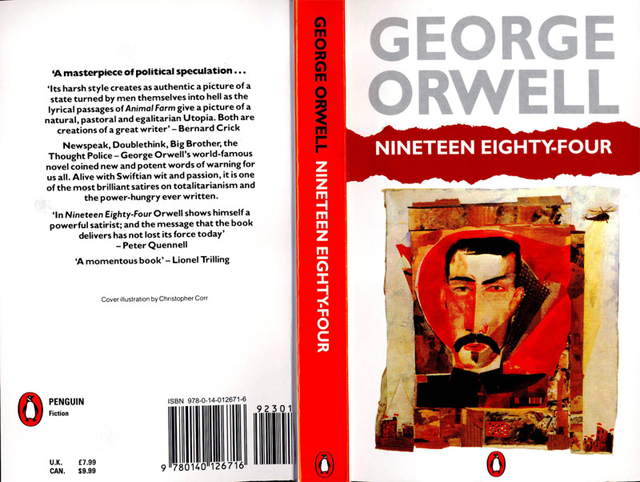
The blurb on 1989’s Nineteen Eighty-Four doesn’t sound much like a novel at all:

Newspeak, Doublethink, Big Brother, the Thought Police – George Orwell’s world-famous novel coined new and potent words of warning for us all. Alive with Swiftian wit and passion, it is one of the most brilliant satires on totalitarianism and the power-hungry ever written.

Maybe. But it sounds like a bit of a slog.

When it came to doing the reissue (out in July) it didn’t take a lot of head scratching for me to decide that a) it was time I re-read one of my favourite books and b) the starting point for writing this blurb had to be the excellent opening line, which manages to be perfectly ordinary until its very last word – which rips the rug out from under your feet. Nice work, George.

By listing some of the words that Nineteen Eighty-Four had added to the English language, the old blurb was trying to get across the book’s weight, its sheer importance. Unfortunately, as with a lot of attempts to make things sound worthy, Nineteen Eighty-Four just comes across as dull. Something to be admired rather than liked.

I think we can do better than that.

‘It was a bright cold day in April, and the clocks were striking thirteen.’

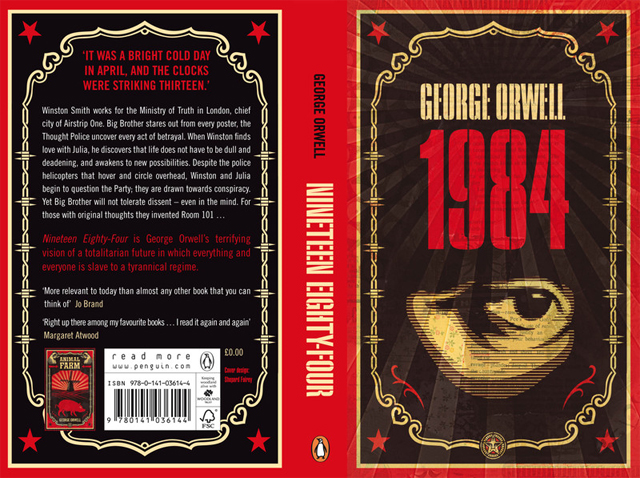
Winston Smith works for the Ministry of Truth in London, chief city of Airstrip One. Big Brother stares out from every poster, the Thought Police uncover every act of betrayal. When Winston finds love with Julia, he discovers that life does not have to be dull and deadening, and awakens to new possibilities. Despite the police helicopters that hover and circle overhead, Winston and Julia begin to question the Party; they are drawn towards conspiracy. Yet Big Brother will not tolerate dissent – even in the mind. For those with original thoughts they invented Room 101 …

This edition is not the Penguin Modern Classics edition. This edition is the one we want to get into the hands of school kids, to grab their short attention spans. So yes, putting the key words – Big Brother, Thought Police, Room 101, Ministry of Truth – in there is important, but that is no reason to leave the story or the characters out. The great thing about Nineteen Eighty-Four is that it is so unsettling, it is so terrifying and bleak (and not much fun as satire, either). To get that across we need to know what’s at stake – what Big Brother is opposed to. We need Winston and Julia, their hopes and love, their humanity. Without Winston and Julia there is no tension, no story.

A book might be a classic, big names may rate it, teachers might tell you it is an essential read. But that’s no reason not to sell it as if it’s brand new – to some people it will be – or not to try to seduce the sceptical reader into turning to the first page despite themselves.

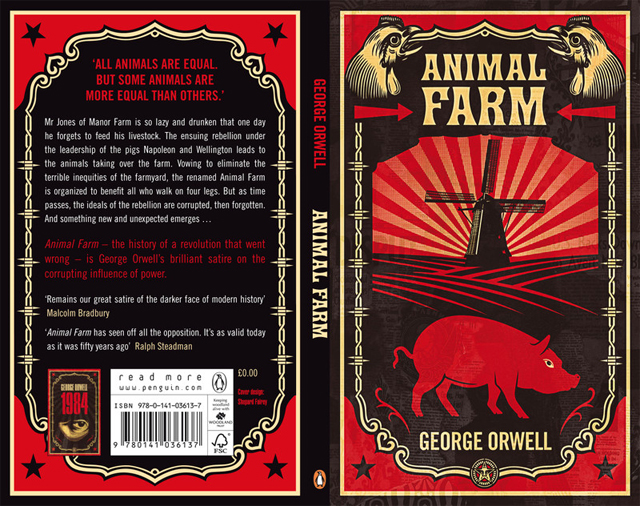
At the same time as Nineteen Eighty-Four we’re reissuing Animal Farm:

Both books feature stunning covers by Shepard Fairey – if you’re going to grab people, get them by the short and curlies. But don’t let either cover art or blurbs distract you from the words within.

Colin Brush is Senior Copywriter at Penguin. Visit the Penguin blog

Launch Debate 2008: Orwell, ID Cards, the Citizen and the State

Speakers

Details

The Orwell Prize, Britain’s pre-eminent prize for political writing, opened for submissions for its 2008 prize with a number of exciting announcements at London’s Frontline Club.

Prize money for each of the two awards (one for journalism, one for books) was trebled, from £1000 to £3000, thanks to the generosity of The Political Quarterly and Orwell’s son, Richard Blair. It was also announced that for the first time, the Prize would be administered in partnership with the Media Standards Trust.

The judges for 2008 were revealed: Annalena McAfee, journalist, author and founder of Guardian Review; John Tusa, former journalist and head of the BBC World Service and now chairman of the V&A Museum; and Albert Scardino, Pulitzer-prize winning journalist and former executive editor of The Guardian. Jean Seaton, Professor of Media History at the University of Westminster, is the Director of the Prize.

And a new website – the Prize’s first – went live at 7pm, as it was officially unveiled by Jean Seaton. Professor Seaton said: “We may not live in 1984 but we live in a society where doublespeak corrupts public understanding, nationally and internationally and Big Brother still haunts us. Orwell’s austerity and radicalism are as relevant as ever.”

The launch also featured a debate on ‘Orwell, ID Cards, the Citizen and the State’ featuring David Goodhart, Nick Cohen, Jenni Russell and Heather Brooke. Click here to read a full account of the discussion.

Links