Search Results for: why i write

Amelia Roles – ‘Misconception’

“A well-executed political piece: excellent stream of consciousness displayed in each tightly packed paragraph, and a crisp ending.” – Delia Jarrett-Macauley, novelist, academic and broadcaster, and Chair of the OYP judges 2023

Scroll to the end of the page to read and listen to a conversation between Amelia and 2021 winner, Anya Poerscout-Edgerton.
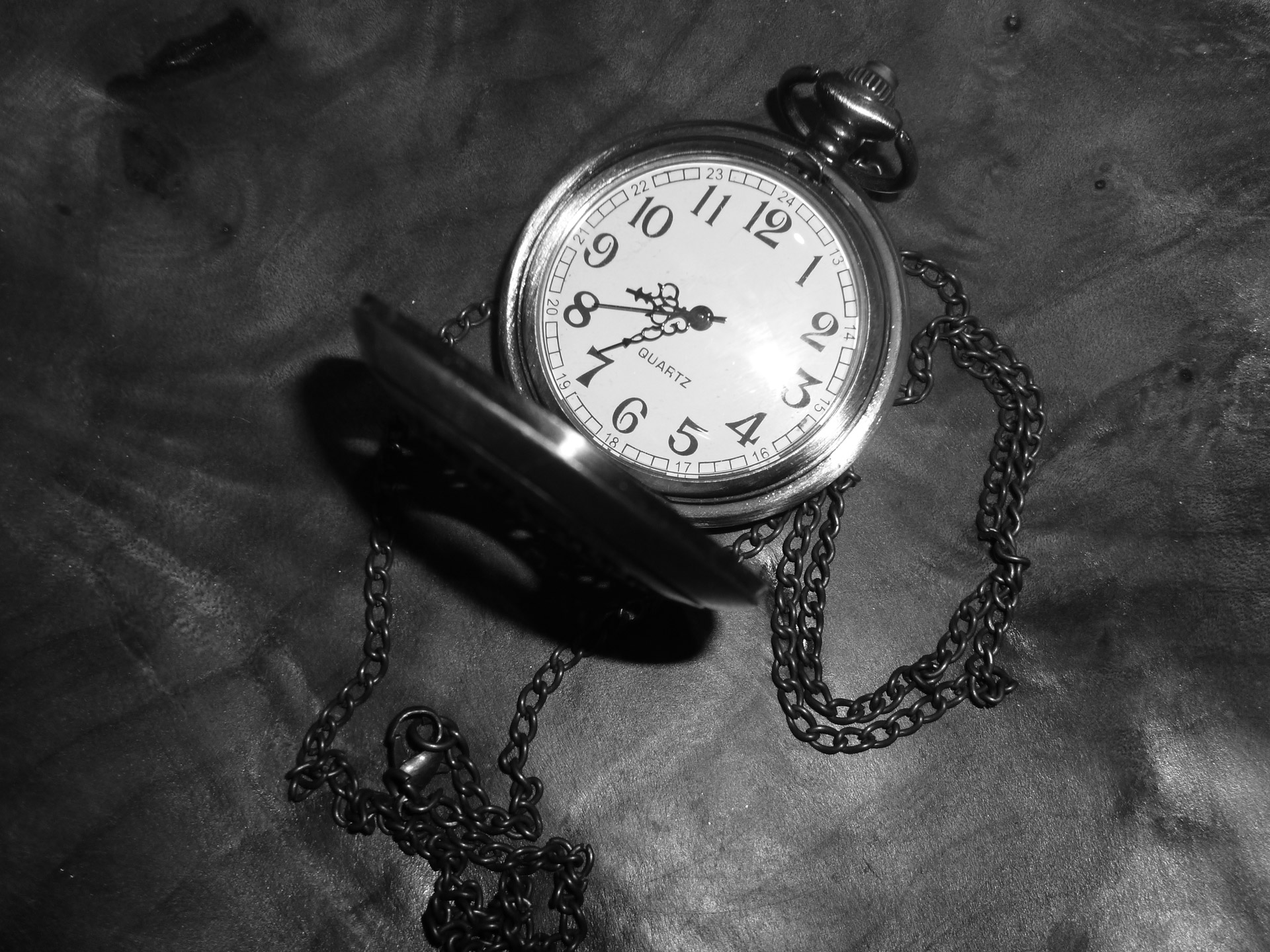
Pocket Watch Free Stock Photo - Public Domain Pictures

Five minutes.

Five minutes to wait. Five minutes of dread. That’s what awaits you. Five minutes silently praying that only one red slash appears. Five minutes in which you decide you can no longer sit motionless on the toilet seat, waiting, dreading, praying. Five minutes in which you get up, leave your room 101 and grab  your phone, cradling it close because any comfort is better than none. Cradling it like you’d cradle a baby, just like you might have to if the white window of the plastic stick is smeared with two red strokes of blood. Like the blood spilled on the battlefields in the latest day of this cruel, constant war  against humanity.

Four minutes.

Four minutes in which you open the news, already anticipating the horrors. Four minutes where you see the yellow and blue flag dragged through the dirt by the criminals who claim to want peace. Four minutes where you read about the people who are doing this for absolutely no reason except their  own selfishness and pride. Pride that spurs these monsters to massacre innocent people, no more  than numbers to the cowards that call themselves leaders. Leaders who commit atrocities others gasp  at, yet do nothing to protect the future generations from having to witness them. Future generations  who don’t get a choice, being born into this endless cycle of misery. Misery we are taught we deserve. But other people bomb civilians mercilessly despite them not being at any fault in the causation of this war. Not a “special military operation”, a war where innocent masses are just pawns to manipulate  leaders to make the coward’s moves.

Three minutes.

Three minutes where you become wiser about thousands of spectators starving in Africa, fleeing their  seats from the encroaching desert, sprinting closer, dragging everything it can under with it and  instead of weaving through obstacles he sprints straight through them. The sea warms up on the  opposing side of the field, threatening to break dreams. When the whistle blows, the two of them will  fight for territory, each wanting more than either should have, pressing forward relentlessly. Both  want to win, to be victorious, to have the right to rule over the other. The rainforest stands on the  sidelines, watching morosely. She should cheer, she should encourage them to fight but her green  pom-poms dangle uselessly from her sides, brown sleeves pulled down to hide the vine like scars that  snake across her arms. The scars run deep and the ones creating them don’t realise that with her  silence they’ve bought their own destruction and signed the contract. They barely look at the contracts  they sign, their names on her death warrant. The death warrant so many know of and yet push her  towards the gallows themselves. After the game, orphans dig through litter bins desperately seeking  food even if it’s just a crumb of popcorn to sustain them another day. These children who shouldn’t have to provide for themselves.

Two minutes.

Two minutes in which you read how youth suicide rates have increased dramatically. Children who  haven’t had their chance to make positive impacts on the world, to teach others to be better, to not make the same mistakes that have led us to this avalanche of depression, ending their existences because they can’t cope anymore. They murder themselves with knives, with alcohol, with drugs, the  things they shouldn’t have access to and yet use to take away the pain, anything to get that clarity,  that swooping high that is wrongly given in the form of pills, drink and blades. Why are children feeling so desperate that they want to die? And why is society shunning them if they have scars on their bodies or a constant smell of alcohol or constant mood changes from withdrawal. Why are parents doing nothing, feeling disappointed they’ve been saddled with these burdens they forget they created and were supposed to have nurtured, cared for, rocked through tears. The children whose parents should have waited at the school gates, held them quietly after a nightmare, cried for them at  graduations, fed them, clothed them, loved them. The children who are shouted at, blamed, locked  away, manipulated into believing they are unworthy of love or time. The children who are hit,  abandoned, starved, forced to endure the torment they didn’t ask for and do not deserve.

One minute.

One minute in which you contemplate why anyone would want to bring a child into this world anyway. Why have a child if it will only be put through all the torture that the universe has to offer? Allowing the child’s soul to go and be at peace before it has to face these horrors would be so much kinder, so much less painful for both of you. The baby you will be forced to carry for nine long months of suffering because five judges, all of whom aren’t part of the generation of fighters, of protesters, of people who want their rights, made you the criminal if you decide that you don’t want to raise a child in this godawful world. Five judges, four of whom are men, who never have to worry about pregnancy, who have never had to wonder if one wrong move could ruin their lives, who have never had to clutch keys between their knuckles and hurry past catcalling drunks propped up in alleyways, no one to hear you  scream if the worst happened. The men who are allowed to make decisions for millions of women despite never having felt the relief at the sight of blood on a sanitary towel – the knowledge that you won’t have to worry about a child in this cruel world is the greatest relief in the universe. The woman who agreed with them because of the age old ideals people are blinded with. The ideals that people  will have to fight to change and unlearn.

Zero minutes.

Five judges and two lives.

Five minutes and two lines.


We asked previous winners and runners up of the Orwell Youth Prize to interview the 2023 cohort about their Orwell Youth Prize writing. Below, we have both an audio recording and transcript of 2021 winner, Anya Poerscout-Edgerton, in conversation with 2023 winner, Amelia Roles. They discuss form and structure, stripping back their writing, the importance of humour, their writing ambitions, and top tips for future Youth Prize entrants!

TABBY: Hello, I’m Tabby Hayward, I’m the Programme Coordinator for the Orwell Youth Prize, and I’m here today with Amelia and Anya, who are two of the past winners of the prize, and are now part of our Orwell Youth Fellows Programme. They’ll tell you a bit more about that in a moment. But the Prize is currently open for entries on the theme of Home. And we welcome writing in all forms, from stories and poems to articles, essays, scripts, and more, and from students in secondary school, years 7 to 13 throughout the UK. Now, without further ado, I’m going to hand over to Anya and then Amelia to introduce themselves and to talk a bit about their writing.

ANYA: Hi I’m Anya, I won the prize in 2021 with a short screenplay. Now I’m 18, I’m a gap year student, and I’m excited to talk to Amelia about her piece. It’s really good.

AMELIA: Hi, I’m Amelia, I won the prize in 2023. I’m 14 and I wrote a short story about the Roe versus Wade abolishing in America.

ANYA: My first question was, apart from your winning piece, which is really good, I was reading it the other day, it’s really moving, quite tense – what would you get everyone in the world to read, if you could, and why?

AMELIA: Oh, that’s hard! I don’t think it’s a certain thing I’d get everyone in the world to read – I would certainly encourage people to read more and discover kind of their favourite genre or text to read, because I really don’t think we do enough of that. So I think if people read more, they’d probably be better informed. And that would help the world in a lot of ways.

ANYA: I’ve mentioned this before in meetings, I really like the novel Push by Sapphire. It really –  I read it when I was about 16, and I think it really opened my eyes to a kind of diversity of experience. And obviously, it’s like one quite specific experience, it’s about a black girl growing up in an abusive household in New York. And there’s a lot of poverty, and a lot of hardship. But she kind of finds her voice through writing. But yeah, that really kind of affected me when I was 16 and made me who I am today. So yeah, I think that would be my answer.

AMELIA: So I read the piece that you’ve got on the Orwell website. And I thought it was really interesting the way you wrote it like a screenplay. Because obviously, I’ve only ever written short stories, I can’t do poetry or anything like that. So is that like your writing style for everything? Or is it the way you just chose to write that particular piece?

ANYA: That was actually the first time I’d ever written a screenplay. I remember, I watched loads of YouTube videos and taught myself. And I think it was because, I wrote a lot of short stories before that when I was younger, and I often found that I didn’t have very good economy of language, I would kind of write a lot of things just for the sake of them because they sounded nice, and like I was good at using words. And I felt that a screenplay is a really good exercise in economy of language, and like kind of taking it right back to like, what does the audience need to know? So yeah, I kind of enjoyed that, that’s how I came to it.

AMELIA: Stripping it back is really hard to accomplish. But I think you did a good job.

ANYA: Well because your piece is quite – that’s what really struck me about it is, I mean, there was a narrative of sorts, but it was really stripped back to like, quite intense, concentrated pieces of prose, which is really kind of effective in the way that you – obviously you have to read the piece, Orwell Foundation website, please read the piece! – but like it’s really stripped back and condensed. It’s like, like, you know those little ginger shorts you get. Like that.

AMELIA: I think that I was kind of just rambling for a lot of it. And I guess that worked out in favour! But it was kind of just a very angry rant, if anything,

ANYA: Well often that’s the best writing, I think, when you just like open the Notes app on my computer, I just start like, grrrrr, really angry about something! And then, anyways, what drew you to writing in such an expressive non-traditional prose form, as opposed to more traditional narrative or academic nonfiction that we learn at school?

AMELIA: I think it was just like I say, a very angry rant. And I kind of think I took the problems – because I wrote about climate change, the impact that parents have on their children – and I kind of just took all the problems in the world and constructed my own little rant about each of them and then kind of sectioned it. I think that’s the way I went about it.

ANYA: Organised ranting.

AMELIA: Yeah!

ANYA: It worked out really well! It’s amazing.

AMELIA: How did you kind of develop – because I listened to your podcast, and then I read the piece on the Orwell website. And I thought it was – you’ve got a great sense of humor in your writing! So how did you kind of develop that? Or is it just like your internal monologue?

ANYA: Often I’m quite funny, because I’m quite scared, because I’m really scared of people thinking that I’m too pretentious or that I’m taking myself too seriously. Maybe that’s to do with being a woman or something, I don’t know! So often, I feel like I have to laugh at stuff. But also, because I think that laughing can be really powerful, and like deconstructing – oh, now I sound pretentious! –  deconstructing, like absurdities in everyday life. I think it’s really good for that. And because it kind of takes you, kind of you realise you’re laughing, and then you kind of get this almost distance from, I don’t know, from yourself, where you’re like, ‘Oh, that is really weird’. And then that’s where thought begins. I don’t know!

AMELIA: I think also laughing is very therapeutic, for a lot of people. If you’ve had a really bad day, and you just kind of sit down and do something you find that’s actually funny, I think that can help in a lot of ways. So I think you really inspired me maybe to try and write something a bit more humorous, rather than just sadness, anger, all the angst, kind of thing!

ANYA: But also don’t be afraid to be angsty, I think because, you know, like, you get the ‘Cheer up love might never happen’. Because you get told, ‘Don’t be angry about this stuff, don’t be sad about this stuff’. But you can! You definitely can – you should.

AMELIA: Do you see yourself kind of taking on the path of writing in the future? Or do you think you would move to kind of a podcast and screenplay genre?

ANYA: That’s literally my exact question except adapted for you! So I think you can see, can you see this? No? I, well, I’m hopefully going to go and study a science degree at university. So I kind of don’t – it’s not my plan for my career. But yeah, I just try to write what makes me happy, write what I’m interested in. Fill up my hard drive with just random, like half essays of something that I thought when I got home from work! Screenplays – I’m trying to move away from them, a little bit, because I think I’m getting back into liking language and kind of, I want to learn how to apply the same economy of language to prose again, and then how to write prose again, because I think also prose is more maybe useful in everyday life. But I don’t know, I just go with the flow, baby!

AMELIA: I think that’s really kind of the whole reason people write, because it makes you happy. Like, there are a lot of writers out there who – you can tell when they’re writing because they want to and when they’re writing because they’ve got a deadline to adhere to, and they just have to crank something out. Or else they won’t money. I think, with those sorts of pieces, there’s no point doing it if it’s not going to be enjoyable, or it’s not going to make you feel better about your own opinion.

ANYA: I saw in your little Youth Fellows bio, that you said you want to be a journalist?

AMELIA: Yeah.

ANYA: Is that still the case? If so, have you got like a specific area of journalism in mind?

AMELIA: I’m not sure really. Because I did get asked – we  had like a mock interview kind of set up at school. And they were like, ‘What do you kind of see yourself doing in the future?’ And I said I wanted to do journalism, and it was an English teacher who was interviewing me. And she said, ‘That’s very odd, because you wrote fictional narrative, but you want to do nonfiction journalism’. And I don’t think it has to be completely specific that it’s nonfiction, kind of, if you have fictional stories that get a point across and then you can link that in. I think that’s kind of something I’d like to have a look at doing, and see where the writing takes me.

ANYA: That’s a nice little end – I think?

TABBY: Yeah, brilliant, great work, guys. Can I just ask you both to say, one piece of advice for anyone considering entering the Orwell Youth Prize this year?

AMELIA: Make sure that the subject you write about isn’t something you’ve been forced into writing about, because it’s just not going to be the same. Because I remember there were a lot of people who entered it at the same time as me. And I could tell they didn’t really care about what they were writing about. Whereas I cared about what I was writing about. I think that’s what makes the difference between a very monotone piece of writing and a piece of writing where you can tell the person’s obviously deeply invested in the subject matter.

ANYA: My advice, I think my advice is almost like to younger me entering the prize, which sounds so gross, but still! Don’t be afraid of being pretentious, I think, because people like you can definitely do writing and having opinions, whether that’s because you’re female or whatever else. And also, I think that people who are pretentious are usually people who are ungenuine, so if you’re genuine, and you really care about a thing and are passionate about a thing, and you really want to write about it, I don’t think there’s really that much of a risk of being pretentious. Just go for it. Go for it. Just do it.


Amelia Roles is a junior winner of The Orwell Youth Prize 2023
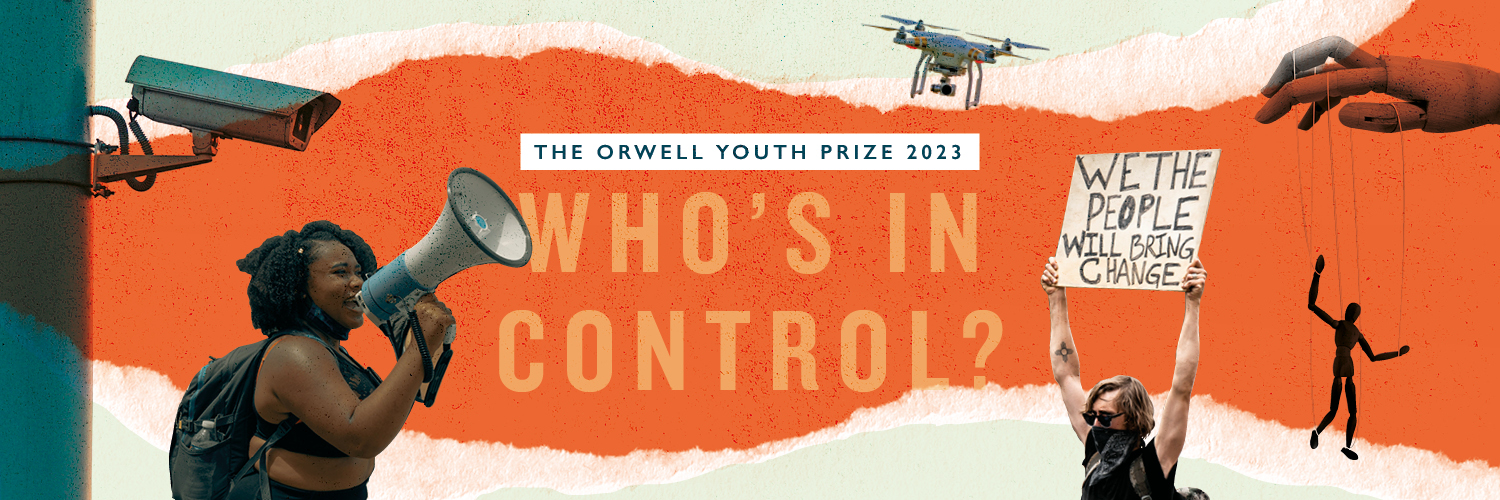
The Orwell Youth Prize 2023: Winners

From chilling, richly imagined dystopias to essays on meritocracy and colonial borders, we are delighted to announce the winners of The Orwell Youth Prize 2023, on the theme of ‘Who’s in Control?’.

All of this year’s winning entries – including runners up and highly commended, in senior and junior categories – are available to read now via the links below.

The Orwell Youth Prize 2023: Who’s in Control?

At a time when so many issues affecting young people, from education to the cost of living, feel out of control, and when it can be hard to know who or what to believe, we asked our entrants to think and write creatively about the theme ‘Who’s in Control?’.

Over 500 young writers responded in the form of essays, poetry, short fiction, journalism, and video game designs. The standard was once again incredibly high, so much so that our selectors chose forty-three outstanding pieces to go forward to the judges.

The judges of The Orwell Youth Prize 2023 were Orwell Prize-winning author, Delia Jarrett-Macauley; Financial Times Global Education Editor, Andrew Jack; the BBC’s Disinformation and Social Media Correspondent, Marianna Spring; and Forward Prize-winning poet, Will Harris. Chair of Judges, Delia Jarrett-Macauley, said:
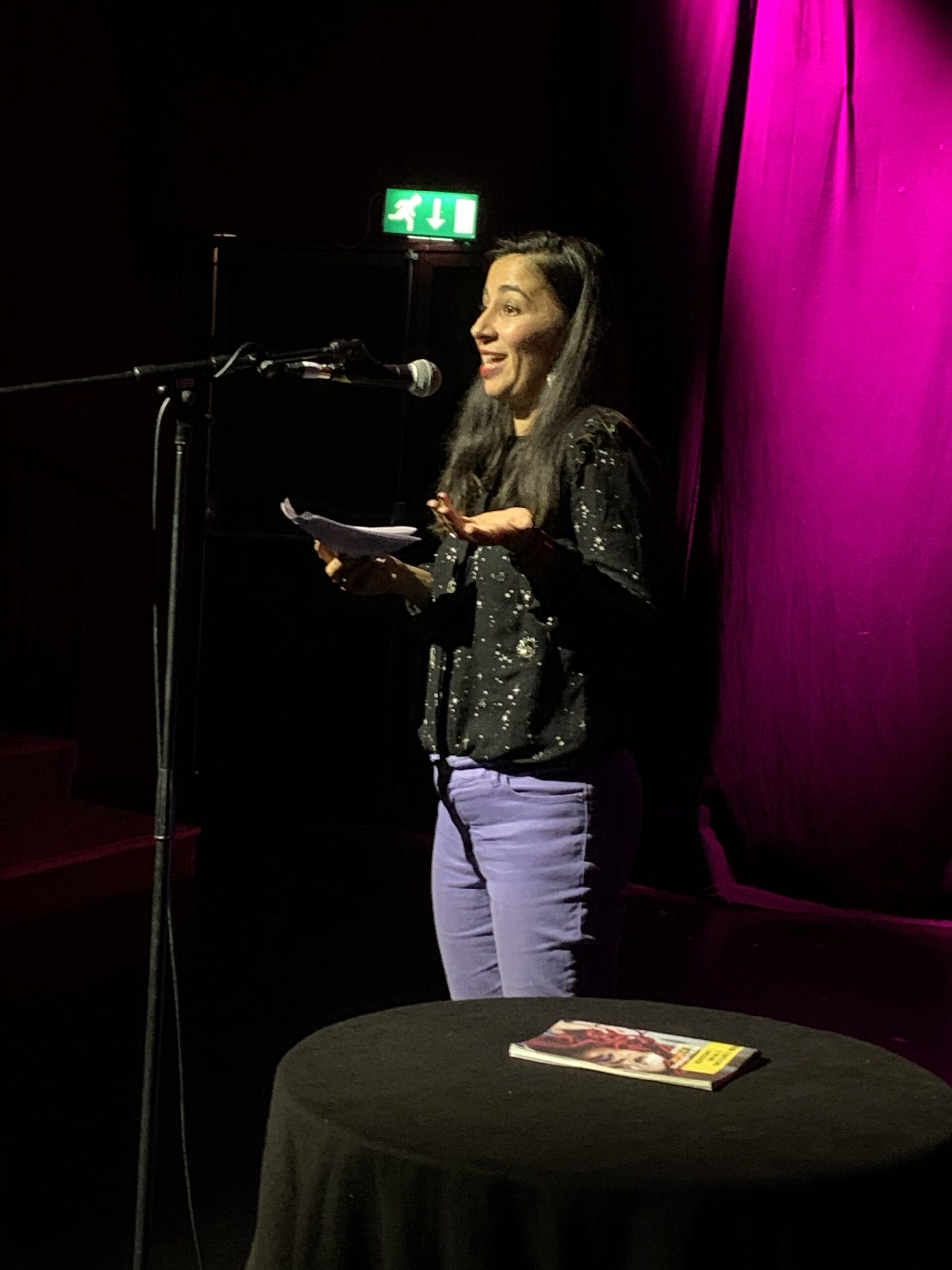
We thoroughly enjoyed reading this year’s submissions for the OYP and were impressed by the range of unusual stories, poems, essays and scripts tackling the theme ‘Who’s in Control’. It was rewarding to discover so many well-executed pieces, and we were impressed by your creativity and original ideas. Keep writing! And congratulations to all.

Our volunteer readers also delivered over 400 pieces of feedback, ensuring that every entrant who requested it had a personal response to their work and the benefit of writing advice and inspiration from our network of professional writers, academics and publishing professionals.

The winners and runners up will also be invited to join The Orwell Youth Fellows, a collective of young writers starting conversations and developing new writing that is responsive to our changing world – and supporting other young people to engage with the prize.

The Orwell Youth Prize Celebration Day  2023

All the shortlisted writers were invited to the Celebration Day at University College London on Saturday 8th July 2023, where they took part in a creative writing workshop with the award-winning writer and poet Anthony Anaxagorou and shared their work before receiving their prizes, including a copy of George Orwell’s essays and The Orwell Youth Fellow’s Zine, Axial Tilt. Thank you to everyone who entered and congratulations to all our winners!


JUNIOR WINNERS

Beth Anker – Meritocracy: The Politician’s Pipe Dream

Priya Floura – Tick Tock

Heike Ghandi – The Catharsis of a Crane

Amelia Roles – Misconception

JUNIOR RUNNERS UP

Edward Blair-Heikkinen – Simulation 0413

Ruxue Jia – Why is it so dark?

Ellie Lee – An Uncontrollable Scribble

Marianne Lee – Obedience

SENIOR WINNERS

Zaeema Assad – The Radcliffe Line

Iris Mamier – Beware of the dog!’ says the man with the gun

Lucas Wong – Men’s Shoes

SENIOR RUNNERS UP

Heather Chapman – Tableau with Sea Breeze and Salt Crown

Ewan Guarnieri – A Grand Reveal

Rosetta Millar – The Collective

HIGHLY COMMENDED

Zirui Peng – To The Northerner (Junior)

Catie May McAleese – Thy Will Be Done (Senior)


The Orwell Youth Prize 2023 shortlisted writers, selected by our volunteer readers, were:
Amaia Blades-Darwen; Amelia Roles; Annabel Ovonlen; Anouk Wood; Beth Anker; Catherine McMullan; Catie May McAleese; Chelsea Xu; Doobee Adura; Edward Blair-Heikkinen; Ellie Lee; Ethan McMillan; Ewan Guarnieri; Francis McCabe; Haneen Eldegail; Hau Tak Ng; Heather Chapman; Heike Ghandi; Imogen Oliver; Imogen Watts; Iris Mamier; Isabella Tait; Jasmine Lai Man Chun; Lucas Wong; Lauren Slater; Marianne Lee; Narthana Jayaweerasingham, Nikita Kurgan; Nia Hopes; Oliver Lewis; Pip van Toorn; Priya Floura; Pun Wattanasiritham; Rebekah Wilson; Rosetta Millar; Ruby Campbell; Ruxue Jia; Sebastian Sexton; Selina Zheng; Semilore Kaji-Hausa; Treasure Stephen; Vanessa Deko; Zaeema Assad; Zirui Peng.

Introducing the Finalists for The Orwell Prize 2023

The finalists for the 2023 Orwell Prizes were announced today, with forty-five outstanding works of non-fiction, fiction and reporting nominated across five categories, including the new Orwell Prize for Reporting Homelessness, sponsored by the Centre for Homelessness Impact.

The full lists are published below with comment from our judges, while you can read more about all the finalists on the Orwell Foundation website. Readers can also try an exclusive extract from each of the nominated books through Exact Editions, here.

The Orwell Festival – the Orwell Foundation’s annual celebration of the most important and imaginative writing and reporting – kicks off in Bloomsbury and online, on 6th June, with a number of finalists making an appearance alongside special guests including Succession’s Jesse Armstrong. The full schedule and booking can be found on the Orwell Festival website.

We would like to express our gratitude to our core sponsor Political Quarterly, Prize sponsors the Centre for Homelessness Impact and A. M. Heath and our founder Patron, Richard Blair, for making these awards possible for another year. Find out more about how you can join them in supporting our work by becoming a Friend or Patron here.

The winners of the 2023 Orwell Prizes will be revealed at the Prize Ceremony in central London on 22nd June 2023.


Orwell Prize for Political Writing 2023 

Show Me the Bodies: How We Let Grenfell Happen by Peter Apps (Oneworld)

Time to Think: The Inside Story of the Collapse of the Tavistock’s Gender Service for Children by Hannah Barnes (Swift Press)

Invasion: Russia’s Bloody War and Ukraine’s Fight for Survival by Luke Harding (Faber)

Who Cares?: The Hidden Crisis of Caregiving, and How We Solve It by Emily Kenway (Headline)

Inside Qatar: Hidden Stories from One of the Richest Nations on Earth by John McManus (Icon)

The Patriarchs: How Men Came to Rule by Angela Saini (HarperCollins)

The Last Colony: A Tale of Exile, Justice and Britain’s Colonial Legacy by Phillipe Sands (Weidenfeld and Nicolson)

Divided: Racism, Medicine and Why We Need to Decolonise Healthcare by Annabel Sowemimo (Wellcome Collection)

Fire of the Dragon: China’s New Cold War by Ian Williams (Birlinn)


Martha Lane Fox, chair of judges for The Orwell Prize for Political Writing 2023, said:

In Nineteen-Eighty-Four, Winston Smith observes that “the best books… are those that tell you what you know already”. I respectfully disagree. I defy anyone not to learn something new from the shortlisted books this year. The range and depth of the subjects reveal what strange and complex times we live in, while the clarity of the storytelling helps us understand so much more about some of the challenges we face, from geopolitics and the overcoming of historical inequalities, to the future of health and care. These books will move you, inform you and help you to make sense of what’s going on around you.”


The Orwell Prize for Political Fiction 2023

Small Worlds by Caleb Azumah Nelson (Viking)

Birnam Wood by Eleanor Catton (Granta)

Bournville by Jonathan Coe (Viking)

The New Life by Tom Crewe (Chatto and Windus)

A House for Alice by Diana Evans (Chatto and Windus)

The Story of the Forest by Linda Grant (Virago)

Demon Copperhead by Barbara Kingsolver (Faber)

After Sappho by Selby Wynn Schwartz (Galley Beggar)


Boyd Tonkin, chair of judges for The Orwell Prize for Political Fiction 2023, said:

This is a list of finalists packed with vital, urgent stories delivered by hugely gifted storytellers. The eight novels we have chosen encompass the political life of people in society on many levels, and from many angles. From quests for sexual and emotional freedom, and the struggle for true fulfilment against daily prejudice and injustice, to the abuse of corporate power and the fate of the embattled Earth itself, their authors confront the deepest fears and hopes that drive individuals and communities today. They do so, just as George Orwell would have wished, not by preaching, lecturing or veiled propaganda but in engrossing narratives full of wonder, surprise, delight, tragedy and comedy. We hope that you read, and enjoy, all of them.”


The Orwell Prize for Reporting Homelessness 2023, sponsored by the Centre for Homelessness Impact

Read, listen to and watch this year’s finalists

Carolyn Atkinson (BBC Woman’s Hour & You and Yours)

Lucy Campbell (Single Homeless Project)

Daniel Hewitt (ITV News)

Daniel Lavelle (The Guardian)

Freya Marshall Payne (The Guardian, new writing)

Zohra Naciri (new writing)

Jack Simpson (Inside Housing)

Vicky Spratt (The i paper)

Daniel Trilling (Prospect)


Alan Rusbridger, chair of judges for The Orwell Prize for Reporting Homelessness 2023, said:

Some of Orwell’s most vivid and impactful writing was on the theme of homelessness, hence this year’s decision to add a new category. We were so impressed by the quality and quantity of the entries, which collectively told a depressing and shaming story about a crisis in towns and cities across the country. The shortlisted entries span memoir, reporting, video, audio, data, academic research, stories of lived experience and more. Though the overall picture they describe is often a harrowing one it is heartening that so many writers, researchers and journalists remain doggedly committed to documenting the crisis so tellingly.”


The Orwell Prize for Journalism 2023

Paul Caruana Galizia & Katie Gunning (Tortoise Media)

Isobel Cockerell (Coda Story & Audible)

Helen Lewis (BBC R4 & The Atlantic)

Yogita Limaye with Imogen Anderson, Sanjay Ganguly and Malik Mudassir Hassan (BBC News)

Sean Morrison (The Bristol Cable)

Madeleine Schwartz (The London Review of Books)

Quentin Sommerville (BBC News)

Wendell Steavenson (1843 Magazine)

Gary Younge (The Guardian, The New Statesman, We Are Unedited)


Yasmin Alibhai-Brown, chair of judges for The Orwell Prize for Journalism 2023, commented:

This shortlist for the Orwell Prize for Journalism, proves that excellent print and broadcast journalism lives on and continues to be a vital force in our democracy. Diverse voices from across the political spectrum cover foreign and domestic themes with passion and authority. Some give fresh perspectives on subjects that have long been in the public domain while others bring to light under-reported stories with extraordinary urgency. Orwell wrote lucid prose, opposed totalitarianism and exposed economic and imperial injustices. The journalists on this shortlist use precise and evocative language and tackle a wide range of subjects from the war in Ukraine to urban poverty and racism. His spirit lives on.”


The Orwell Prize for Exposing Britain’s Social Evils 2023

Sanchia Berg & Katie Inman (BBC News)

Shanti Das (The Observer)

Craig Easton (The Guardian, FT Magazine, BBC R4, i-D)

Liberty Investigates: Mirren Gidda, Jessica Purkiss, Eleanor Rose, Aaron Walawalkar (gal-dem, ITV News, The Observer)

Dean Kirby (The i paper)

John Phipps (The Economist)

Maeve Shearlaw & Christopher Cherry (The Guardian)

Noel Titheradge (BBC News)

Stephen Topping (Manchester Evening News)

Mark Townsend (The Observer)


Ed Thomas, 2023 Judge and 2022 Winner of The Orwell Prize for Exposing Britain’s Social Evils commented:

This year’s shortlist for exposing Britain’s Social Evil’s is testament to fearless reporting crafted with care and compassion. All the entries shine a light in the darkest of places, giving a voice to the most vulnerable of people in our society, failed by institutions and struggling to be heard. In the tradition of Orwell, this is journalism that compels us to look again, and ask searching questions about the reality of life for so many in Britain today.”


For further information and images please contact James Tookey (The Orwell Prize for Political Writing & The Orwell Prize for Political Fiction) or Alice Adonis (Journalism, Social Evils and Reporting Homelessness).


Who Cares?

Around the world, millions of people are quietly caring for long-term unwell, elderly or disabled loved ones; one-in-eight people in the UK and a sixth of the total US population, with comparable proportions across the globe. For many, this is a full-time job, saving our economies billions each year.

Yet when writer, activist and former policy advisor Emily Kenway found herself in the painful position of caring for her mother, she discovered that provision for people in her situation was, at best, hopelessly inadequate and, at worst, completely non-existent. This isn’t only in the form of paltry financial handouts for informal caregivers, but also a dearth of social, psychological, workplace and community structures to support people going through this experience.

Deftly blending memoir, polemic and deeply researched investigation, Who Cares lifts the lid on a subject society has never been willing to confront. Through Emily’s personal story, as well as the voices of other caregivers and those receiving care, unflinching investigations into the facts of care, and research from scientists at the forefront of potential solutions all over the world, this ground-breaking books asks vital questions about why we have a ‘crisis of care’, at both a global level and in the individual lives affected – and shows how we need to reorganise and reimagine the building blocks of our world to ensure caregiving is at its heart.

FINDING A FORM! – A Resource by Will Harris

We asked four professional writers to create resources to help guide entrants through the process of researchingfinding a formstarting to write and responding to feedback on an entry to the Orwell Youth Prize.

Who am I? (part 1)

I’ve always done lots of writing of different kinds, though what I’ve ended up doing most is poems. I started writing poetry in my mid-teens because I didn’t know anyone else who was doing it. Also, I couldn’t play any instruments and I’d read somewhere that poems were like song lyrics without the music.

Since then, alongside writing poems (and working), I’ve written book reviews and essays. They access different parts of my brain: a poem can be justified by sound or feeling; an essay will be judged on its argument. But I like going between them. When I get frustrated with a poem, I can walk next door (in my brain) and write an essay. In doing that, something might get dislodged in the poem.

The first book I published was a short non-fiction book (or long essay) called Mixed-Race Superman, which circled around race, heroism, masculinity, and the limits of speech to affect political change. It came about by chance – as in, I wasn’t planning to write it – but its form emerged from the process of writing; it almost made the writing of it necessary.

What is form?

It makes sense to look for analogies in other art forms (that word again): in music, for example, form might be the rhythm or time signature of a piece; in art, form might refer to the lines and shapes an artist draws on the page before adding colour and shade.

Form could, in musical terms, be described as the rhythm animating a piece of writing – the flow that makes the words sound good (‘right’) and keeps the reader’s eye moving down the page.

In painterly terms, it could be the shape of a piece of writing, whether short/long sentences and paragraphs, lots of punctuation, or (in the case of poems) lines, stanzas, even particular shapes into which the text has been fitted.

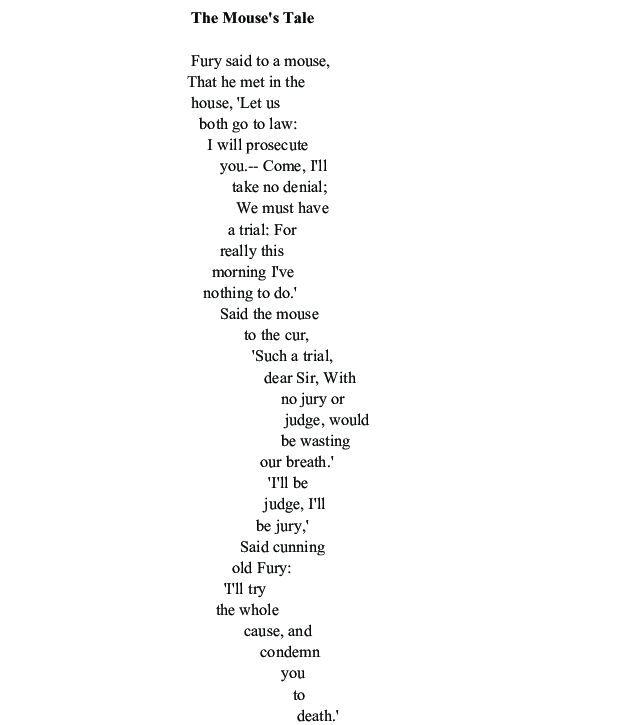
The most famous example of shape-based writing – also known as concrete poetry – probably comes from Lewis Carroll’s Alice’s Adventures in Wonderland, where Alice imagines a mouse telling a tale shaped like a mouse’s tail and we see the text curl down the page in that very shape, a perfect fusion of form and…

…she kept on puzzling about it while the Mouse was speaking, so that her idea of the tale was something like this –


Form and…?

Form on its own doesn’t make much sense (or about as much sense as sense does without sound). Form exists as one half of a duo. As day conjures night, form brings up the shadow of content.

But what is content? Content is usually synonymous with subject matter. Your content might be – on any given day – the taste of Lilt, the government’s reliance on foodbanks, the life cycle of the eel. Form is how this subject comes to appear on the page.

Content is the dough, and form is the kitchen appliance that turns it into spaghetti. But that doesn’t quite capture it. Because dough is itself an already carefully mixed and kneaded ‘form’. Form and content, likewise, are an inseparable yin-and-yang duo; you can’t think of one without the other.

Examples?

Let’s take two examples which might, like the mouse’s tale, be called perfect unions of form and content.

  1. In the 1730s, Alexander Pope wrote this two-line poem (a couplet) and had it engraved on the collar of a dog which he gave to the Prince of Wales:

I am his highness’s dog at Kew;
Pray tell me, sir, whose dog are you?

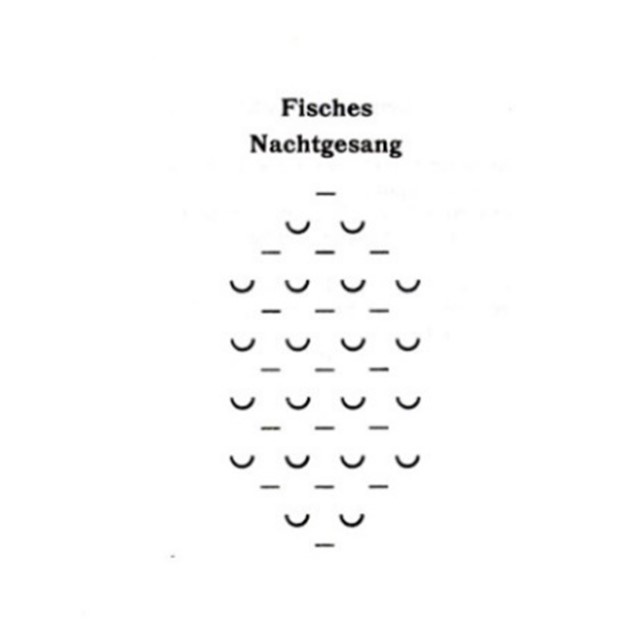
  1. The German poet Christian Morgenstern wrote this poem well over a century ago, whose title translates as ‘Fish’s Night Song’:

But do you agree that these two poems are especially pleasing combinations of form and content? If so, why? And if not, how could you do it better?

A challenge:

Write your own example of form and content perfectly combined. It could be a text to be written on the side of a helicopter, tattooed on the chest of a famous actor, or inscribed on a single sheaf of grass. Let your imagination wander.


Forms around us

In her preface to Frankenstein, Mary Shelley writes that ‘invention, it must be humbly admitted, does not consist in creating out of void, but out of chaos.’ Chaos might be another name for content without form.

We can’t help but impose forms on the world, thinking ‘tree’ or ‘that feels like cotton’ or ‘that dog looks happy’. Invention in writing isn’t so different. It begins with the same heightened awareness of form, of the forms already around us.

In this mood of heightened awareness, the premonition of form meets us everywhere: in the pattern of bubbles in a soft drink, in crowds flowing out of the station, in clouds. We can’t avoid it.

And maybe the point of writing, as Mary Shelley argues, isn’t to invent something out of nothing; it’s to recreate that feeling when several chaotic wisps of cloud briefly combine to form the shape of a happy dog.


Who am I? (part 2)

Writing is often reduced to its content or subject matter. It’ll always be about something (a kidnapped dog in Alaska, a star-crossed couple in Italy, etc.).

But much of the time writing starts with something harder to pin down: the search for a form. This might be no more than a rhythm or a shape on the page. Form doesn’t hold content like a shell contains a nut. Form, like a satellite dish, allows us to reach those dark and faraway places we wouldn’t know existed otherwise.

A challenge:

I want you to think about how you would answer the question ‘Who am I?’ Try to follow the intuition of form. For example, what you write could take the form of a pair of trainers, an astrological chart, or a series of instructions (to get somewhere or make a dish). Whatever the case, let the rhythm and line carry the form and take you somewhere unexpected.


BONUS ACTIVITY! Sleepy time with James Joyce 

The Irish writer James Joyce was someone for whom form was the whole point of writing. From the late 1920s to the end of the 1930s – the last decade of his life – he wrestled with a book in which, as his friend Samuel Beckett put it, ‘form is content, content is form.’ Beckett would go on to say: ‘His writing is not about something; it is that something itself… When the sense is sleep, the words go to sleep…’

But what do sleeping words look like? This is Joyce’s attempt to write in a language that doesn’t describe sleep but feels sleepy, from Finnegans Wake (1939):

Can’t hear with the waters of. The chittering waters of. Flittering bats, fieldmice bawk talk. Ho! Are you not gone ahome? What Thom Malone? Can’t hear with bawk of bats, all thim liffeying waters of. Ho, talk save us! My foos won’t moos. I feel as old as yonder elm.

What makes these words sleepy? The way the sentences trail off, the preponderance of sound over sense, the warped allusion to nursery rhyme, song or proverb?

A challenge:

Fill a page with a piece of writing in which ‘the sense is sleep, the words go to sleep.’ Be as imaginative with the page as you can. Draw on anything that makes you think of sleep and think about how to make the words themselves feel sleepy.


Thank you for reading this resource. We hope you enjoyed it and that it comes in useful as you write your entry to the Orwell Youth Prize! If you have any feedback on our resources, please email info@orwellfoundation.com.

Will Harris is a London-based writer. His debut poetry book RENDANG (2020) was a Poetry Book Society Choice, shortlisted for the T.S. Eliot Prize and won the Forward Prize for Best First Collection. His second book of poems, Brother Poem, was published by Granta in the UK and by Wesleyan in the US in March 2023.

The commission of these resources was supported using public funding by the National Lottery through Arts Council England as part of the Orwell Foundation’s Regional Hubs project.

Research! A Resource by Sujana Crawford

We asked four professional writers to create resources to help guide entrants through the process of researching, finding a form, starting to write and responding to feedback on an entry to the Orwell Youth Prize.

About me

Hello! I am Sujana. I write across different genres ranging from poetry and scripts to essays and reports. In my day job, I work as a UX Researcher. This mainly involves talking to people from different walks of life. Doing so enables me to better understand a situation or a problem, before working out (mostly digital) solutions.

My writing practice enriches the way I carry out my research, and more importantly, my research skills and tools really feed my creative writing.

My poems have been published in different anthologies and magazines, and I have read and performed my work at various festivals and open mics. This is my favourite part about being a writer, getting to share my work with an audience. I have also written scripts for radio (you can listen to my BBC Radio 4 play here) and stage. I even acted in one of my plays, as you can see in the picture! (Sujana is on the left in a red headband.)

I enjoy writing about nature and about the different experiences I have had such as traveling and working in different countries, motherhood, and friendships. I see research as very much part of my writing process, especially when I am exploring themes new to  me.


The value and importance of research

Spending some time learning about a topic helps you both widen and deepen your understanding. It makes your writing richer and enables you to be precise in your descriptions.

When I am in ’research mode’ I try and fully immerse myself in that world. What I mean by that is – if for example I am researching about apples, then I will likely do all or some of the following:

  • Eat an apple in the morning for a whole week, noticing and noting down everything I see and feel – colour, shape, taste, sound it makes when I bite into it, etc.
  • Find a way to learn about how and where apples grow and the different varieties, as well as how they have evolved over time.
  • Talk to friends about how they like to eat apples (raw or cooked, sliced or whole etc.)
  • Look up recipes about apples in cookbooks and BBC good foods.
  • Interview a neighbour who has an apple tree in her garden.
  • Visit a market to learn about the prices of apples.
  • Visit a garden centre to learn about different pests and diseases different variety of apples can get and how to treat them.
  • Use the Internet to learn about how apples are consumed in different cultures.

This kind of immersion enables me to widen the things I can say about a particular subject. It also helps me discover the necessary vocabulary and syntax, and often crystalises the understanding I already had. When I do begin to write afterwards, I am able to do so more confidently and precisely.

Researching for different forms

Research can feed into and support different forms of writing differently. When working on longer forms like essays or short stories, reading a book or an article, or talking to somebody with relevant lived experience, will help you get the facts right. It will also help you take your readers on a better journey (which is why we write, isn’t it?).

While working on a poem, on the other hand, you might wish to hone into something. More than in other forms, in poetry every word you use needs to own its place – each word needs to serve a purpose and add to your piece. As a result, your research will likely end up being more specific too. After some generic reading, my research here tends to be about finding the appropriate word and context to say what I want to say.

You will not use everything you research (but it will never go to waste)

Below I share the opening lines from my poem ‘Marshland Whispers.’

Having found her rhythm,
a snipe has taken to winnowing her secrets,
tales of silk, golden as a grass spine.

Did you know that the guttural sound made by wading bird, snipe, is called winnowing? I didn’t, until I read widely about this very shy species and visited a nature reserve to try and see them for myself (they eluded me, sadly). Ultimately, however, the only bit of research I used in my poem was the word ‘winnowing.’ That is not to say all the other research was wasted. Just recently, over two years of writing this poem, when writing about natural habitats, my old research on snipes came to good use. I don’t think anything ever goes to waste in a writer’s world!


Where to begin

Research can take many forms and what approach you take depends mainly on how much time you have and what tools you have access to. In today’s world, it’s easy to think asking Google is the obvious place to start. However, when my two children have a writing or research project, we start by reading a book together (as I do for my own projects). This often means a trip to our beloved local library!

What my children have found particularly exciting and helpful is asking our family and friends about things they have lived- or work experience on (e.g., talking to a neighbour who worked as a vet helped enrich my son’s story about a poorly cat). I will never cease to be blown away by just how willing and happy people are to share what they know. No amount of trawling YouTube or asking Google can compare to a good personal story

My top 5 research tips

  1. You do not need to do all your research in one sitting. Allow your mind time to mull over ideas. You can always return for some more research.
  2. Have a plan and a list of things you want to research before beginning. It is easy to get distracted and lose track of your work and time.
  3. Learn to keep notes of your research questions and learnings. You never know what you need to reflect on.
  4. Be careful when online and remember not everything you read on the Internet is true.
  5. Keep an open mind when researching: try not to go too narrow too soon.

Here’s an exercise to help sharpen your research skills:

Pick one idea from the list below (or come up with one yourself). Spend some time researching it, remembering to take notes. Then use your learnings to write a short story. Once you have done this, write a poem on the same theme.

Do you think you used your research differently for different forms?

Ideas you could choose from:

  • Winters aren’t as cold as they used to be.
  • Parents should always listen to their children.
  • I want to be the Prime Minister.

A classroom activity: Writing a research-based collaborative short piece

Pick a theme for the class to research and write about (I’ve suggested a few ideas options below). Then divide the students into 4 to 5 groups, ideally with at least 3 in each group.

Provide each group an allocated time and the responsibility to research a sub-theme of the main theme.

After the allocated time (this could be a min. of 30 mins or up to a week), bring all the groups back together and write a collaborative piece together – with each group contributing a sentence or line at a time. A short piece, such as a poem or short essay would work best.

Tips:

Provide research materials for the students such as relevant books, article print outs and pictures.

Encourage students to speak to people who had an interest or expertise on the chosen themes (this could be somebody in their family or a teacher at school).

When writing the collaborative piece, one option is to ask Group One to provide the first line or sentence, for Group Two to think of a second line in response to the first one, and so on.

Before you know it, the class will have created a new piece of writing together!

Possible themes

  • A local hero… sub-themes could include:
    • the local hero’s childhood
    • what deeds made them into a hero?
    • their significance today
    • similarly celebrated people in other places
  • Should we all be vegetarians? Sub-themes could include:
    • what are the consequences of animal farming?
    • what would happen if we all stopped eating meat?
    • cultures that primarily eat a vegetarian diet
  • Should pavements and cycle lanes be prioritised over main roads? Sub-themes could include:
    • evolution of transportation
    • cycle friendly cities around the world – what makes them different?
    • air and noise pollution
    • are there benefits to fewer people owning cars?

Thank you for reading this resource. We hope you enjoyed it and that it comes in useful as you write your entry to the Orwell Youth Prize! If you have any feedback on our resources, please email info@orwellfoundation.com.

Sujana Crawford is a poet, playwright, researcher and facilitator, whose work is driven by a fascination with people, places, traditions and folklore. She is based in Warwickshire.

The commission of these resources was supported using public funding by the National Lottery through Arts Council England as part of the Orwell Foundation’s Regional Hubs project.

Professor Peter Davison

Professor Peter Davison

The Orwell Foundation is deeply saddened to announce the death of Professor Peter Davison, one of the pre-eminent authorities on the life and works of George Orwell, and, with the assistance of his late wife Sheila, Orwell’s long-time editor. Davison’s The Complete Works of George Orwell, which runs to twenty volumes, was first published in 1998.

In a personal tribute (published in full below), the Foundation’s Director Professor Jean Seaton, said: “Peter’s extraordinary contribution was the make the modern Orwell possible.”

The Foundation sends its condolences to Professor Davison’s family.

The Foundation is privileged to host a number of resources featuring Professor Davison and his work on our YouTube channel, including an extended interview on his book ‘George Orwell:  A Life In Letters’ and an appearance at the Cheltenham Literature Festival in 2010. Professor Davison’s memoirs, written in 2020 are available on the Orwell Society’s website and Peter’s collection of Orwell-related books and other material, donated by him to the Society, is on permanent loan to the Museum of Wigan Life.

Professor Seaton writes:

Only Peter Davison could have recognised Jacintha Buddicom, leaving a solicitor’s office from an apparently insignificant picture taken by a passing street photographer in 1927. Buddicom had just signed away her illegitimate daughter to an uncle and aunt. The baby was not Eric Blair’s, though Blair (Orwell’s real name) had brought back an engagement ring for her when he returned from Burma. She would not, could not, see him as she was expecting the child. Blair believed that she would not see him because she had resented his bungled physical approach before his departure for Burma. Only Peter could identify why this picture mattered, but only Peter brought a special humanity to the interpretation – it was the young, distraught women’s body language that had alerted him to look more closely at the picture. In doing so he put together a poignant piece of the emotional jigsaw around George Orwell’s early life (and Jacintha’s). It was an eloquent identification.

Peter Davison has sadly died with his sons around him. His darling wife and helpmeet Sheila died several years ago. He was a super scholarly sleuth. The scale of the intellectual mastery breathtaking. Peter’s extraordinary contribution was to make the modern Orwell possible.

Peter edited with a tenacity, comprehensiveness, and sheer love the complete works of Orwell. Without this extraordinary work of scholarly compilation, exquisitely edited and contextualised, Orwell’s work would be fragmented and dispersed, and the range of the writing and the development of his thinking would be lost. Davison allows any reader to discover the milieu, the moment, and the development of every fragment of Orwell’s writing. It is a remarkable achievement. Seeing the works to publication was in itself an epic story.

Peter was a very sweet, modest man who combined warm human communicativeness with a splendid capacity to hunt down and hold onto details. He brought to Orwell studies a dedication to accuracy that matched the author’s own. I first met him when my husband (who died many years ago) wrote an introduction to Orwell’s essays on England. There was a hilarious supper in a trendy Notting Hill restaurant on the night the book was launched. Peter ordered fish and it, somewhat surprisingly, arrived with banana. The table, as I recall, riffed on Orwell and bananas.

Peter was loveable and has, in a formative way, made the Foundation’s work possible. We send our condolences to his children and grandchildren and celebrate a special life, so well lived, that contributed so much to public understanding of important things.”

Jean Seaton, 18th August 2022

Women and Climate Change – Ruby Kalayil-Peacock

“The remarkable achievement of the text is to correctly, clearly and captivatingly expose the correlation between historically systemic and modern issues; and how, despite that, women around the globe continue to play an indispensable role in solving them.” – Dan Bernardo

Every day, 37-year-old Zeitu from Ethiopia walks five miles, lugging enough water to support her seven children. [1] Lately, her 15-year-old daughter Zahra has joined her, often missing school as a result. Zeitu and Zahra are by no means alone: millions of women in many rural communities are responsible for maintaining the household’s water, energy, and food supply, as well as childcare. Women make up 50-80% of food production worldwide, yet own only 10% of land. [2] As a result, women make up 70% of the world’s 1.3 billion poor, [3] so are more affected by threats to land and natural resources, and therefore climate change. Moreover, they have less access to technology that would help them to adapt to climate change, and are less involved in decision making, so are unable directly to affect change concerning the environment. 

After the 1991 Bangladesh cyclone, 90% of fatalities were women and children. In many cases, women, impeded by clothes or unable to swim due to ideas around modesty, could not flee. [4] This tragedy exemplifies how increasingly common extreme weather events will disproportionately affect women. During climate disasters, women’s responsibilities mean that they must work more, and harder, leaving less time for education and earning income: women are rendered unable to migrate and seek refuge. Furthermore, when struggling financially, families may remove girls from school to work or get married. [5] 

After Hurricane Katrina in the USA, violence from men towards women rose by 98% [6] – just one example of how climate disasters have complex social effects on women which intertwine with their domestic lives. Women’s health often declines after a disaster, due to reduced access to adequate maternity care, or spending long hours in drought conditions that cause heatstroke, and women become more vulnerable to domestic violence, sexual assault, and trafficking – a concept coined ‘climate violence.’ Men feel they should protect women, and frustration at their failure to do so leads to violence. As the economy suffers after a climate disaster, women struggle more to find jobs; nine in ten countries have laws preventing women from the same economic opportunities as men, including banning women from factory jobs, working at night, or getting a job without permission from husbands. [7]

However, this is not to say that women are utterly helpless in these situations. These expectations imposed on women in many cultures can be harnessed in times of climate disaster. Skills involving water storage, food preservation, and management of natural resources can, with adequate female representation in power, be invaluable. Said representation is sadly minimal, with only one quarter of people brought onto TV to talk about the climate in 2020 being women, [8] and even fewer women of colour. There is, obviously, no evidence to suggest that women are less competent in decision-making roles – quite the contrary; women often recognise the risk around climate change’s proposed ‘solutions’ more. Indeed, white males have been proven to possess a lower risk perception, so are likely to take bigger, more dangerous risks: the ‘white male effect’, [9] a phenomenon proved by the Women’s Environment and Development Organisation (WeDo). Perhaps unsurprisingly, carbon dioxide emissions per capita are lower in nations with more women in government, and a study of the European parliament showed that women are more likely to support environmental legislation. [10] 

Moreover, many women internationally have been given agency to recover from and prevent issues arising from climate change. Activist Charlot Magayi established the Mukuru clean stoves initiative to help women in Kenya replace cooking stoves with greener alternatives, and women in Africa are heading the initiative Solar Sister, which helps communities build small-scale solar grids to be more in control of their energy source. The Barefoot College, set up in India, trains women to be solar engineers to, again, control their own energy production. The latest G7 summit had a section on gender and climate change, and charities like ActionAid are working with women to empower them into leadership roles. International financing funds now require systems to include women in programmes- for instance, the International Fund for Agricultural Development, which prioritises women farmers. [11] 

Women all over the world are empowering others and overseeing change. Kenya’s Dr Wangari Maathai was the first African woman and environmentalist to receive the Nobel Peace Prize in 2004. While nowadays Greta Thunberg is a familiar female face of the climate activism movement, few remember that Maathai, an African female environmentalist orchestrated the ‘Green Belt movement,’ for women to plant and look after trees. Thanks to this movement, tree nurseries have been built, fifty-one million trees planted in Kenya alone, and women trained in things like beekeeping. [12] 

Another African woman who has made a huge impact is Isatou Ceesay, who founded the One Plastic Bag recycling movement in Gambia, and a project that produces bags made of recycled waste and gives many West African women jobs. Alongside these stories are American marine biologist Rachel Carson, who helped ban DDT and to establish Earth Day, and sailor Emily Penn founded eXXpedition to carry out women-only plastic pollution expeditions. [13] Yet still, there are dozens of unsung female heroes of environmental activism, whose voices are rarely heard. In the USA, two-thirds of those who organise climate strikes are women, [14] and female scientists in Africa are bringing their knowledge of agriculture to laboratories and research departments. 

The only thing that can solve any of these problems is true gender equality, and there are still countless examples of a gender divide evident in any environmental negotiations. For example, the UK leadership team for COP26 was originally 100% men; disparities in vaccine access worldwide meant that who was able to attend COP26 was unjust. [15] Things need to be tackled at the fundamental level: inequalities in job opportunity, domestic roles, and education need to be eradicated. A step towards this should entail women-only policies in any development schemes, and more female representation in decision-making. We must work together to build a ground-level network that stretches worldwide, to ensure that no-one, man, woman, or child, is left behind as the world changes irreversibly every day. 


1 Women and children walk up to 20,000 steps a day for water, reveal WaterAid and Wimbledon Foundation’, Water Aid UK, 9th July 2018 

2 Balgis Osman-Elasha, ‘Women… In the Shadow of Climate Change,’ UN Chronicle, accessed 10th March 2022  

3 Ibid. 

4 How To Save a Planet, ‘We Can’t Solve the Climate Crisis Without Gender Equality, We’ll Prove it to You.’,  Spotify podcast, 6:29, September 2021,  

5 Climate Change and Gender’, Action Aid UK, updated 17th November 2021,  

6 ‘We Can’t Solve the Climate Crisis Without Gender Equality, We’ll Prove it to You.’, 9:05

7 ‘Climate Change and Gender’, Action Aid UK 

8 ‘We Can’t Solve the Climate Crisis Without Gender Equality, We’ll Prove it to You.’, 17:41

9 ‘We Can’t Solve the Climate Crisis Without Gender Equality, We’ll Prove it to You.’, 15:14 

10 ‘We Can’t Solve the Climate Crisis Without Gender Equality, We’ll Prove it to You.’, 19:43 

11 Joe McCarthy, ‘Understanding Why Climate Change Impacts Women More Than Men’, Global Citizen, 9th March 2020, 

12 ‘We Can’t Solve the Climate Crisis Without Gender Equality, We’ll Prove it to You.’, 22:51 

13 ‘Beyond Greta Thunberg: the Women Fighting Against Climate Change’, Acciona, accessed 10th March 2020 

14 ‘We Can’t Solve the Climate Crisis Without Gender Equality, We’ll Prove it to You.’, 41:58

15 ‘We Can’t Solve the Climate Crisis Without Gender Equality, We’ll Prove it to You.’, 44:51


We asked our 2021 and 2020 Orwell Youth Fellows to interview our new 2022 winners and runners up. Below, 2021 runner-up Marnie McPartland interviews Ruby Kalayil-Peacock about the importance of research and the inspiration behind her essay ‘Women and Climate Change’. You can also read Marnie’s 2021 article ‘Equality in Education’ here.

  1. You support your argument with multiple interesting sources. How did you go about your research and what do you think such evidence adds to the piece?

I mainly conducted my research online, using Google, and particularly the websites for the United Nations and ActionAid, both organisations committed to combatting gender inequalities and climate change worldwide. I felt it was important to include plenty of concrete, quantitative evidence in my piece, as it seems that often issues surrounding climate change and gender inequality can feel rather abstract and distant, and I wanted to ensure that I made it clear quite how grave these problems are. There are people who still deny their existence, and so I felt I should prove it using factual evidence.

  1. What inspired you to approach the climate crisis from the angle of women’s involvement?

I first heard about the increased effects of the climate crisis on women from a podcast that I was listening to, and was deeply surprised that I had never heard this topic being discussed before. I decided to write this piece to bring about awareness, and thought that if I approached the subject of the climate crisis from a more social angle, not simply an environmental one, I could convey how deeply human beings are affected by what can otherwise feel like a rather abstract concept; as we in the Western world do not often feel the direct effects of the climate crisis, we do not always fully grasp its severity.

  1. Do you think your conclusion that inequality in the crisis ‘need[s] to be tackled at a fundamental level’ is achievable?

I do feel that tackling inequality between the sexes at its root, and therefore greatly reducing the increased effects of the climate crisis on women, is achievable. Indeed, I feel it is the only truly effective way of dealing with this ancient issue. A lot of ‘action’ being taken against sexism can be seen as simply papering over the cracks when it is too late, and I think that governments worldwide should make it their mission to tackle disparities in education and job availability between the sexes. I concede that changing deeply-engrained attitudes and practices is by no means easy, but it is certainly achievable.


Find out more about all our Orwell Youth Fellows here and buy their climate crisis zine, Axial Tilt here.

Enter the 2023 Orwell Youth Prize here.

The Conundrum of the Fossils – James Lomax

“A parable, set in the 19th century, in which a naturalist builds a wall to save a forest, but gets little help. Nicely written, wry and fluent.” – Professor Michael Jacobs

January 14th 1884

It is with great ardour that I write these words. At long last, it seems that my plight has been answered. A Mr Jonathan Percival from the Dorset County Council has allowed me to have an audience with the board concerning the fossil problem I have been raising awareness on. I hope my proposal will finally convince them to take action on this issue. In a few days, events may at last go in my favour.

January 18th 1884

The day has been confusing, to say the least, but nevertheless I have achieved my goal. Upon entering the elegant hall that the Council resides in, I was greeted by Mr Percival and the other distinguished gentlemen, who had given me half an hour to detail my ambitions to them. I informed them of the situation of the fossils: how half a century of excavation has left the landscape covered by the remains of creatures from aeons past, how vulnerable these fossils are to weathering and the action of the waves, and how significant, nay essential, they are in revealing more of the rich history of life on our planet. An entire lost ecosystem could be gone forever if these processes continue at the same rate. As I spoke, I tried to weave passion in my words, aiming to rally these gentlemen like a military commander before a major battle.

Mr Percival looked in the direction of his fellows, each gentleman giving a brief nod. “We thank you for your speech,” he told me. “Clearly this is a complicated situation, and we all see that action must be taken. Would you care to enlighten us as to what you have planned?”

I prepared myself to deliver my proposal. “The biggest threat to these fossils is the slow yet continuous rise of the ocean. In a mere few years’ time, they may be lost to the waves, and with them, knowledge of the world before mankind. Therefore, I propose a short wall, further down the beach, which will protect the fossils for another few decades, giving my colleagues enough time to extract them and take them to museums, where they shall be treated with the care they deserve.”

Before consulting the other gentlemen, Mr Percival asked, “This extraction process is expected to last a few decades?” 

“Oh yes,” I answered him. “Great caution must be taken to avoid damage to the fossils. Once one is broken, it can never be fixed.”

“Of course. These fossils must not be damaged. So. What does the board say?” Some gentlemen whispered among themselves. Most simply nodded again. One man raised his voice and asked, “How will this wall change the appearance of the beach?”

“The wall shall be made of rock, taken from elsewhere, in order to blend in with the coast,” I responded.

“Good,” the gentlemen said. “You must understand that tourism is a significant, nay essential, part of the local economy. I would hate to see it sacrificed for the sake of some- for the sake of these valuable remains.”

As there were no further questions, Mr Pervical addressed me again. “It appears we are unanimous. You may build your wall for the sake of these fossils. You must take care, though, to keep it in line with the natural theme of the coast.”

“And now,” he continued as I left, “it has been confirmed that a member of the royal family will soon holiday in our esteemed county. We must ensure that they are given a-”

His voice was drowned out by the frantic speech of the other board members, each eager to be heard above the others. I fear that such a lackadaisical triumph as mine is no triumph at all. Yet, approval was what I desired, and approval was what I received. In the morning I shall begin construction.

January 19th 1884

I enlisted the help of a few locals to help me begin mapping out where the wall would go. Amazingly, none of them were aware of the danger the fossils were in, and all agreed that it was noble of me to do all I could to save them. They did regret to inform me that an innumerable amount of other tasks will prevent them from giving me any further aid, but they wished me all the best in my efforts. I am heartened by the faith people have in me. I do not work at this wall on my own. After all, doing what you love is never truly work.

March 10th 1884

The sea wall approaches completion. My funds are growing thinner, but I have never had to pay any other workers, so my situation could have been far worse. While I have presented a donation box, it is only too understandable that much of the population simply cannot afford to fund me right now, which is why my own fortune is being used to supplement the humble grant given by the Council.

Every morning I walk to my store of rock, and, carrying as much as I can in my trusty wheelbarrow, trudge down to the beach. There, I deposit the wheelbarrow’s contents and begin adding to my barrier. It brings me great joy that it is keeping back some of the weaker waves.

Sometimes I spy a few people watching me work from afar. I am pleased that they are as invested as I am and eager to see the wall being created in order to save these magnificent fossils.

Yet this endless toil is beginning to affect me. There are times when I trundle my wheelbarrow down the beach, and stop and catch sight of the fishermen out on their boats, or the shopkeepers opening for the day. Then I gaze at my wall, a meagre, shallow thing, and the awesome and terrible waves crashing against, spraying the precious fossils with droplets of surf, and for a split second the truth of what is actually happening sinks in. Then I notice somebody watching me and continue walking, anxious for them to see me working away, and secretly hoping that another set of footprints will follow mine down to the shore.


We asked our 2021 and 2020 Orwell Youth Fellows to interview our new 2022 winners and runners up. Below, 2021 winner Jude Leese interviews James Lomax about metaphor and allergorical fiction, and the characters in his story ‘The Conundrum of the Fossils’. You can also read Jude’s 2021 winning poem ‘Work Experience as a Young Campaigner’ here.

  1. With there being an abundance of allegorical fiction out now regarding climate change, why did you decide upon fossils in the 19th century as your metaphor?

I chose fossils in my piece to show how much information and knowledge can be taken from the natural world. The fossils are of animals long dead and gone, but they’re still full of information from the nature of evolution to the nature of extinction. If we can learn this much from life that is no longer around, how much can we learn from life that we still have the chance to save?

  1. How did you plan out the individual features and characters of your parable? Do they all represent specific kinds of people or institutions which you feel are preventing us from saving the planet?

All the characters each represent different attitudes held by different people. The narrator is the one who understands the crisis and wants to do all they can to slow it but finds themselves relatively alone. Mr Percival is the public figure who gives an impression that they care but doesn’t really, at least not as much as about other, less important, issues. The board member that raises a question about tourism represents the kind of person primarily occupied with money first and the environment second. Finally, everyone else represents the general public – they know about the crisis, and some of them care, but it’s not very important and only a minor aspect of their lives overall. When writing this piece, I wanted to exaggerate all these different kinds of people to essentially call them out and make them sound rightfully ridiculous.

  1. The narrator of your piece could be interpreted as either optimistic or naïve. Which do you think it is?

I can’t say they’re optimistically naïve, can I? I wanted to make the narrator quite a pathetic character in their little efforts to do their bit, just to show how much the climate crisis needs many people all working together to combat it, instead of one person who is trying their hardest but probably won’t accomplish much. Their attitude is of one who expects support that will never come and I hope this makes my piece a bit more moving.


Find out more about all our Orwell Youth Fellows here and buy their climate crisis zine, Axial Tilt here.

Enter the 2023 Orwell Youth Prize here.

2054 – Eleanor Mead

“A dystopian science fiction short story set in Paris and on an unnamed shoreline in the global South. Experimental in form, the writing achieves a disturbing dramatic tension.” – Professor Michael Jacobs

25-10-2054

Northern Hemisphere, Grigny, Paris

She looked at the empty containers. After taking them from the storm cellar she had just left them sitting on the counter, dreading what their vacant bodies meant. When the cellar got down to the dregs then it was time to replenish, else face the inevitable reality of starvation.

Today she’d have to go outside. With a new face mask delayed by Neoquick’s trademark slow delivery service, she would have to brave the air alone.

The girl downed another glass of water before optimistically slathering on sunscreen, a thick layer of white to cover her flushed skin. She flashed a smile to whoever may be watching through the front camera before she flicked to the Paris air alerts. She studied the screen, not bothering with the flat’s windows. It may look clear and sunny out there but she knew better. Everyone did.

The app indicated the air quality had decreased dramatically over the last hour; the Capital had issued a red warning: STAY INSIDE. She sighed and went to close the phone, not wanting to see another ad, but without failure, a propo from the rebellion popped up.

Today the hackers had replaced the normal image of smiling Parisian farmers working from the kindness of their hearts for their twisted truth: 

the Capital’s propo is sent out daily to ease the minds of the rich who had condemned their fellow Frenchmen to death. To ease the mind of sinners. Many don’t care as so many of the Capital’s farmers are immigrants, escaped from the uninhabitable land of the equatorial belt. Unable to speak French, unlike yourself, no work is available to them and now they can’t even get necessities-

She shut off the phone, bored of their ludicrous proposal.

Rolling her eyes, she flopped onto the easy clean sofa that was positioned directly opposite the kitchen. She wasn’t entirely sure why it was designed this way but it was always too hot for her to consider moving it. Tugging her knees into her chest defensively, she attempted to bypass her reality.

She buried her face in her hands, the darkness giving her space to think. Her mother had gone out this morning, this she knew without even checking. Her mother would be out late into the night, working hard in order to allow her to order things on Neoquick. But since wages had dropped again, ordering on the web was impossible. She didn’t have a choice.

Removing the ice, she rose and headed to the door. She didn’t bother checking her phone, knowing the warning would only work to dissuade her from the task at hand. Taking the scarf from beside the door, she tossed it around her neck before gathering the containers.

After the Crisis had begun its steep incline, the Capital stepped in. No single-use plastics would be tolerated, as if this would close up the disintegrated mess of the Ozone layer. No one tried to fault the stupidity of this plan from either the illusion of hope or the reality of what would happen if they ever did.

The girl pressed her hand against a square panel hidden in the surface of the wall, listening for the hiss of the door release. As the iron door slowly rolled open there were three short beeps before her morning pill shot into her mouth. Dutifully she swallowed it, without a second thought, and tightened the scarf over her nose and mouth before stepping into the hallway.

The apartment block was as hot as everywhere else in the suburbs. There were rumours of air conditioning in central Paris, where the elite lived; spread through whispers that have no discernible source and without a defined source there can never truly be truth.

She stepped out into the sweltering heat and doubled over, unable to breathe. The air was hot and heavy, clogged with the pollution of her ancestors who she silently cursed, her eyes watering as grit poked at them.

She tried to cough the grit out of her, tying the scarf even tighter. Hoping and praying that this time wouldn’t be the time, that today wouldn’t be the day that Marjorie Morel died.


Southern Hemisphere: off the grid

Frances’ head broke the warm surface of the water, rivulets of the foul smelling substance rolling down her face. She threw her spear and morning catch onto the shore before dragging herself to meet it.

After the Capital had banned practically everything, Frances had had enough of watching others slowly fade away on the rations that had been provided. She had taken her life into her own hands, fuelled by the rumbling pit in her stomach. With no family or friends left, she headed back down the rocky mountain trail but nothing could have prepared her for the sight that greeted her return.

Her home entirely sunk beneath the dark surface of the swollen Indian Ocean. It wasn’t something easy to get used to and even after a week Frances wasn’t sure if she ever could.

Returning to her home was preferable to complying to the Capital and blindly following their soldiers. The water submerged most of their cameras and short circuited the rest and with the soldiers all deployed on the Capital’s relocation missions, she couldn’t have been safer.

After the Capital’s warnings she had avoided the ocean at first, chewing on bark to alleviate some of her gnawing hunger. Then she decided enough was enough and used a sharp stone to fashion her first spear.

Frances lay back, letting her hair pool around her as she let the sun dry her off. In these moments the stifling heat was a little more bearable. As she took a second to breathe, she thought about today’s hunt.

It had been much harder than usual: the water harder to move through, the jellyfish harder to spot. Today she’d had to settle for lumping handfuls of salty seaweed into the shell she used. The shell was likely her greatest success, it was large and green with a curve that made it a great bowl. Whatever creature that had called it home was long dead so she had little qualms in taking it from the ocean bed.

Sitting up, Frances reached over to her Capital-issued water bottle. Other than the clothes on her back, it was the only thing she had kept as its distilling function allowed her to drink

from the sea. She wasn’t entirely sure of all of the science behind it but she knew some of the basics. It was designed to remove salt, cells of dead marine animals and carbon dioxide among other things.

She took a sip of the water, it was gritty but she was used to it. After she had knocked the bottle, one of the mechanisms had been damaged and it didn’t work right but it had kept her alive so far so she wasn’t complaining. Frances looked over at her pathetic pile of seaweed, pushing a ringlet of readily dried hair from her face. Then she heard it-

The unmistakable buzz of helicopter blades.

Fear clenched her chest, stopping her heart as the realisation hit her. She hadn’t been careful enough and now the Capital was coming for her. 

Foregoing the collection of her meagre morning catch, Frances ran. Darting through the trees, she wound her way uphill trying something they wouldn’t expect. The helicopter persisted.

The machinery was faster than her, skimming across the top of the canopy as the soldiers peered down at her. Soldiers dropped to the forest floor, boots landing with heavy thumps.

She only noticed their chase as the helicopter darted away, inspiring her to pick up the pace though she couldn’t work her aching limbs for long.

Darting to the right she heard them crashing around behind her. The pounding of her heart in her ears was too loud for her to realise they were close enough to hear her breathe.

Feeling herself begin to slow, she willed more air into her lungs, more strength into her pumping legs. It wasn’t enough.

The soldier pounced: his solid weight driving her face-first into the ground as he chanted the Capital slogan, chilling her to the core.

“Tell Tale Tit, your tongue shall be slit; and all the dogs in the town shall have a little bit.”


We asked our 2021 and 2020 Orwell Youth Fellows to interview our new 2022 winners and runners up. Below, 2020 winner Hugh Ludford interviews Eleanor Mead about her tips for budding writers and the inspiration behind her story ‘2054’. You can also read Hugh’s 2020 winning story ‘You Are What You Eat’ here.

  1. Is the grim future your piece presents something you could see coming to pass in the coming decades, given the date you chose?

Grimness is all I can see for the future as of late. The climate crisis will not be abateing any time soon, as no policies can truly support the future science foresees for us. My story exaggerates the 2050s as a reminder of what is to come if we fail to change our ways in the face of our rapidly heating planet.

  1. What would be your one tip for a budding writer?

Stories don’t always come to you as you’d expect, taking some time away from your work can sometimes be the best thing for your story.

  1. Which other writers inspire you?

When writing dystopian pieces I tend to find inspiration from authors such as Margaret Atwood and Christina Dalcher. Both are feminist icons who write stories that view the female experience through a different lens. I would like to emanate their ability to shine a light on feminism in my own work.


Find out more about all our Orwell Youth Fellows here and buy their climate crisis zine, Axial Tilt here.

Enter the 2023 Orwell Youth Prize here.

Research

These resources are designed as a jumping-off point for students entering our writing prize on the theme, ‘Acts of Courage’.

They are not intended to be a complete guide, but rather to inspire ideas, help you explore different angles, and point you towards reliable, balanced information. Courage can mean many different things. It might mean standing up to someone more powerful than you, speaking out when other people remain silent, defending somebody who is being treated unfairly, challenging an idea you disagree with, admitting that you were wrong, or finding the courage to do something that scares you.

Whether you’re writing an article, an essay, a story, or even a poem, research can help you explore what courage means in the world around you. You might find stories of people who have taken enormous risks, discover examples of everyday courage, or come across arguments that make you rethink what it means to be brave.

We asked writer and researcher Sujana Crawford to tell us a little about her own research methods – read her tips for getting started here.

For George Orwell, courage was closely linked to intellectual honesty. He famously defined freedom as the right to tell people what they do not want to hear. This meant having the moral courage to speak uncomfortable truths and challenge prevailing orthodoxies, even when doing so invited intense backlash.

“If liberty means anything at all it means the right to tell people what they do not want to hear.” George Orwell, ‘The Freedom of the Press’

Orwell’s own life embodied this principle. He risked his physical safety fighting in the Spanish Civil War, where he was badly wounded. Later, while suffering from severe tuberculosis, he lived on the remote Scottish island of Jura while writing Nineteen Eighty-Four, driven by a desire to expose the dangers of totalitarianism.

In his essays and journalism, Orwell often championed the underdog while refusing to romanticise any political party or movement. He believed that writers had a responsibility to face unpleasant facts, even when those facts were inconvenient to their own political commitments.

The Orwell Foundation continues this tradition by recognising intellectual courage in political writing and reporting: the willingness to investigate, question, challenge and write honestly without simply following the crowd.

Writing is a creative process, but research can help you discover the people, ideas and events behind the things you want to write about. You might come across surprising acts of courage, untold stories, difficult questions, or people who found courage in circumstances where they had very little power.

As 2026 Orwell Prize for Political Writing winner Karen Bartlett put it:

“All my books have a historical impulse, but without political purpose I’d never start and without enthusiasm I’d never finish. Most of my books are about people fighting for justice … We all know that human beings can be terrible, but I am always motivated to write about those who are also turn out to be amazingly brave and heroic.”


What does courage mean?

Before you start researching, think about what you mean by courage.

Is courage about doing something frightening? Is it possible to be brave without being physically courageous? Can telling the truth be an act of courage? What about changing your mind? Is standing up to your friends sometimes braver than standing up to an obvious enemy?

You might want to explore the difference between courage, heroism and recklessness. Does doing something dangerous automatically make someone brave? Or does courage depend on why they did it?

You could also think about whether courage is always visible. Some forms of courage happen in public, such as protesting or speaking in front of a crowd. Others happen privately: asking for help, leaving an abusive situation, admitting a mistake, defending someone who is being bullied, or continuing with something difficult when nobody else knows how hard it is.

Think about the people you consider brave. What have they actually risked? Their safety? Their reputation? Their friendships? Their career? Their freedom? Their lives?

And who gets remembered as a hero? Are there forms of courage that are less visible, or people whose courage has been overlooked?

The Amnesty International resource Here I Stand: Stories That Speak for Freedom contains stories and poems exploring courage, solidarity, freedom and standing up against injustice.


Our very own Trainee Trustees have been thinking about courage too…

Bella says:

‘I believe that in order to be courageous, you have to first be scared. A veteran actor is not as brave as someone who stands up and delivers their part with shaking hands. A thrill-seeking skydiver is not as brave as someone who parachutes out of a burning plane. Courage is uncomfortable. It forces you to change shape, to adapt, to grow.

Bravery comes from finding the thing that matters more to you than your fear. This could be a dream, a loved one, or a political cause – sometimes it’s simply the desire to live freely and authentically. Often the things that make us brave are, helpfully, also the things that inspire us to write – this was certainly the case for Orwell, whose relentless pursuit of his principles galvanised his writing and not infrequently put him in harm’s way.

Bravery is passion that defies your instincts. First, find what scares you and then, find what you hold dear. Courage will follow.’

Eleni says:

‘Courage is the ability to speak, act, and exist as one’s authentic self. It doesn’t mean acting without fear, but instead having the courage to adapt and continue forward despite being afraid. It means being motivated by a personal ethos and set of values that allow for acts of strength and authenticity despite adversity. George Orwell showed courage in a range of ways, such as risking his life in the Spanish Civil War, choosing to resign from a job that didn’t align with his values, and publishing books and essays that were censored and lost him allies in publishing. However, it can also be seen in smaller actions, such as allowing for personal growth, speaking up against bullying, showing persistence in a class or a job you don’t always enjoy, or choosing to express yourself despite the fear of judgement.

Fundamentally, to show courage is to be honest with yourself and to prioritise a moral conviction above potential consequences. Whether this is shown loudly through globally recognised acts of political resistance, or quietly through prioritising authenticity in your everyday life, courage is a bridge between the person you are and the person you want to be.’


Standing up to power

Some of the most famous examples of courage involve people challenging those with much greater power than themselves.

Why do people decide to speak out when they know there may be consequences? What makes someone willing to risk their job, reputation, freedom or even their life for something they believe in?

Orwell provides one example. He fought against fascism in Spain because he believed that the conflict was about more than the politics of one country. His experience there also changed his understanding of propaganda and political truth, and became an important influence on his later writing.

You could research:

1/ George Orwell and the Spanish Civil War

2/ Rosa Parks and the Montgomery Bus Boycott

3/ Nelson Mandela and the struggle against apartheid

4/ Emmeline Pankhurst and the women’s suffrage movement

5/ The Civil Rights Movement

But remember that courage does not have to belong to famous historical figures. Orwell encouraged us to look at what is in front of our nose. You could look for stories of people in your own community who have challenged injustice, campaigned for change or stood up for somebody else.

What makes an ordinary person decide that something is important enough to take a risk?


Courage and journalism

What does it mean to be a brave journalist?

Journalists sometimes have to report from war zones, investigate powerful organisations, expose corruption or tell stories which governments, businesses or powerful people would rather remain hidden.

But courage in journalism does not necessarily mean putting yourself in physical danger. It can also mean spending months investigating something nobody wants you to investigate, publishing an unpopular story, admitting an error, or allowing people whose experiences are often ignored to tell their own stories.

The Orwell Foundation’s own Orwell Prizes celebrate writing and reporting that combines political purpose with clarity, courage and fidelity to truth.

In 2026, the Orwell Prize for Political Writing recognised Karen Bartlett’s The Escape from Kabul, while Fatemeh Jamalpour was a finalist for For the Sun After Long Nights. Their books offer very different examples of what courageous political writing can look like.

Jamalpour was banned from journalism in Iran and told by interrogators that she could not produce any kind of content. She continued to write, recording her interrogations, and later reported from the streets of Tehran during the Woman, Life, Freedom uprising.

“I felt a responsibility: if they were in prison, I had to report from the streets of Tehran, to watch and write.”

Fatemeh Jamalpour, For the Sun After Long Nights — Political Writing finalist 2026

She describes writing under dictatorship as having both a political and historical purpose:

“My reporting may not change events immediately, but it documents them for the future — so that one day people will know the long and painful road we travelled toward freedom.”

Fatemeh Jamalpour, For the Sun After Long Nights

You can read more about Jamalpour and the other 2026 Political Writing finalists here.

You could also explore Andrey Kurkov’s Three Years on Fire, which documents his experience of Russia’s full-scale invasion of Ukraine and the realities of living through war.

Ask yourself: What does it take to keep writing when someone is trying to stop you?


Courage and bearing witness

Sometimes courage means making sure that something is not forgotten.

Ukrainian novelist, poet and human rights activist Victoria Amelina left her career as a fiction writer after Russia’s full-scale invasion of Ukraine. She began working as a war crimes researcher, documenting evidence of atrocities and helping to preserve the stories of people affected by the war.

Among other things, Amelina helped uncover the buried diary of Ukrainian children’s author Volodymyr Vakulenko, who had been executed after his abduction by Russian forces.

Her story raises difficult questions about the relationship between writing, truth and responsibility.

What makes someone decide to stop writing fiction and begin documenting reality? What does it mean to preserve someone’s story after they are gone? Is documenting an injustice itself an act of resistance?

You could explore the work of journalists, historians, photographers, human rights investigators and ordinary people who have documented events which others wanted to conceal.

The International Committee of the Red Cross and Amnesty International also provide resources on conflict, human rights and the protection of civilians.


Speaking out

Sometimes the bravest thing you can do is say something when everyone else is staying quiet.

This could mean challenging a racist joke, defending someone who is being bullied, reporting wrongdoing, questioning an authority figure, or telling someone that their behaviour is unacceptable.

But speaking out can have consequences. You might lose friends, be criticised online, damage your reputation or find yourself isolated from the people around you.

This raises some interesting questions:

  • When should we speak out?
  • Is it ever right to remain silent?
  • Does courage require risk?
  • Why can it be so difficult to disagree with our friends?
  • Does social media make speaking out easier or harder?
  • What happens when speaking out makes you unpopular?

You could research whistleblowers – people who expose wrongdoing from inside organisations. What motivates them? What happens to them afterwards? What protections should they have?

You could also explore journalists who have risked their safety or careers to report stories that people in positions of power would rather keep hidden.

The Committee to Protect Journalists documents attacks on journalists around the world and the risks involved in reporting difficult stories.

Orwell’s writing repeatedly returned to the importance of speaking honestly, even when doing so was uncomfortable. In essays such as ‘Politics and the English Language’, he argued that language could be used to conceal reality rather than describe it.

What would you be willing to say if you knew that some people would be angry with you for saying it?


Courage and activism

Young people have often been at the centre of campaigns for social and political change. Sometimes courage means taking to the streets; sometimes it means organising a campaign, persuading other people, writing to a politician or simply being the first person to say that something is wrong.

The UNICEF Youth Action Guide provides practical advice on advocacy, research, networking, action planning and campaigning.

The UNICEF UK Youth Advocacy Toolkit offers advice on choosing an issue, developing a campaign and communicating with decision-makers.

Amnesty International UK also has a Youth Activist Toolkit with advice on starting groups, organising campaigns and taking action on human rights.

Ask yourself: What makes someone courageous enough to act? And what makes it difficult for people to act together?


Courage and disagreement

It can take courage to change your mind.

We often think of courage as standing firmly by what we believe. But what happens when new evidence shows that we were wrong?

Changing your mind can mean admitting that you misunderstood something, apologising to someone, or accepting that an argument you believed was convincing does not stand up to scrutiny.

Orwell was deeply concerned with the dangers of political conformity. His writing repeatedly challenged the pressure to accept ideas simply because everyone around you appeared to believe them.

The Orwell Foundation’s criteria for the Orwell Prizes include critical thought and intellectual courage. These qualities involve questioning assumptions rather than simply accepting the views of the people around you.

Ask yourself: Is it braver to defend your beliefs, or to change them when the evidence demands it?


Courage and everyday life

Courage does not always make the news.

Think about the kinds of courage you encounter in everyday life. Someone might move to a new country and have to build an entirely new life. Someone might tell their friends that they are struggling. Someone might stand up for a classmate who is being bullied. Someone might challenge a prejudice they have previously held themselves.

These stories can be just as interesting as stories about famous heroes.

You might interview someone you know about a moment when they had to be brave. Ask them:

  • What were you afraid would happen?
  • Why did you decide to act?
  • Did anyone help you?
  • What happened afterwards?
  • Would you make the same decision again?
  • Did you feel brave at the time?

Remember to ask permission before using somebody else’s personal story in your writing, and be sensitive when discussing experiences that may be difficult or private.


When courage goes wrong

Not everything described as courage is necessarily brave.

History is full of people who have taken enormous risks for causes which caused terrible harm to others. People can also use the language of courage to justify violence, cruelty or reckless behaviour.

This gives you another interesting question to explore: Can something be courageous and wrong at the same time?

What is the difference between courage and recklessness?

Is someone brave if they are willing to hurt themselves? What about if they are willing to hurt someone else?

Can a person be courageous in service of a bad cause?

You might find that thinking about these questions makes your definition of courage much more complicated – and much more interesting.


Creative Forms

The Orwell Youth Prize supports many different forms of writing and mediums for expression.

You could write an essay about an issue that requires courage to discuss. You could write a piece of journalism about someone who has stood up for others. You could write a short story about a character facing a difficult choice. You could write a poem about fear, resistance or resilience.

You could even create a game in which the player has to make difficult moral choices.

If you are interested in Game Design, you can start with this video made by Youth Prize Winner Benjamin McEwan.

We welcome both concepts and games themselves, and here are some places you can turn your narratives into games:

1/ Twine is a great place to start because it can be used to create interactive, nonlinear stories without needing coding knowledge.

2/ This helpful Twine guide may help.

3/ Godot Engine

Think about how the form you choose might change the way your reader experiences courage. Would a poem communicate fear differently from an essay? Could a game make a reader experience the consequences of a difficult decision?


Full-length Fiction Works

There are lots of novels which explore courage, fear, resistance and morality.

You might start with:

George Orwell’s 1984 and Animal Farm

Harper Lee’s To Kill a Mockingbird

Ray Bradbury’s Fahrenheit 451

Aldous Huxley’s Brave New World

Markus Zusak’s The Book Thief

Malorie Blackman’s Noughts & Crosses

Lois Lowry’s The Giver

Khaled Hosseini’s The Kite Runner


Poems

Poetry can be a powerful way of exploring courage.

You might explore:

‘Still I Rise’ by Maya Angelou

‘Invictus’ by William Ernest Henley

‘If—’ by Rudyard Kipling

‘The Hill We Climb’ by Amanda Gorman

‘Caged Bird’ by Maya Angelou

You could also look for poems written by people who have experienced war, imprisonment, exile, discrimination or political repression.

What does courage look, feel, or sound like in a poem?


Our Youth Fellows suggest…

Paul Gallico’s The Snow Goose

Anne Bronte’s The Tenant of Wildfell Hall


Prize-winning Inspiration

Below are some previous Orwell Youth Prize entries which might inspire you to think about this year’s theme.

Look beyond the subject matter and ask yourself what is courageous about the writing itself. Is the writer tackling something difficult? Challenging an assumption? Telling a story that is usually ignored? Taking an unusual creative risk?

‘The Faceless Drug’ by 2019 Junior Winner Francesca Morgan explores the death penalty through fiction.

‘Brick Lane: A Case Against Social and Ethnic Exclusion in Britain’ by 2019 Winner Asher Gibson explores social and ethnic exclusion in Britain.

‘If Liberty means anything at all, it means the right to tell people what they do not want to hear’ by 2016 Winner Alexander Butcher explores free speech and censorship – and asks what it means to defend the right to express unpopular ideas.

You could also explore The Orwell Youth Prize’s previous winners and see how young writers have approached difficult subjects in very different ways.


Ready to get started?

You don’t need to find the biggest or most dramatic example of courage.

Start with something that interests you.

Think about something you have seen, experienced, read about or disagreed with.

Then start researching.

Talk to people. Read different perspectives. Look for evidence. Follow stories beyond the headline.

Be prepared to discover that your first idea was incomplete or even wrong (!).

And remember that courage can be part of the writing process too. Sometimes the most interesting thing you can write is the thing you have been wondering about but have been afraid to ask, or put on paper before.

Once you’ve started exploring the theme, head to our Find Your Form page to start thinking about which form will allow you to best express your ideas.

Inspiration

The Orwell Youth Prize takes its inspiration from the author, journalist and essayist George Orwell. Orwell wrote from his own experiences, putting himself in difficult and often dangerous situations. He did this to gain first-hand knowledge, enabling him to describe the conditions and people he came across accurately and honestly. He worked as a colonial policeman in Myanmar (formerly Burma), fought fascists in the Spanish Civil War and slept rough in Paris and London.

Orwell also wrote in language that was clear, concise and compelling for his audience. We encourage you to follow George Orwell’s example: to write about something that matters to you, and that you want to draw to the attention of others.

Here we’ve put together some prompts inspired by Orwell’s writing and different kinds of courage, to help you start thinking about the theme. When you’re ready to start researching, head to our Research page to browse reading, or watch and listening about courage in today’s world.


COURAGE AND CONFORMITY

‘There was truth and there was untruth, and if you clung to the truth even against the whole world, you were not mad.’ – Nineteen Eighty-Four

‘Freedom is the freedom to say that two plus two make four. If that is granted, all else follows.’ – Nineteen Eighty-Four

‘Nothing was your own except the few cubic centimetres inside your skull.’ – Nineteen Eighty-Four

‘Until they become conscious they will never rebel, and until after they have rebelled they cannot become conscious.’ – Nineteen Eighty-Four

‘Four legs good, two legs bad!’ – Animal Farm

Questions:

  • What does it mean to hold on to your own view when everyone around you disagrees?
  • When might staying quiet be brave, and when is it just easier?
  • What’s the difference between not having an opinion and being too afraid to share one?
  • Think of a time you went along with something you didn’t quite believe. What would it have taken to do something different?

COURAGE AND FEAR

‘He wears a mask, and his face grows to fit it.’ – Shooting an Elephant

‘I often wondered whether any of the others grasped that I had done it solely to avoid looking a fool.’ – Shooting an Elephant

‘When the white man turns tyrant it is his own freedom that he destroys.’ – Shooting an Elephant

‘Till that moment I had never realized what it means to destroy a healthy, conscious man.’ – A Hanging

‘If you want a picture of the future, imagine a boot stamping on a human face – for ever.’ – Nineteen Eighty-Four

Questions:

  • Is it possible to do something that looks courageous for a cowardly reason? What might that look like in real life?
  • Why might the fear of embarrassment feel bigger, in the moment, than the fear of doing something wrong?
  • What does it take to notice that something is wrong, when everyone else is carrying on as if it’s normal?
  • Does courage look different depending on how much power you have?

COURAGE IN ORDINARY LIFE

‘If there is hope, it lies in the proles.’ – Nineteen Eighty-Four

‘He had done his job at the front with faultless courage and willingness.’ – Homage to Catalonia

On the Spanish working class, who exhibit: ‘…a real largeness of spirit, which I have met with again and again in the most unpromising circumstances.’ – Homage to Catalonia

‘It is only because miners sweat their guts out that superior persons can remain superior.’ – The Road to Wigan Pier

‘I will work harder!’ – Boxer’s motto, Animal Farm

Questions:

  • Whose courage tends to go unnoticed or unrewarded?
  • Is loyalty always a form of courage? When might it become the opposite?
  • Is there a difference between courage and endurance?
  • Orwell believed hope came from ordinary people rather than the powerful. Do you agree?
  • Who is the bravest person in your own life and would they describe themselves that way?


Feeling inspired? Head on to the Research page for some tips on researching your entry – and to explore how writers and journalists are tackling our theme today.

Notes On Being Black. – Laurell Jarrett Anderson

“This writer conveys an important message through a strong and personal tone. Their research skills and attention to detail contribute to an overall excellent piece, exploring racial issues within a modern context. With a particularly powerful analysis of racism online and in the media, it’s a piece which must be read and understood by everyone using such platforms.” – Jessica Johnson

I had come across a book called ‘Loud black girls’ last year and being so intrigued by the title alone, I purchased it straight away. It told me that “Being a loud black girl isn’t about the volume of your voice- and using your voice doesn’t always mean speaking the loudest or dominating the room.”[1] I was reminded of the stigmatization that came with being a black girl and found myself repeating ‘that’s so true!’ or ‘that’s happened to me!’ as I read each page. The black community shares so many of the same experiences and relate to each other in so many different ways, despite the irony that we are often talked about as if we are one person. We live in a society that has shown us how white people stay in the spotlight while black people are kept behind the curtain, their talent and hard work going without credit. So many years have gone by, yet most of the same issues that black people faced around discrimination and racism back then, are the same today. Despite the protests, laws and even the Black Lives Matter movement, issues that we faced over 70 years ago are still rife in today. Here are some notes on being black that I think are worth listening to.

‘Racism is not getting worse, it’s getting filmed.’
The media is something that touches all lives in some way, so heavily influenced by what we see and read in everyday life, including social media. Apart from being so eager to find out what celebrities are up to online, there’s a much darker and more damaging side to being so easily exposed to what we see. The deaths of George Floyd, Breonna Taylor, Ahmuad Arbery, Elijah McClain and many other innocent black lives lost due to racism and police brutality, have highlighted the systematic racism that prevailed not only in America, but all parts of the world and a lot closer to home. There is a lot of distressing content in the news and videos that are shared online, often without any warning. “Staying away from socials just to avoid hearing the blood curdling agony in George Floyds voice again and again.”[2]- This was what singer, actress and businesswoman Rihanna posted last summer in support of justice for George Floyd and other black citizens who have died. Videos like these circulated on the internet, making it hard to escape from the devastating murders that were happening in America, and also had a big impact on our mental health and wellbeing. Seeing black people persecuted, arrested and abused all the time is traumatic. More can and must be done to identify and abolish racial hatred within the police force, as well a safer way of spreading awareness of police brutality and murder in the media that is cautious and understanding of black peoples mental health, because as said by Will Smith: “Racism is not getting worse, it’s getting filmed.”[3]

‘Appreciation not appropriation’
Whilst racism and hate crime is an obvious act of prejudice, there is so much else happening that has been normalised. For example, the commedical and ridiculing representation of African American Vernacular English (AAVE) by non-black people and ‘blackfishing’ online, the phenomenon of non-black influencers and public figures using bronzer, tanning, Photoshop, or even cosmetic surgery to change their looks to appear black or mixed race. One time I read online that people were debating whether or not saying ‘black people’ to refer to, well, black people, was offensive or not. The problem with this is that people are assuming the word ‘black’ has negative connotations in the first place, adding to the problem even more. These not so important twitter debates, shifts our focus onto less relevant news and activism. There is so much more behind a word. The way we present ourselves is so much more than just a hairstyle. The appropriation of black women in particular is further established by celebrities spending fortunes on huge lips, skin tanned too dark and having surgery that can now give them unrealistically wide hips. The standard physical attributes of a black woman have been popularised and colonized by white women who had once oppressed black women for their natural features. American TV series like ‘The real housewives of Atlanta’[4], explicit music videos targeted at the black community and other forms of popular culture have also shamelessly pioneered the ‘black woman’, depicting us as loud, aggressive and hypersexualised, just for entertainment.

‘You’re not what we’re looking for’
In the past, there has been nowhere near as much representation for people of colour interested in cosmetics or hair compared to the western beauty standards that celebrate ‘whiteness’, in fact, this can still be seen today. A message that has probably been drilled into every black girl’s head is that “you’re going to have to work even harder than everyone one else because you have two strikes against you- your gender and race.” I often find that as a black girl, everything we search up about ourselves has to be marked: ‘Black girl hairstyles’ or ‘Black girl makeup routine’. When I was younger, I was given the rare beauty magazine for black women- that was only sold in black hair shops. Once a month. I was also the only black girl in my class at primary school (until one other girl joined in year 5) so people would always touch my hair and ask me why I didn’t just straighten it to fit in. I share my experiences with many black girls all over the world, but this goes a lot deeper than just magazines and childhood memories. It’s compounded by seeing brands and publications that have historically excluded and marginalized Black people, yet now share messages of solidarity with the Black Lives Matter movement. Where was this solidarity when Black people were applying for jobs? A study by the centre for social investigation at Nuffield College found that minority ethnic applicants had to send 60 per cent more applications to get a positive response from an employer than a person of white british origin. These results were compared with similar field experiments dating back to 1969, revealing that this type of discrimination has remained unchanged for over 50 years. [5]

‘This world does not move without black creativity’
More emerging black artists, creatives, engineers and scientists are pushing through the industry barriers and making their voices heard. Although we are tired of not seeing enough black people in executive roles, and the systematic disenfranchisement that exists within these industries. Not enough has been done to support black people into executive roles in the creative industry, even though black culture is unquestionably one of the most popular and sought after ‘aesthetics’ amongst mainstream media, from music to fashion and art. Since the Black Lives Matter protests more people have woken up to the reality of how the black community is not, and has never really been, represented or credited in mainstream brands/ businesses. The societal realisation of how black individuals go on to achieve despite the prejudices and institutional racism they encounter, has resulted in the mass emergence of ‘Diversity and Inclusion programmes’ that in progressively diversifying their business by allowing the ‘best’ black candidates to occupy the same roles that dismissed them in the first place. We have always been silenced and stereotyped, preventing us from getting executive roles for years. We have been labelled as the ‘angry black girl’ at school and always had to run that extra mile in order to be given the equal opportunities, whilst constantly being pulled down by white privilege. This is an evolving conversation, and it requires evolving education.[6] It’s now 2021 and young black children who are interested in art, history, sports, fashion, science or engineering need to be able to see successful and affluent people in those industries who look like them, in order to be inspired and achieve. So how can we move forward? Well, we can begin by understanding and recognising the exploitation that black people still face within the media for profit and entertainment, enabling the promotion of black culture to become more well known as something positive. Secondly, give black people the jobs and platforms so that they can achieve and earn just as much as their white counterparts, ending a cycle of career deprivation and unemployment. This world does not move without black creativity [7], so it’s about time we start appreciating it.

REFERENCES

1. Loud Black Girls: 20 Black Women Writers Ask: What’s Next? (1 October 2020)
https://www.amazon.co.uk/Slay-Your-Lane-Presents-Black/dp/000834261X

2. Rihanna Laments ‘Blood Curdling Agony’ of George Floyd’s Death (30 May 2020)
https://www.rollingstone.com/music/music-news/rihanna-george-floyd-death-1007883/

3. Will Smith: “Racism Is Not Getting Worse, It’s Getting Filmed” (3 August 2016)

https://www.hollywoodreporter.com/news/will-smith-colbert-race-relations-obama-politics-sings-summertime-916816

4. The Real Housewives of Atlanta (2008) https://www.imdb.com/title/tt1252370/

5. NEW CSI REPORT ON ETHNIC MINORITY JOB DISCRIMINATION (21 January 2019)
https://www.nuffield.ox.ac.uk/news-events/news/new-csi-report-on-ethnic-minority-job-discrimination/

6. “Racism Is A Global Issue”: Edward Enninful On The Importance Of Cultivating An Anti-Racist Agenda (1
June 2020) https://www.vogue.co.uk/news/article/edward-enninful-racism

7. #blkcreatives (pronounced hashtag Black creatives) was created by Melissa Kimble to uplift Black creatives
+ remind us of our creative freedom.(17 June 2020) https://blkcreatives.com/about-us/

A Small Thing – Anya Edgerton

“Witty, charming and, most importantly, real. The author captured a moment in time and translated it into an essential and honest conversation our society is having right now.” – Dan Bernardo

INT. SCHOOL HALL – DAY
In a school hall, there is a circle of chairs. Variously
slumped and sat on these are 6 students around age 16, and a
teacher.


PANS TO:


KAYCEE, with unkempt hair and an unassuming smile, sits with
a grubby-folded-up piece of paper in her lap, sitting on her
hands.

CLARA has her hair in a ponytail and sleeves rolled up, and
bright blue hearing aids. She is sprawled out on the chair,
but in an intimidating way.

TAYLOR has their hair in bunches and rolled up blazer cuffs,
and hold a piece of paper with blue scrawls all over it,
their legs neatly crossed underneath the chair.

AMELIA, with a concise bob and optimistic demeanour, sits on
the chair backwards, straddling it. Her blazer is adorned
with badges, for bands, political movements and squirrels.

MAY, with dark hair and eyes that flit around, and a half-
endearing, half-annoying habit of saying everything like a  question, sits with her arms and legs crossed, as if trying
to shrink.

ISLA, very long red hair, and many bracelets and bands on, is
the only one without a jumper or a blazer. She sits leaning
forward, one cheek smushed into a fist.

Finally, the TEACHER: a woman in her 20s, warm,
understanding, won’t take any rubbish, cross-legged.


TEACHER

So who’d like to start?
Anyone? Or should I pick someone…
(points finger playfully)

MAY (O.S.)

I’ll start??


PANS TO:


MAY, is tightly gripping a piece of paper with deep fold
marks in it. She fidgets a little.


MAY (CONT’D)

(she reads, shakily)
Wanderer’s Nightsong I, Johann
Wolfgang von Goethe.


CLARA groans and slumps forward, head in her hands. The
TEACHER raises her eyebrows at Clara, who goes quiet. MAY
stops, and watches nervously, like a cat at a ping pong
match. TEACHER gestures for MAY to continue.


MAY (CONT’D)

(a little quieter, without
much rhythm)
THOU THAT FROM THE HEAVENS ART,
EVERY PAIN AND SORROW STILLEST,
AND THE DOUBLY WRETCHED HEART
DOUBLY WITH REFRESHMENT FILLEST,
I AM WEARY WITH CONTENDING!
WHY THIS RAPTURE AND UNREST?
PEACE DESCENDING
COME, AH, COME INTO MY BREAST!


Beat.


TEACHER

(with a reassuring smile)
Thank you, MAY, that was lovely. I
think CLARA might have heard it
before?


CLARA’s a little sheepish.


CLARA

No… it’s not that.. just… we
always have to study the work of
very posh and very dead white men
and metaphors I can’t understand…
It just doesn’t feel…
(motions as she struggles
to find the word)
relevant.


That hangs in the air for a beat. Flickers of agreement in
the eyes around the room.


MAY

(rapidly)
I’m really sorry, I, it, was in the
library… and I just, I thought it was nice.. I’m sorry-

TEACHER

(interrupting, warmly)
No need to say sorry, MAY! I asked
you to bring in a poem you liked
and you did just that.


MAY offers a weak smile.


TEACHER (CONT’D)

But… Clara has a point.
Sometimes, we hear a lot of the
same… voices. Anyone got anything
not by a ‘very posh very dead white
man’?
(laughs)

ISLA

I’ve got Warning by Jenny Joseph.
You know, ‘when I’m older I’ll wear
purple’… Jenny Joseph is a bit
dead, though, so…

AMELIA

(abruptly)
I have that poem from the
inauguration… Amanda Gorman, The
Hill We Climb? Amanda Gorman is
definitely not dead, or white, or a
man… she might even be president
one day!

TAYLOR

That’s very… political, though…
I mean… not everything is politics-

AMELIA

(overlapping with Taylor)
Poetry is political!


Beat.


TAYLOR

But people write about their
personal lives, and love, and
nature, and they’re not
political… that… that’s just
small things.


They look at the TEACHER. She gestures for them to continue.


TAYLOR (CONT’D)

Do you think that everything in
life’s political? Even the small
things?

AMELIA

Yes… yes I do.


TAYLOR sighs.


TEACHER

Taylor, what did you bring in?

TAYLOR

I brought in June Jordan’s Poem for
My Love. It’s beautiful, and not
political.

TEACHER

Well… it could be argued that
June Jordan’s work was very
political – she was a bisexual,
Jamaican-American poet who wrote
about gender, race and
representation, amongst other
things.

TAYLOR

But it’s love! Just because you’re
an oppressed person shouldn’t mean
that you have to always be
politically engaged!

AMELIA

That’s privilege – when your mere
existence, let alone your equality
or rights, is not inherently
political, or a protest.

TEACHER

(shrugs)
You both make good points…
Kaycee? What about you? What’ve you
got?

KAYCEE

Oh!
(fumbling around with
paper)
I… brought… an A.A. Milne poem.
The guy that wrote Winnie the Pooh
I love Winnie the Pooh – I love
Eeyore. Anyways, it’s a poem in one
of my little sister’s books I read
her, Daffodowndilly.

TAYLOR

See! Daffodils and Eeyore aren’t
political!
(turning to AMELIA)

AMELIA

Well, A.A. Milne was a white man,
so he had the luxury of being not
political, I guess?… I don’t
know.


A smug look from TAYLOR. The TEACHER observes this, brow
furrowed, then renews her smile, turning to CLARA.


TEACHER

Clara, you haven’t told us what
poem you’ve got?

CLARA

(suddenly diminutive)
Oh, no, it’s rubbish… everyone
else’s is so… they don’t wanna
hear mine, I mean…

TEACHER

(smiling encouragingly)
Come on! I asked everyone and that
includes you.

CLARA
(spilling out, quickly)
My Wi-Fi broke and I, I didn’t have
any data and I was too scared to go
to the library…

AMELIA

(half-shocked, half-
laughing)

You? Scared?


TEACHER shoots her a sharp look. She looks down, sheepish.


CLARA

(sharp intake of breath,
rapidly)
I wrote my own poem.


Beat. AMELIA’s eyebrows raise, and any sheepishness is
replaced by earnest. CLARA sees her interest and takes
courage from it.


CLARA (CONT’D)

(gesturing to AMELIA)
Writing is an act of protest,
right?


AMELIA nods.


CLARA (CONT’D)

I figure my own poem could be the
most… relevant one I’d find. Even
if it’s a small thing.


CLARA takes a deep breath, and raises the piece of paper to
eye-height. Her mouth opens to read. Cut to black.

On Keeping a Time Capsule – Jennifer Yang

“‘An incredibly memorable and thought-provoking piece, reminding us how starting small begins with a human connection to someone or something. The writer perfectly demonstrates the sense of disconnectedness that looms over all of us, but shows that by re-developing our relationship and emotional connection with objects, we will once again re-grow our connection to those around us.” – Jessica Johnson

When they’d sold the house, they’d thrown away their ‘impractical possessions’
along with it — outdated ration tickets, traditional Chinese paintings, and old stamps.
My heart lurched. Slow panic. My grandparents had just left my treasures with food
straps. An irreversible action. Soon a new family would move in — a mechanical motion,
an insignificant click in the grand gyres of time. It was as if they had never been there
at all: their indistinct chatters, smoke from cooking, evaporated into plain air, so
simply, dismissively, cruelly. Their new twenty-first floor flat is tidy, modern, and
efficient.

My grandparents are not alone. It seems natural to leave old things behind as
civilisation moves forward tirelessly, but our consistent pursuit of the new and the
advanced has, in some ways, deprived us of appreciation for who we really are. We
want to show we are following the direction of the masses– technology, convenience,
minimalism — so we are constantly buying things and throwing them away, just to
keep up with the flow. We are gradually adopting an ‘ending is better than mending’
mentality where we’ re losing patience for our items.

This is a dangerous mentality — the way in which we treat our items might evolve
into ways in which we treat others. Trendy things are, by their nature, short-lived and
disposable. Abandoning these items seems justifiable. We no longer invest in any
emotional connections with these items because it’s too effortless to buy another one.
Then, is that why we’ve become quick-to-judge, impatient, and unwilling to spare our
precious time for others? In the end, what have we been rushing after and what
remains important to us?

That’s when one returns to the embrace of a time capsule for comfort — a
refrigerator for unchangeable memories dwindling in the absurd flow of time. I’ve
never met anyone who keeps a time capsule, and I can’t help but wonder who engages
in this outdated idleness. Those who would keep a time capsule must have a
melancholic temperament, an inescapable longing for things that are bound to decay,
and a scrupulous mind that takes every miniscule item into account. They might be
accused of being hoarders, as they are so reluctant to clean their already-brimming
drawers.

For me, a time capsule is a brilliant realm of old pages, bronze bell, and broken
shards of memories. These items have long lost their practical uses, but they still
remain as testimonies of 20th-century China. The bronze bell, say, intricately carved
into the shape of a roaring tiger, was given to me by my grandfather. He wore it
around his neck as a child, for the ringing bell would remind his busy parents (probably
preparing dinner for their huge family) that their son was just playing in the longtangs
(narrow streets between neighbourhoods in Shanghai), and thus probably not lost or
kidnapped. I’ve never participated in that part of history, but I can visualize it: wisps
of smoke wafting out of the shared kitchens, mingling with the laughter of children at
play. Such is the power of time capsules — they relate you to something seemingly
distant yet familiar. In my time capsule, there’s an item that stands out to me the most.

The beaded mouse, a 串珠老鼠 (in Chinese), was given to me by an old man in
a care home. He was highly intelligent and curious — eighty odd years had not
bleached his passion for Maths challenge questions. But for him as a young boy, the
path to university was made impossible — re-education through forced labour has made him a factory worker. His job was to make beaded decorations — vases, cupmats, small animals. As he aged, he developed a leg injury and needed care-takers; his wife had passed away and his son did not have enough time to take care of him. Then he was put into this care home.

‘Here’s a gift for you,’ he said, placing the beaded mouse into my palm,
‘superfluous stuff, really, they’re everywhere.’ The old man had a smile borne out of
genuine care; his hands were surprisingly warm on that chilly winter day. Then I
realised he had been lonely. One or more years without a visit from his preoccupied
son in this care home, with those red numbers flashing poignantly on electronic clocks
from one second to the next. The old fellow would vomit next door. The caretaker
removed his sick. The caretaker served his glutinous lunch. Then evening would ensue.
He longed for that delayed visit as he finished another beaded mouse. My beaded
mouse.

I could never quite capture what I felt that day. The colour of the mouse’s plasticky
beads would always intensify all of a sudden, as if reminding me that those wrinkled
hands have sewn time, memories, history, longing together, into a domestic,
‘superfluous’ mouse. Like all other mice, it occasionally lets out a strident squeal to
remind me it’s lonely, just like its creator.

The demographic crisis in China will bring more populated care homes in the
future, and even the most dispassionate mind would grieve at how painfully silent
these care homes are. Meanwhile, our obsessions with trendy yet disposable items
reveal our lack of patience for anything associated with the past. In the process of
doing so, we gradually, unconsciously lose patience for each other, and we stop
thinking of others.

Perhaps, one way for us to hold onto each other is to keep a time capsule. A simple,
tangible box that stores the memories and emotion that seem increasingly rare as we
evolve into more efficient creatures. It might be slightly absurd to see how our topics
of interest have changed drastically over time, but time capsules can show us
something more surprising: how we’ve participated in shaping those changes. And
when one discovers how easy it is to connect with another seemingly unapproachable
member of society, one begins to have more patience with the rest.

This year’s Orwell Youth Prize winners start small – and point in a new direction

The Orwell Foundation can today reveal the winners of The Orwell Youth Prize 2021, after young writers from across the UK responded to the theme ‘A New Direction: Starting Small’.

From the conservation of Norfolk’s wetlands to the poetry of political campaigning, this year’s winning writers were deeply engaged with the local environment. Our winners and runners-up used personal experience, observation, and imagination to address social issues like racial discrimination, sexual harassment, and inequality – and suggest new directions for change.

For this year’s entrants, in a world that can often feel too impersonal, ‘starting small’ also meant treasuring and translating individual experiences and memories, from a magpie on a neighbour’s roof, to keeping a ‘time capsule’ of family heirlooms.

This year, the Youth Prize also asked every entrant to suggest the ‘one positive change’ they would most like to see in their lives. Answers were ‘inventive, bold and optimistic’, seeking to solve issues from racial and gender inequality to climate change.

Far more than just a prize, The Orwell Youth Prize is a project which aims to give something back to everyone who takes part. Through individual feedback from our network of volunteers, we support every young person who enters to develop their creative and critical writing.

And by seeking out new audiences for young writing, and by reflecting back our entrants’ collective concerns, we aim to make young people’s priorities part of the national conversation.

In 2021 The Orwell Youth Prize received poems, short stories, prose, essays, journalism, screenplays, game designs, speeches – and everything in between. Visit the Orwell Youth Prize website and social media or click on the links below to read each entry and hear responses from writers, journalists and campaigners.

Winners receive a cash prize and a copy of Orwell’s entire works and winners and runners-up will all be invited to take part in the Orwell Youth Fellows programme.

Senior Winners

‘Work Experience as a Young Campaigner’ – Jude Leese (Poetry)

‘The Quiet Revolution’ – Max Baker (Fiction)

‘Two for Joy’ – Isabella Rew (Poetry)

‘New Hair, Who Dis (Dear Mrs Johnson)’ – Faith Falayi (Poetry)

Senior Runners-up

‘Mending the Safety Net’ – Ruby Alexander (Essay)

‘A New Direction: Starting Small’ – Marnie Rauf (Fiction)

‘Notes on Being Black.’ – Laurell Jarrett Anderson (Journalism)

Junior Winners

‘It’s Not Your Fault’ – Katie Sherley (Essay)

‘A New Direction: Starting Small by Creating Norfolk Wetlands‘ – William Walker (Essay)

‘On Keeping a Time Capsule’ – Jennifer Yang (Essay)

‘A Small Thing’ – Anya Edgerton (Screenplay)

Junior Runners-up

‘Equality in Education’ – Marnie McPartland (Journalism)

‘Why?’ – Varscha Arul (Essay)

‘The Voting Booth’ – Charlie Owen (Fiction)


Our judges

Each entry was read by at least two assessors, and the final winners were chosen by the 2021 judges Adam Cantwell-Corn, Naush Sabah, Jessica Johnson, and Dan Bernardo.

Our partners and sponsors

‘A New Direction: Starting Small’ was funded by ‘Rethinking Poverty: The Webb Legacy‘, and George Orwell’s son Richard Blair. The Orwell Foundation is grateful to everyone who has made this year possible, from entrants to volunteer readers, teachers, schools and community groups, and all our partners and sponsors.

About The Orwell Youth Prize

The Orwell Youth Prize is an annual programme for students in year 8 – 13 (or equivalent) culminating in a writing prize. Rooted in Orwell’s values of integrity and fairness, the prize and the activities around it introduce young people to the power of language and provoke them to think critically and creatively about the world in which they are living.

Contact us

The Orwell Youth Prize will return in 2021-2022! If you would like to know more about any of the Foundation’s activities for young people, or are interested in working with us as a partner, school, teacher or volunteer, please get in touch with us at admin@orwellyouthprize.co.uk, and mark your email FAO Jeremy Wikeley (Programme Manager).

The Orwell Youth Prize 2021: Winners

We can now announce the winners of The Orwell Youth Prize 2021: ‘A New Direction: Starting Small’ 

Congratulations to all our winners, and thank you to everyone who took part this year and trusted us with your writing.

By seeking out new audiences for young writing, and reflecting back all our entrants’ collective concerns, we aim to make your priorities part of the national conversation.

You can read each entry, hear from the winners themselves and read responses from writers, journalists and campaigners by clicking on the individual links below. We will also be posting highlights on our social media throughout the afternoon.

Each entry was read by at least two assessors, and the final winners were chosen by the 2021 judges Adam Cantwell-Corn, Naush Sabah, Jessica Johnson, and Dan Bernardo.

Judge Dan Bernardo, founder of Playtra Games, had the following message:


This year, we also asked every entrant to tell us the ‘one positive change’ they would most like to see in their lives. Answers were ‘inventive, bold and optimistic’, seeking to solve issues from racial and gender inequality to climate change.

We will be sharing some of the most original and inventive responses on our blog and social media in the coming days and weeks, as well as interviews with this year’s winning writers, curated by the Orwell Youth Fellows.

‘A New Direction: Starting Small’ is sponsored and supported by ‘Rethinking Poverty: The Webb Legacy‘, and George Orwell’s son Richard Blair. The Orwell Foundation is grateful to every young person, teacher, volunteer, school and community group who got involved, and all our partners and sponsors, for making this year possible.


In 2021 The Orwell Youth Prize received poems, short stories, prose, essays, journalism, screenplays, game designs, speeches – and everything in between. The winners were:

Senior Winners

‘Work Experience as a Young Campaigner’ – Jude Leese (Poetry)

‘The Quiet Revolution’ – Max Baker (Fiction)

‘Two for Joy’ – Isabella Rew (Poetry)

‘New Hair, Who Dis (Dear Mrs Johnson)’ – Faith Falayi (Poetry)

Senior Runners-up

‘Mending the Safety Net’ – Ruby Alexander (Essay)

‘A New Direction: Starting Small’ – Marnie Rauf (Fiction)

‘Notes on Being Black.’ – Laurell Jarrett Anderson (Journalism)

Junior Winners

‘It’s Not Your Fault’ – Katie Sherley (Essay)

‘A New Direction: Starting Small by Creating Norfolk Wetlands‘ – William Walker (Essay)

‘On Keeping a Time Capsule’ – Jennifer Yang (Essay)

‘A Small Thing’ – Anya Edgerton (Screenplay)

Junior Runners-up

‘Equality in Education’ – Marnie McPartland (Journalism)

‘Why?’ – Varscha Arul (Essay)

‘The Voting Booth’ – Charlie Owen (Fiction)


The following pieces were also highly commended: 

Joe Pierce – A Way Out (Junior)

Hannah Bush – Think twice (Junior)

Anouk Wood – How to Fix a Broken Planet: Terrestrial Maintenance for Dummies (Junior)

Tilly Heath – Born The Souls who Settle in the Soles of our Shoes (Junior)

Benjamin Yu – Little Brighton (Senior)

Jamie Chong – Walking Home in a New Direction (Senior)

Nathaniel Tompkins – Explained, but not Understood (Senior)

The Orwell Prize winners of Political Writing and Political Fiction 2021 announced

The Orwell Prize for Political Fiction 2021, sponsored and supported by Richard Blair and A. M. Heath, has been awarded to Summer by Ali Smith (Hamish Hamilton), the fourth and final book in her Seasonal Quartet. Written and published at great speed last year, Summer captures our time with great acuity, and is hopeful and furious in equal measure. Winter and Spring were previously shortlisted and longlisted for the prize, in 2018 and 2020 respectively.

The winner of the 2021 Orwell Prize for Political Writing is Between Two Fires:  Truth, Ambition and Compromise in Putin’s Russia by Joshua Yaffa (Granta). A series of beautifully-written pen-portraits of fascinating individuals – TV producers, priests, human rights activists and more – trying to thrive in contemporary Russian, many of whom are little-known to a Western audience, it is the Moscow-based journalist’s first book.

Both winners receive £3,000, and will be invited to take part in a winners ceremony later in the year. In videos released online today, both authors accepted the award virtually: Ali Smith recorded her piece in front of the Orwell mural on Southwold pier in Suffolk, while Joshua Yaffa dialled in from Moscow. Jean Seaton, the Director of the Foundation, said:

Like Orwell, both our winning authors this year are invested in the individual heart and minds’ negotiation with the pressures of their society: be it Britain heading into the 2020s, or the last two decades of Putin’s Russia. Joshua Yaffa has found an extraordinary new way of looking at Russian life, and the decisions and compromises made by those who want to make a difference, while Ali Smith’s ground-breaking project, her deft storytelling and sharp ear all make her a thrilling choice for this year’s Orwell Prize for Political Fiction. We are grateful to the careful work, and graceful discussions of the judges. And we also want to thank Richard Blair – Orwell’s son – for his generous support and interest in this prize.”

Ali Smith will be the special guest on BBC Radio 4’s Start the Week, 09.00AM on Monday 28th June.


SUMMER BY ALI SMITH (HAMISH HAMILTON)

The judges for the 2021 Orwell Prize for Political Fiction are: Delia Jarrett-Macauley (chair), former winner of The Orwell Prize for Moses, Citizen and Me; Andrea Stuart, author; Bea Carvalho, head fiction buyer at Waterstones; and Mark Ford, professor at University College London and author. They said:

The conclusion to Ali Smith’s seasonal quartet seals her reputation as the great chronicler of our age. Capturing a snapshot of life in Britain right up until the present day, Smith takes the emotional temperature of a nation grappling with a global pandemic, the brink of Brexit, heart-breaking conditions for refugees, and so much more. It will serve as a time-capsule which will prove to be essential reading for anyone seeking to understand the mood of Britain during this turbulent time.”

Ali Smith, speaking next to the mural of Orwell at Southwold Pier in Suffolk, said the following about the news:

I am so happy to be awarded the Orwell Prize for political fiction.

Orwell’s fiction understands the acute difference between the politics of art and the artfulness of politics. His fiction demonstrates that the power of language is mighty, and that this might is life-changing, world-changing and world-forming; and that language wielded for political power alone will reduce us all to a kind of fodder for powers that be or powers that want-to-be, while the core power of art and of the arts is always expansive, dimensionalising, liberating, complex, and concerned with revealing the human condition and revitalising and re-empowering the human dimension.

 “What I have most wanted to do” he said, … “was to make political writing into an art.”  The place where these two things meet can’t not be a place of humane – and inhumane – revelation.  To me, that’s what the word Orwellian means.  This, and that the structures of our arts, the shapes they take, will always make visible the structures by which we’re living, and who controls the language of the narratives we’re communally telling ourselves, and the workings of the narratives by which we’re being delineated as individuals and as a people.

 That’s why the past and future visions of his fiction will always be timeless, and why the Orwell Prize for political fiction really matters.  Big thank you.


BETWEEN TWO FIRES: TRUTH, AMBITION AND COMPROMISE IN PUTIN’S RUSSIA BY JOSHUA YAFFA (GRANTA)

The judges for the 2021 Orwell Prize for Political Writing are: Anand Menon (chair), Professor of European Politics and Foreign Affairs at Kings College London; Angela Saini, award-winning journalist and broadcaster, and author; Richard Ekins, Professor of Law and Constitutional Government at the University of Oxford; and Rosemary Goring, author and columnist with the Herald and the Sunday Herald. Commending Between Two Fires, the judges said:

A magnificent and moving account of everyday life in Putin’s Russia. Beautiful and haunting, Yaffa illuminates the challenges of moral life and the ways in which authoritarian rule is maintained. Beautiful and haunting, the book illuminates the challenges of moral life and the ways in which authoritarian rule is maintained.”

Joshua Yaffa sent in an acceptance speech from Moscow, where he is based:

I’m thrilled and honored to have won the Orwell Prize, an award that bears the name of an author who, perhaps more than any other, created a body of work that shows how one can write about politics with both clarity of thought and great humanity. That model was never far from my mind as I wrote Between Two Fires: I wanted to understand the dilemmas of compromise of the characters who form the core of the book, remaining clear eyed about their choices and the consequences of those choices, while also holding on to an empathetic reading of their lives and circumstances, oftentimes never quite sure whether I would have chosen or been able to act differently myself. The exercise of power and politics—especially in a place like Putin-era Russia—can complicate or scramble the pursuit of a noble, honest life, but life in all its beauty and strangeness remains all the same, even for those who make their own accommodation with the system. Orwell was a constant reference as I tried to untangle these stories and tell them with lucidity and, I hope, a measure of literary artistry.   


The shortlists, announced last month, featured thirteen writers working across different genres and forms to explore, confront and articulate the political challenges of our time, taking in reportage, nature-writing, history, experimental fiction and thrillers, and ranging across the world, from a Cumbrian hill-farm to a town in South-eastern Nigeria, and from the American Deep South to Ngaba Sichuan. The full list can be seen here.

The winners of The Orwell Prize for Journalism (John Harris and John Domokos, The Guardian) and The Orwell Prize for Exposing Britain’s Social Evils (Annabel Deas, for ‘Hope High’, a Radio 5 Live podcast series) were also announced this afternoon.

The Orwell Foundation also today revealed that the Orwell Prizes will return this autumn in a new format, with plans for an ambitious live event series in 2022, and a revised system of finalists and winners to replace the current longlist to winner structure, with the aim of achieving greater impact for the writing and reporting which comes through the prizes. More information will be announced in the autumn.